
Discover a Lithuanian sun and moon myth for kids about Saulė, Mėnulis, and Žemė, and how taking turns makes room for different ways of caring.
🎧 Listen to the Episode


Episode Overview
Length
🕛 12 mins
Host
🎙️ Laura Menousek
Release Date
September 10, 2026
Journey Highlights
- Travel to Lithuania, a Northern European country filled with forests, rivers, lakes, and long winter nights.
- Meet Saulė, the Sun; Mėnulis, the Moon; Žemė, the Earth; and Perkūnas, the powerful thunderer.
- Hear a traditional sky story explaining why the Sun watches over the daytime while the Moon guards the night.
- Discover how traditional stories express people’s questions about the natural world while science explains that day and night occur because Earth rotates.
- Fill your Belief Backpack with the reminder that we can care in different ways and both ways can matter.
For Parents and Educators
Why the Sun and Moon Take Turns introduces children to a traditional Lithuanian sky story while opening conversations about cooperation, balance, and the many ways people can show care. In the story, Saulė and Mėnulis both love Žemė, but their disagreement keeps them from seeing that she needs what each offers. With help from Perkūnas, they learn to listen, consider Žemė’s needs, and take turns.
After listening, invite children to think about situations in which two ideas can both have value. Ask:
- Why did Saulė and Mėnulis disagree?
- What changed when they stopped focusing on who was more important?
- How did each character care for Žemė differently?
- When have you worked with someone whose way of helping was different from yours?
- Why do people, animals, and plants need both active time and rest?
- What could you do when two people have different—but equally helpful—ideas?
The episode also provides an opportunity to compare traditional storytelling and scientific explanation. Lithuanian storytellers used characters and relationships to explore the pattern of day and night. Science explains that day and night occur because Earth rotates, causing different parts of the planet to face toward or away from the Sun. Children may also notice that the Moon sometimes appears during the day—an excellent starting point for observing and recording the sky.
Extend the learning by having children keep a simple Sun and Moon observation journal. Over several days, record when the Sun sets, when the Moon becomes visible, its apparent shape, and whether it can be seen during daylight. Younger children can draw what they observe, while older learners can add times, weather conditions, compass directions, and questions for further investigation.
Most importantly, help children carry the episode’s Belief Backpack takeaway into everyday life: We can care in different ways, and both ways can matter.
Did You Know? For Adults
1. This episode is based on a documented Lithuanian legend.
A version recorded near Pakruojis in 1970 describes Saulė and Mėnulis as parents who both love their daughter, Žemė. When they argue over who will protect her, Perkūnas acts as judge and decides that Saulė will watch over Earth during the day and Mėnulis during the night—the central storyline shared in this episode. (llti.lt)
2. Another recorded version appoints Thunder instead of Perkūnas.
A similar legend recorded near Dusetos in 1928 says that God sent Griausmas, or Thunder, to settle the disagreement. This variation reminds us that traditional stories do not always have one fixed, “official” version. Details change as stories travel between families, communities, and generations. (llti.lt)
3. Saulė, Mėnulis, and Žemė are both names and everyday Lithuanian words.
In Lithuanian, saulė means “sun,” mėnulis means “moon,” and žemė can mean “earth,” “ground,” or “land.” The story transforms familiar parts of nature into members of a celestial family.
4. The Sun is female, and the Moon is male in Lithuanian tradition.
Saulė is traditionally personified as a goddess, while Mėnulis is male. This may surprise adults who are more familiar with Greek and Roman traditions, where the Sun is commonly represented as male and the Moon as female. Baltic traditions remind us that cultures do not all interpret the sky the same way. (Encyclopedia.com)
5. Perkūnas was much more than a loud storm character.
Perkūnas was the Baltic god associated with thunder, lightning, storms, and rain. He appears frequently in Lithuanian religious and mythological sources and became one of the best-known figures preserved in later folklore. (Visuotinė lietuvių enciklopedija)
6. Lithuanian mythology survives through fragments, not one organized book.
Unlike Greek mythology, Lithuanian traditional religion did not leave behind a single ancient collection telling its complete story. Scholars reconstruct it using chronicles, folk songs, legends, customs, and accounts recorded centuries later. That is why relationships and events involving Saulė, Mėnulis, Žemė, and Perkūnas may differ from one source to another. (Visuotinė lietuvių enciklopedija)
7. Lithuania officially adopted Christianity in 1387.
Older Baltic beliefs did not immediately disappear. Elements continued within folktales, seasonal celebrations, family customs, songs, and other cultural traditions. This long period of preservation helps explain why ancient celestial figures remained part of Lithuanian folklore. (urm.lt)
8. Personifying the sky helped people explore patterns they observed.
Giving the Sun, Moon, Earth, thunder, animals, or plants human qualities is called anthropomorphism. Through stories, natural forces could love, argue, make choices, and learn—turning an observed pattern in nature into a memorable explanation carrying human meaning. (Visuotinė lietuvių enciklopedija)
9. Lithuania has a singing tradition built around agreement.
Sutartinės are traditional Lithuanian multipart songs whose name comes from sutarti, meaning “to be in agreement” or “to be in concordance.” Separate voices sing different interlocking parts to create one complete piece—an especially meaningful cultural connection to an episode about different contributions working together. UNESCO added sutartinės to its Representative List of the Intangible Cultural Heritage of Humanity in 2010. (ich.unesco.org)
10. The Sun remains central to Lithuanian seasonal traditions.
During the Rasos, or Midsummer, celebration, traditions focus on the Sun, fire, water, and plants at the time of the summer solstice. Celebrations may include bonfires, songs, dancing, wreaths, and the legendary search for a fern flower. (savadas.lnkc.lt)
11. Lithuania has a museum devoted to humanity’s relationship with the cosmos.
The Lithuanian Museum of Ethnocosmology near Molėtai explores the connections among the sky, Baltic culture, traditional beliefs, science, art, and philosophy. Visitors can move from exhibits about humanity’s ideas of the universe to telescope observations of the actual night sky. (Lithuania Travel)
12. Scientifically, the Sun and Moon do not strictly take turns.
Day and night occur because Earth rotates on its axis approximately once every 24 hours. The Moon does not create its own light; it reflects sunlight and is often visible during the daytime when it is above the horizon and bright enough to stand out against the sky. A traditional legend and a scientific explanation answer different questions: science explains the physical process, while the story explores how people interpreted the pattern and the meaning they found within it. (science.nasa.gov)
Books and Activities to go with the sun and moon
This post may contain affiliate links. If you purchase through one of these links, Faithfully Explore! may earn a small commission at no additional cost to you. Your support helps us continue creating stories, educational resources, and printables for curious kids and families.
Begin with the Science of Day and Night
What Makes Day and Night
By Franklyn M. Branley
Illustrated by Arthur Dorros

What Makes Day and Night is an excellent first book to read after listening to the Lithuanian story. It explains that the Sun does not actually travel around Earth each day. Instead, Earth rotates, carrying different parts of the planet into and out of the Sun’s light.
The book uses clear language, approachable illustrations, and a simple experiment to help children visualize a concept that can otherwise feel surprisingly complicated. Readers can use a lamp to represent the Sun and observe what happens as a model Earth turns.
This is especially valuable for children who understand ideas best when they can see and physically demonstrate them. The book introduces the scientific explanation without taking away from the wonder of the traditional story. Instead, it helps children see that folklore and science can offer different—and equally interesting—ways to explore the sky.
This book is a strong choice for:
- Elementary science lessons about Earth’s rotation
- Homeschool astronomy units
- Families looking for a clear explanation of day and night
- Comparing traditional explanations with scientific models
Try this after reading: Place a sticker on a globe to mark Lithuania. Shine a lamp on the globe and slowly rotate it. Watch Lithuania move from daylight into darkness and back again.
Compare the Sun and Moon
The Sun and the Moon
By Carolyn Cinami DeCristofano
Illustrated by Taia Morley
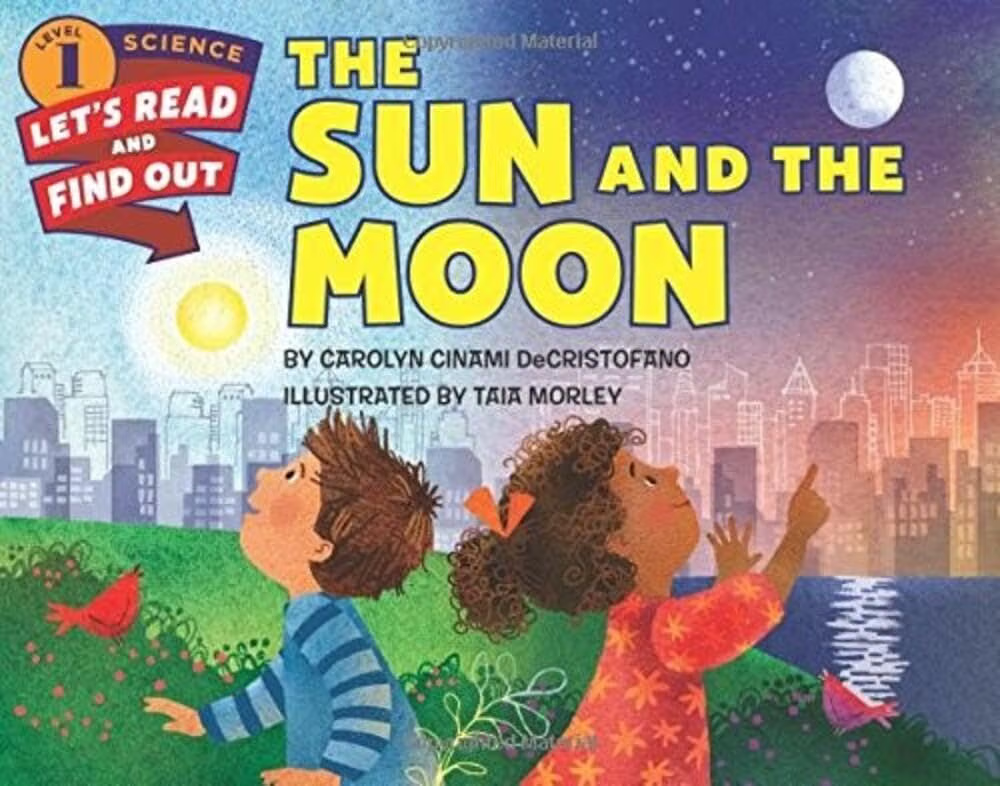
The Sun and the Moon invites children to compare what they notice in the daytime and nighttime skies. The Sun always appears round, while the Moon’s visible shape seems to change. The Sun is a star that produces light, while the Moon reflects sunlight. Children may even be surprised to discover that the Moon does not belong only to the night; it can sometimes be seen during the day.
Part of the Let’s-Read-and-Find-Out Science series, this colorful picture book was created for young children beginning to investigate science. It introduces basic astronomy through engaging text and illustrations without overwhelming readers with too much technical information.
This book is a particularly good match for the episode because children can compare the scientific Sun and Moon with Saulė and Mėnulis from the Lithuanian story.
This book is a strong choice for:
- Children ages 4–8
- Read-aloud science lessons
- Correcting the idea that the Moon only appears at night
Talk about it: How are the real Sun and Moon different from the characters in the story? Why do you think people often imagine them as characters with feelings and personalities?
A Moon Story About Feeling Important
The Night the Moon Went Missing
By Brendan Kearney
What might happen if the Moon felt unimportant and decided to disappear?

In The Night the Moon Went Missing, the Moon notices how happy everyone seems when the Sun appears. Feeling overlooked, Moon leaves the sky—and a young girl sets out to find her.
The story’s emotional heart makes it a lovely bridge between astronomy and social-emotional learning. Children discover that Moon plays an important role even when people do not always stop to notice her. The book also introduces some of the reasons Earth needs the Moon, wrapping real science in a gentle, imaginative adventure.
Rather than simply presenting facts, it invites children to think about appreciation, comparison, belonging, and the different roles people play.
This book is a strong choice for:
- Children who prefer stories to traditional nonfiction
- Bedtime reading
- Social-emotional learning
Talk about it: Have you ever felt as though someone else received more attention than you? What helped you remember that your role was important too?
Build Early Reading Confidence
DK Super Readers Pre-Level: Sun and Moon

Some young explorers are ready to learn about space but still need confidence to read a nonfiction book independently.
DK Super Readers Pre-Level: Sun and Moon combines simple text, strong visual support, and fascinating facts about two familiar objects in the sky. The carefully leveled format helps beginning readers build vocabulary and practice essential nonfiction reading skills while learning why the Sun and Moon matter to life on Earth.
It is an especially practical addition for families and teachers who want one resource to support both literacy and science.
This reader is a strong choice for:
- Beginning readers
- Science-themed literacy centers
- Building astronomy vocabulary
Extend the learning: Ask children to look for and point to the words Sun, Moon, day, night, light, and Earth. Older children can use each word in a sentence.
Discover What Happens After Sunset
Through the Night Sky: A Collection of Amazing Adventures Under the Stars
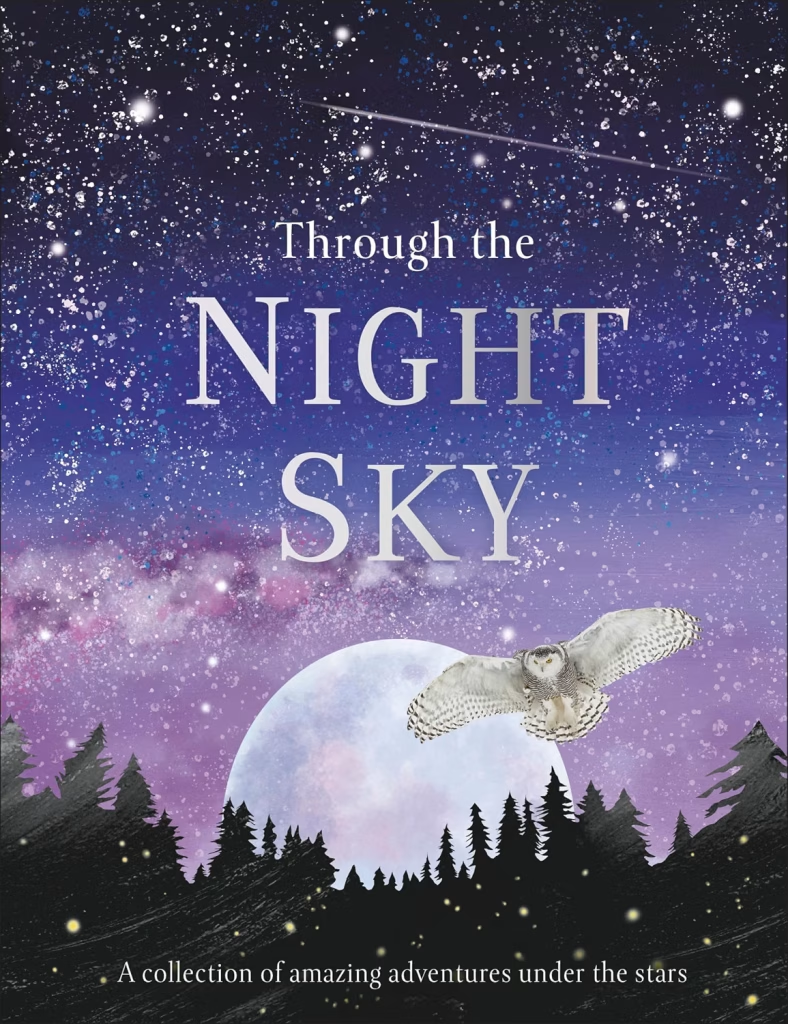
The sky does not become empty when the Sun disappears. In many ways, an entirely new world becomes visible.
Through the Night Sky takes readers on a journey through the remarkable things that happen after dark. Children can explore the Moon, planets, stars, meteor showers, nocturnal animals, and human activities that illuminate the darkness—from fireworks to nighttime celebrations.
This beautifully illustrated book expands the episode beyond one traditional explanation of day and night. It encourages children to see darkness as something filled with activity, movement, discovery, and beauty.
The variety of subjects also makes it a good choice for mixed-age families. Younger children can study the illustrations and choose the scenes that interest them, while older children can read the accompanying information and make connections across astronomy, nature, and culture.
This book is a strong choice for:
- Children who love detailed illustrations
- Family read-alouds with multiple ages
- Night-sky and nocturnal-animal units
Plan a nighttime adventure: Take the book outside with a flashlight, blanket,
Build and Paint a Glowing Solar System
4M Solar System Planetarium
After reading about the Sun, Moon, and night sky, children can create their own space model.
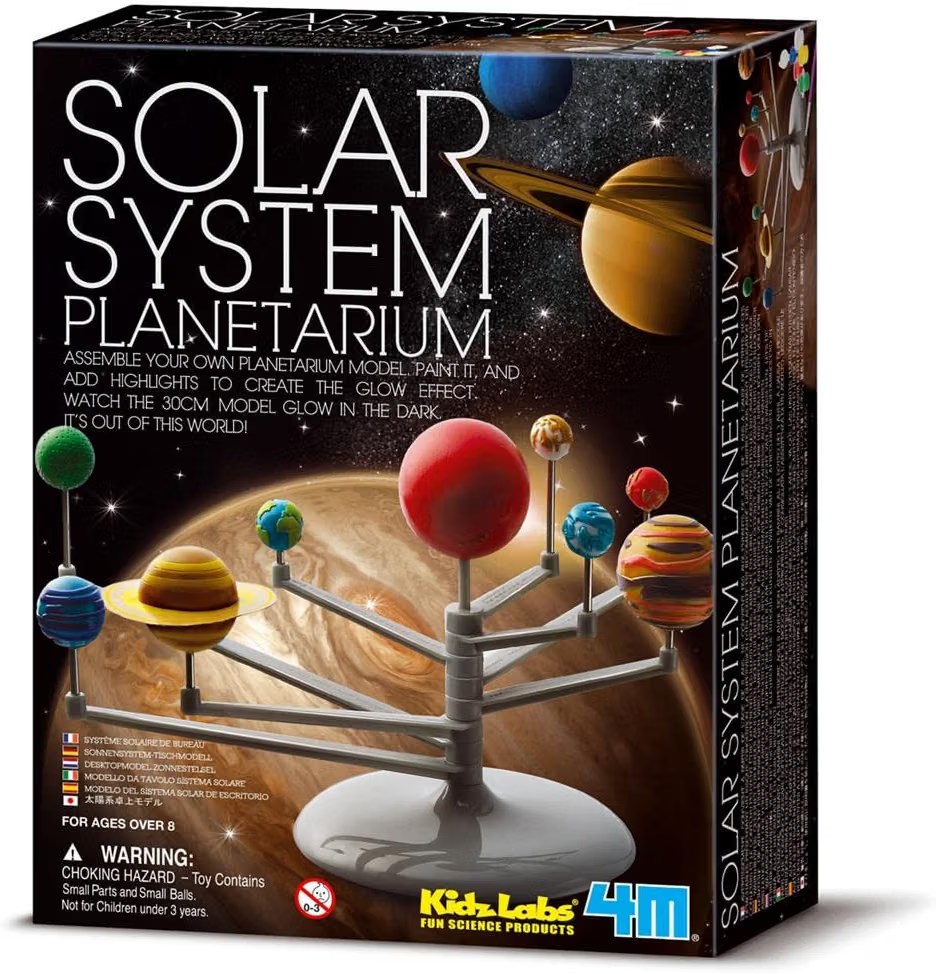
The 4M Solar System Planetarium is a hands-on kit that allows children to assemble and paint the Sun and planets. The plastic planets snap together without glue and attach to a stand with rotating arms. Paint and glow-in-the-dark highlights transform the finished project into a colorful display for a bedroom, learning space, or classroom.
The process of building the model gives children time to notice the order of the planets and consider how the solar system is organized. The rotating arms also provide a beginning demonstration of the idea that planets move around the Sun.
This kit is a strong choice for:
- Children ages 8 and older
- Hands-on and artistic learners
- Family STEM projects
Make it meaningful: Before assembling the model, ask children to find Earth. What makes Earth’s place in the solar system special? Where would the Moon belong, even though it is not one of the eight planets?
Helpful note: Like most tabletop solar-system models, the planets and distances are not shown at their true relative sizes. This is a great opportunity to explain that a real scale model would need to be enormous.
Find Lithuania on the Map
GeoPuzzle Europe Jigsaw Puzzle
The episode begins with the sky, but it also opens a door to another important question: Where is Lithuania?
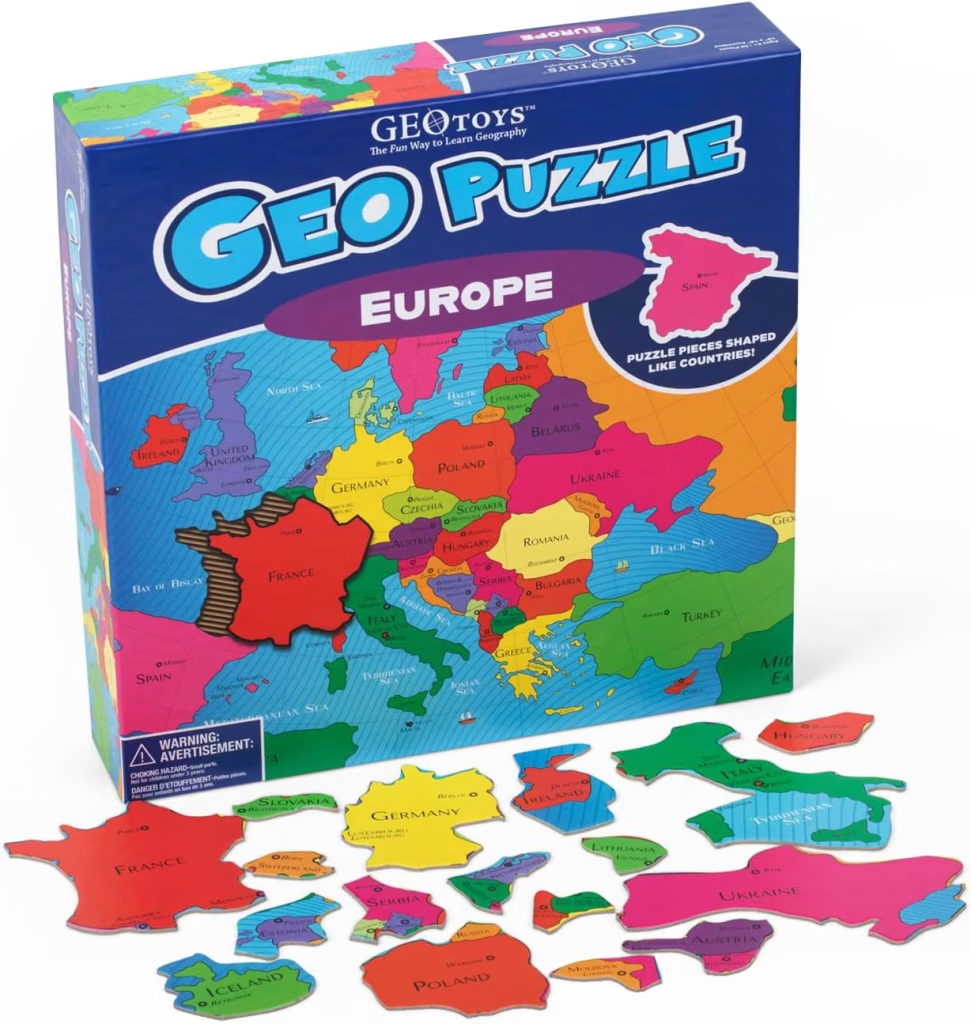
The GeoPuzzle Europe turns that question into a hands-on geography challenge. Its 58 pieces are shaped like countries or groups of countries, helping children learn their names, shapes, and locations as they assemble the map.
As children build, help them locate Lithuania along the Baltic Sea. Then find its Baltic neighbors, Latvia and Estonia. Children can also identify the other European countries they recognize, and the bodies of water surrounding the continent.
Unlike a worksheet that may be completed once and forgotten, a geography puzzle can be used repeatedly. Each time children rebuild Europe, they strengthen their visual memory of where countries belong.
This puzzle is a strong choice for:
- Learning where Lithuania is located
- European geography units
Turn it into a listening activity: Start the Faithfully Explore! episode, spread out the pieces, and see whether children can locate Lithuania before the traditional story begins.
Latest Episodes


Join the Faithfully Explore! Family
Get new episodes delivered right to your inbox:
Share your child’s Belief Backpack art or favorite lesson on Instagram and tag Faithfully Explore!
Help me create more engaging content:
Let us know what you think.