

Explore handpicked book suggestions for every Faithfully Explore! episode. Each list is personally chosen by Laura to help curious kids and grown-ups keep learning, wondering, and connecting through stories long after the episode ends.
Note: This section contains affiliate links. If you click and buy, we may earn a small commission at no extra cost to you. Thanks for supporting Faithfully Explore!
Episode 69: Nasreddin, Turkey, and Fairness
Can someone charge you for smelling their soup? And how would you respond if they tried?
In Nasreddin’s Clever Solution: A Story About Fairness, we meet a hungry traveler, an insistent innkeeper, and a clever problem-solver who knows how to make people stop and think. It’s a funny story with plenty to talk about afterward: listening before judging, questioning unfair demands, and finding respectful ways to speak up.
These books and games about fairness for kids help keep that conversation going. Some introduce more Nasreddin adventures. Others explore equal treatment, cooperation, or the country we visit in the episode.
Whether you’re choosing a family read-aloud, building a homeschool lesson, or planning a classroom activity, here are eight ways to keep exploring.
1. Nasreddin Ten Stories (A1/Level 5)
For children who finish the episode and ask, “Can we hear another one?”

One of the pleasures of meeting a folktale character is discovering that there are more adventures waiting. Nasreddin Ten Stories, offers another way to enjoy his surprising behavior and unusual ideas.
Pair it with the podcast for short reading sessions in which children can listen, read, predict, and explain. You don’t need to finish the whole collection at once; one story can provide plenty of conversation.
Try this together: Pause before an ending and ask, “What do you think Nasreddin will do? What makes you think that?” Afterward, compare your predictions with his response.
Choose this book for: More Nasreddin stories and opportunities to connect listening with reading.
2. The Hungry Coat: A Tale from Turkey
For another clever story about how people deserve to be treated.

In The Hungry Coat, Nasrettin discovers that the welcome he receives changes when his clothing changes. His response turns an uncomfortable experience into a memorable lesson about appearances. Demi’s illustrations draw inspiration from traditional Turkish paintings.
This is a particularly strong companion to the episode because children can compare two situations involving the same character. In both, humor gives people a reason to reconsider their behavior.
The story also makes room for a meaningful question: Should someone need impressive clothing to be treated with kindness and respect?
Try this together: Draw two speech bubbles. In one, explain the unfair demand in the soup story. In the other, explain the unfair treatment in The Hungry Coat. How does Nasreddin respond to each?
Choose this book for: An illustrated read-aloud that connects fairness with dignity and looking beyond appearances.
3. The Wise Fool: Fables from the Islamic World
For families who enjoy stories that make them laugh—and then think.

The Wise Fool introduces readers to Mulla Nasruddin, another name used for the character featured in our episode. The collection gives children more opportunities to explore his distinctive mix of humor and wisdom.
A story collection works well when you want something to return to over several evenings or classroom read-alouds. Instead of rushing to identify a single “correct” lesson, invite children to explain what surprised them and what they think the story suggests.
Try this together: After a story, ask, “Was Nasruddin being wise, silly, or both?” Encourage everyone to support their answer with something that happened.
Choose this book for: Ongoing family storytelling and discussions that welcome more than one perspective.
4. Equal Shmequal
For children who want to know what makes a game fair.

In Equal Shmequal, a group of animals wants to play tug-of-war. But dividing into teams isn’t as simple as counting the players. The animals must consider differences in size and weight as they work toward balanced teams.
This story connects directly to the episode’s example of game rules. It also adds a useful mathematical question: What exactly are we comparing when we say two things are equal?
That makes it a versatile choice for families and educators who want to combine a fairness discussion with mathematical thinking.
Try this together: Imagine organizing a game between a bear, a mouse, and several other animals. Would the same number of animals on each side always create balanced teams? Have children draw a possible solution and explain it.
Choose this book for: A playful connection between fairness, games, and math.
5. Fair is Fair
For exploring why fairness doesn’t always look identical.

Fair is Fair uses a story about three zoo animals to explore a familiar complaint: “It’s not fair!” It provides a starting point for thinking about fairness and differing needs.
Pair it with Nasreddin’s story to broaden the conversation. Sometimes fairness means refusing an unreasonable demand. At other times, it means recognizing that people need different kinds of support.
Children encounter this distinction when someone receives extra help reading directions, uses different equipment, or needs more time to complete a task.
Try this together: Ask, “If one person needs glasses to see the board, does everyone need glasses for the classroom to be fair?” Invite children to think of other examples where different support helps people participate.
Choose this book for: Conversations about individual needs, understanding others, and the difference between fair and identical.
6. Turkey (Countries of the World)
For curious listeners who want to explore the setting beyond the story.

The episode introduces Turkey, also known as Türkiye, before stepping into Nasreddin’s tale. Adding Turkey (Countries of the World) to your reading selection creates an opportunity to move from a traditional story into nonfiction exploration.
Read it alongside a map or globe. Locate the country, revisit the episode’s mention of Istanbul, and let your child choose a question to investigate.
Pairing folklore with nonfiction also gives adults a chance to explain that one traditional tale cannot represent everything about a country or its people. A story can spark curiosity; further reading helps that curiosity grow.
Try this together: Make a page titled “Our Türkiye Discoveries.” Record three things learned from the book, one connection to the episode, and one question to explore next.
Choose this book for: Adding geography and country study to a literature lesson.
7. Junior Learning Social Skills Board Games — 4 Games for Kids Ages 5–8
For moving from talking about social skills to practicing them together.

This four-game set offers a playful way to continue the episode’s conversations with younger children. Its social-skills focus makes it a useful option for families, small classroom groups, or homeschool activities.
Use game time to practice the habits Nasreddin demonstrates: listening, waiting for someone to explain, and thinking before responding.
You might say, “I have an idea, but I’d like to hear yours first,” or, “We disagree. Let’s look at the rules together.”
Try this together: Before playing, choose one skill to notice, such as listening without interrupting. Afterward, invite each player to name a moment when someone used that skill.
Choose this set for: Families and educators looking for structured opportunities to practice communication through play.
8. Peaceable Kingdom Race to the Treasure!
For a family game night built around working together.

In Race to the Treasure!, players cooperate to build a path, collect three keys, and reach the treasure before the ogre. Designed for ages 5 and up, the game gives children a shared goal and opportunities to discuss their next move.
It’s a natural follow-up to an episode about listening and fair treatment. Players can suggest different routes, explain their reasoning, and practice making decisions as a group.
Try this together: Ask, “Has everyone who wants to share an idea had a chance?” After the game, talk about a moment when listening to another player helped the team.
Choose this game for: Practicing teamwork, shared decisions, and respectful disagreement.
Episode 68: Pele and Volcanoes
If you’re looking for resources about Pele Hawaiian goddess for kids, start with Hawaiian stories, then branch into books about family, caring for the land, and volcano science. There’s something here for the child who loves beautiful illustrations, the reader who wants facts, and the explorer who can’t wait to make something erupt.
Start with Pele’s Stories
The Pele Stories: Three Hawaiian Legends: A Primer (Hawaiian Edition)
By Gabrielle Ahuliʻi, illustrated by Jing Jing Tsong
For children who finish the episode asking for another story, this is a natural place to begin.

This collection brings together Pele Finds a Home, Hiʻiaka Battles the Wind, and Naupaka, with text in both English and Hawaiian. Despite the “Hawaiian Edition” label in some listings, it is a bilingual collection. Its larger picture-book format is intended for children in kindergarten through second grade. Gabrielle Ahuliʻi is a Native Hawaiian author and school librarian.
Pele Finds a Home offers younger listeners another telling of Pele’s search, while the additional stories introduce her sister Hiʻiaka and the story of the naupaka flower. That makes this a book families can revisit beyond a single episode.
Try this together: Read Pele Finds a Home after listening. Ask, “What did you recognize? What was different?” Explain that the book and podcast share different tellings within a much larger storytelling tradition.
Choose this one for: A first Pele book, bilingual exploration, and younger elementary read-alouds.
Pele and Poliahu
By Malia Collins, illustrated by Kathleen Peterson
Fire and snow on the same island? That contrast makes an inviting starting point for another adventure.

In this retelling, Pele challenges Poliʻahu to a sled race on Mauna Kea. Their encounter introduces children to another story about powerful forces shaping Hawaiʻi’s landscape. Kathleen Peterson’s batik illustrations give the book a distinctive visual style, and the publisher recommends it for ages seven and up.
This is a particularly appealing follow-up for children who enjoyed the dramatic encounters in the episode. It expands their picture of Pele beyond her search for a home and introduces a different relationship and setting.
Try this together: Create a two-sided picture using warm colors for fire and cool colors for snow and ice. Ask children how the colors help communicate the contrast between the characters.
Choose this one for: Another Pele adventure, expressive artwork, and conversations about competition and powerful emotions.
Discover the Family and Land Beyond the Volcano
Aloha Everything
By Kaylin Melia George, illustrated by Mae Waite
What helps a child come to love the place they call home?

Aloha Everything follows a Hawaiian girl as she discovers her heritage and island world. Its rhyming language and hand-painted illustrations bring together Hawaiian culture, history, and ecology. Author Kaylin Melia George draws on her Native Hawaiian ancestry and the stories of Molokaʻi she heard growing up.
This book broadens the conversation beyond Pele and eruptions. It gives families a way to explore the affection, knowledge, and relationships that make caring for a place meaningful.
It also pairs beautifully with the episode’s question: How do we behave when we enter someone else’s home or homeland?
Try this together: Ask each child to draw a place they love and finish the sentence, “I can care for this place by…” The publisher also offers a free teacher’s guide and I-Spy worksheets for more exploration.
Choose this one for: Beautiful family read-alouds, learning about aloha, and connecting appreciation with responsibility.
ʻOhana Means Family
By Ilima Loomis, illustrated by Kenard Pak
Follow a meal backward, and you begin to discover how many people, and how much care, go into bringing it to the table.

This cumulative picture book follows the growing of kalo, the preparation of poi, and a family gathering for a lūʻau. Its repeating structure invites children to join in, while the illustrations connect the celebration to the land and work that support it. A glossary and author’s note provide additional context.
After an episode about a powerful volcanic landscape, this offers a quieter, everyday connection: land nourishes families, and families depend on one another.
Try this together: Choose a favorite family meal. Who prepares it? Where do the ingredients grow? What would those plants need to thrive? Younger children can draw the ingredients; older children can investigate their origins.
Choose this one for: Family connections, food conversations, and children who enjoy rhythmic, repeating stories.
Answer Those “But How Does It Work?” Questions
Volcanoes
Written and illustrated by Gail Gibbons
For the child who wants to see what is happening beneath the ground, Gail Gibbons provides a helpful next step.

Volcanoes uses maps, labeled illustrations, and straightforward explanations to explore Earth’s layers, plate tectonics, and different kinds of volcanoes. The publisher notes that a working volcanologist reviewed the book.
This is a useful book to keep beside a volcano model. Children can look closely at the diagrams, ask questions, and connect the visible eruption to processes happening below the surface.
Try this together: Invite children to draw a volcano with one side “cut away” so the inside is visible. Use the book to help add labels, then ask them to explain their drawing to someone who hasn’t read it.
Choose this one for: Visual explanations, curious question-askers, and homeschool or classroom science shelves.
Volcanoes! (National Geographic Readers)
By Anne Schreiber
Sometimes a photograph is what makes a subject click.

This National Geographic reader combines volcano science and history with vivid photographs of lava, ash, rocks, and steaming seawater. A Level 2 reader, with a publisher-listed audience of ages five to eight. Children’s reading needs vary, so it can also work as a shared read-aloud.
It makes a useful partner to Gail Gibbons’s illustrated explanations: one book helps children examine diagrams, while the other brings real volcanic scenes into view.
Try this together: Let your child choose the photograph they find most interesting. Ask them to share one observation, one question, and one fact they learned from the accompanying text.
Choose this one for: Photography fans, shared nonfiction reading, and short bursts of science exploration.
Add Movement and Hands-On Discovery
Danny Go’s Volcano Adventure: A Picture Book
By Danny Go!, illustrated by Aleksandar Zolotic
Does your child like to participate in the story? This book gives them a job.

Readers help Danny Go navigate a volcano adventure by tracing, tapping, and turning pages as he searches for magical ice gems. The interactive format combines imaginative challenges with the familiar energy of Danny Go’s adventures.
Use it as a playful change of pace between cultural storytelling and nonfiction. Its treasure hunt also creates an opportunity to connect back to the episode: in make-believe, we can search for magical gems; when visiting real natural places, we can enjoy discoveries and leave them where they belong.
Try this together: After reading, make an imaginary stepping-stone route with flat paper markers on a clear floor. Walk through it while naming things you would want to observe on a real nature adventure.
Choose this one for: Danny Go fans, interactive read-alouds, and children who enjoy movement with their stories.
National Geographic Ultimate Volcano Science Kit for Kids Ages 8–12
Turn “Can we make a volcano?” into a project you can do together.

The Ultimate Volcano Kit lets children cast a model, paint it, and create an eruption using the supplied materials. It also includes a learning guide exploring topics such as volcano formation, tectonic plates, and earthquakes. It is recommended for ages eight and up.
Pair it with one of the nonfiction books so the learning continues before and after the bubbling begins. Allow time for the model-making stages, follow the package directions, and work with adult supervision on a protected surface.
Try this together: Have children sketch the model before the eruption and record what they notice afterward. What path did the liquid take? Which parts of the activity resemble the pictures in their books? Explain that the kit’s bubbling reaction is a model; real lava is molten rock.
Choose this one for: A family science afternoon, a volcano-themed gift, or children who love building and experimenting.
Episode 67: What Makes Day and Night
Begin with the Science of Day and Night
What Makes Day and Night
By Franklyn M. Branley
Illustrated by Arthur Dorros

What Makes Day and Night is an excellent first book to read after listening to the Lithuanian story. It explains that the Sun does not actually travel around Earth each day. Instead, Earth rotates, carrying different parts of the planet into and out of the Sun’s light.
The book uses clear language, approachable illustrations, and a simple experiment to help children visualize a concept that can otherwise feel surprisingly complicated. Readers can use a lamp to represent the Sun and observe what happens as a model Earth turns.
This is especially valuable for children who understand ideas best when they can see and physically demonstrate them. The book introduces the scientific explanation without taking away from the wonder of the traditional story. Instead, it helps children see that folklore and science can offer different—and equally interesting—ways to explore the sky.
This book is a strong choice for:
- Elementary science lessons about Earth’s rotation
- Homeschool astronomy units
- Families looking for a clear explanation of day and night
- Comparing traditional explanations with scientific models
Try this after reading: Place a sticker on a globe to mark Lithuania. Shine a lamp on the globe and slowly rotate it. Watch Lithuania move from daylight into darkness and back again.
Compare the Sun and Moon
The Sun and the Moon
By Carolyn Cinami DeCristofano
Illustrated by Taia Morley
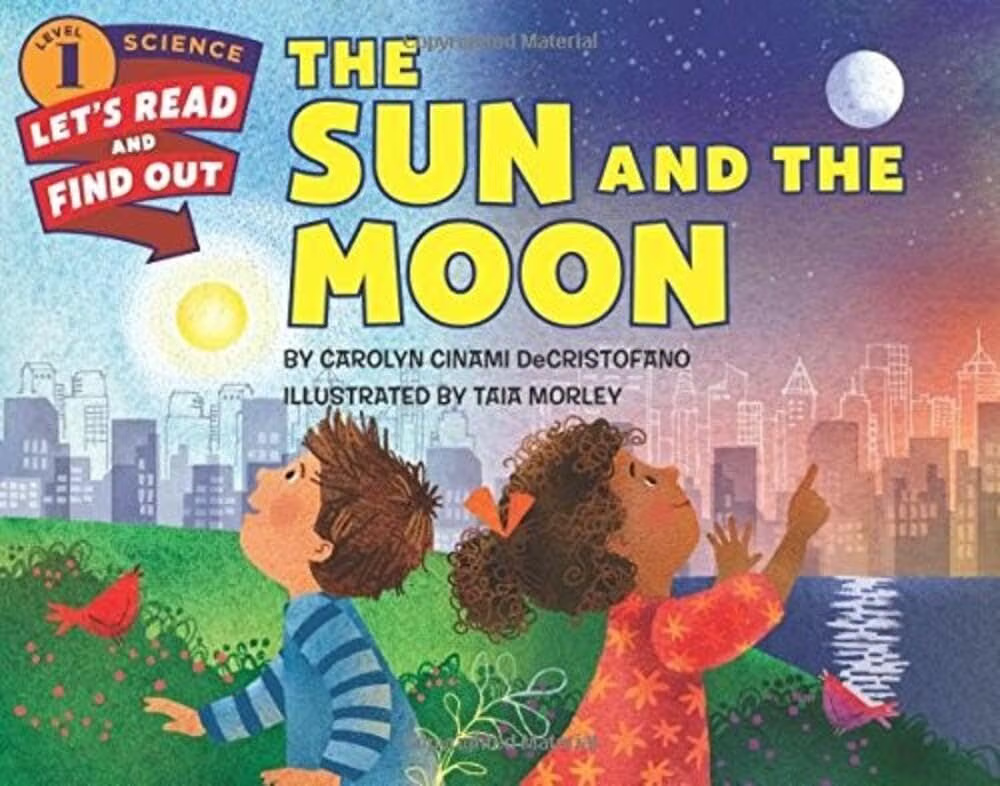
The Sun and the Moon invites children to compare what they notice in the daytime and nighttime skies. The Sun always appears round, while the Moon’s visible shape seems to change. The Sun is a star that produces light, while the Moon reflects sunlight. Children may even be surprised to discover that the Moon does not belong only to the night; it can sometimes be seen during the day.
Part of the Let’s-Read-and-Find-Out Science series, this colorful picture book was created for young children beginning to investigate science. It introduces basic astronomy through engaging text and illustrations without overwhelming readers with too much technical information.
This book is a particularly good match for the episode because children can compare the scientific Sun and Moon with Saulė and Mėnulis from the Lithuanian story.
This book is a strong choice for:
- Children ages 4–8
- Read-aloud science lessons
- Correcting the idea that the Moon only appears at night
Talk about it: How are the real Sun and Moon different from the characters in the story? Why do you think people often imagine them as characters with feelings and personalities?
A Moon Story About Feeling Important
The Night the Moon Went Missing
By Brendan Kearney
What might happen if the Moon felt unimportant and decided to disappear?

In The Night the Moon Went Missing, the Moon notices how happy everyone seems when the Sun appears. Feeling overlooked, Moon leaves the sky—and a young girl sets out to find her.
The story’s emotional heart makes it a lovely bridge between astronomy and social-emotional learning. Children discover that Moon plays an important role even when people do not always stop to notice her. The book also introduces some of the reasons Earth needs the Moon, wrapping real science in a gentle, imaginative adventure.
Rather than simply presenting facts, it invites children to think about appreciation, comparison, belonging, and the different roles people play.
This book is a strong choice for:
- Children who prefer stories to traditional nonfiction
- Bedtime reading
- Social-emotional learning
Talk about it: Have you ever felt as though someone else received more attention than you? What helped you remember that your role was important too?
Build Early Reading Confidence
DK Super Readers Pre-Level: Sun and Moon

Some young explorers are ready to learn about space but still need confidence to read a nonfiction book independently.
DK Super Readers Pre-Level: Sun and Moon combines simple text, strong visual support, and fascinating facts about two familiar objects in the sky. The carefully leveled format helps beginning readers build vocabulary and practice essential nonfiction reading skills while learning why the Sun and Moon matter to life on Earth.
It is an especially practical addition for families and teachers who want one resource to support both literacy and science.
This reader is a strong choice for:
- Beginning readers
- Science-themed literacy centers
- Building astronomy vocabulary
Extend the learning: Ask children to look for and point to the words Sun, Moon, day, night, light, and Earth. Older children can use each word in a sentence.
Discover What Happens After Sunset
Through the Night Sky: A Collection of Amazing Adventures Under the Stars
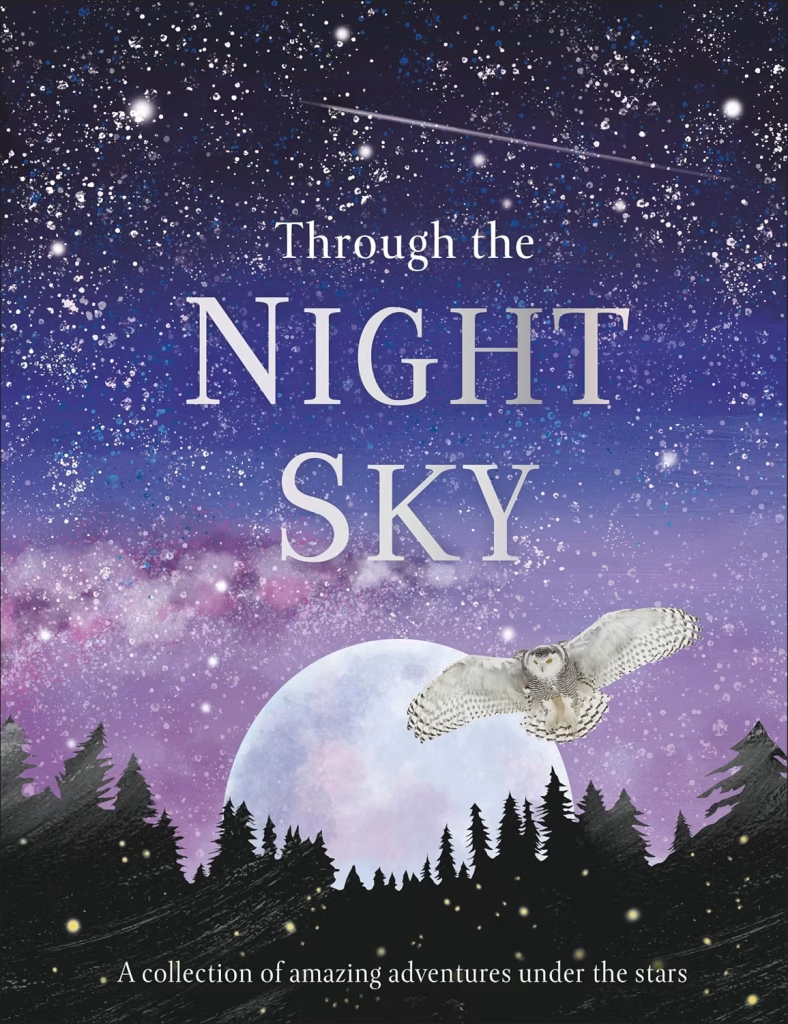
The sky does not become empty when the Sun disappears. In many ways, an entirely new world becomes visible.
Through the Night Sky takes readers on a journey through the remarkable things that happen after dark. Children can explore the Moon, planets, stars, meteor showers, nocturnal animals, and human activities that illuminate the darkness—from fireworks to nighttime celebrations.
This beautifully illustrated book expands the episode beyond one traditional explanation of day and night. It encourages children to see darkness as something filled with activity, movement, discovery, and beauty.
The variety of subjects also makes it a good choice for mixed-age families. Younger children can study the illustrations and choose the scenes that interest them, while older children can read the accompanying information and make connections across astronomy, nature, and culture.
This book is a strong choice for:
- Children who love detailed illustrations
- Family read-alouds with multiple ages
- Night-sky and nocturnal-animal units
Plan a nighttime adventure: Take the book outside with a flashlight, blanket,
Build and Paint a Glowing Solar System
4M Solar System Planetarium
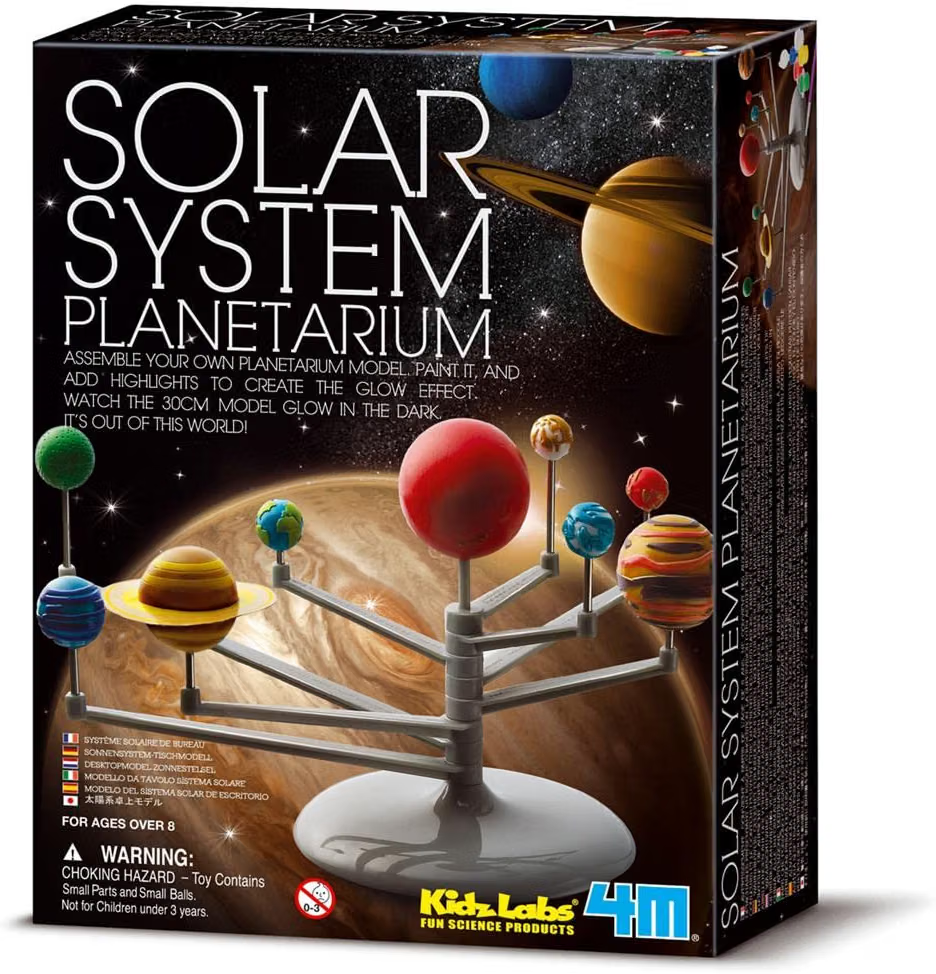
After reading about the Sun, Moon, and night sky, children can create their own space model.
The 4M Solar System Planetarium is a hands-on kit that allows children to assemble and paint the Sun and planets. The plastic planets snap together without glue and attach to a stand with rotating arms. Paint and glow-in-the-dark highlights transform the finished project into a colorful display for a bedroom, learning space, or classroom.
The process of building the model gives children time to notice the order of the planets and consider how the solar system is organized. The rotating arms also provide a beginning demonstration of the idea that planets move around the Sun.
This kit is a strong choice for:
- Children ages 8 and older
- Hands-on and artistic learners
- Family STEM projects
Make it meaningful: Before assembling the model, ask children to find Earth. What makes Earth’s place in the solar system special? Where would the Moon belong, even though it is not one of the eight planets?
Helpful note: Like most tabletop solar-system models, the planets and distances are not shown at their true relative sizes. This is a great opportunity to explain that a real scale model would need to be enormous.
Find Lithuania on the Map
GeoPuzzle Europe Jigsaw Puzzle
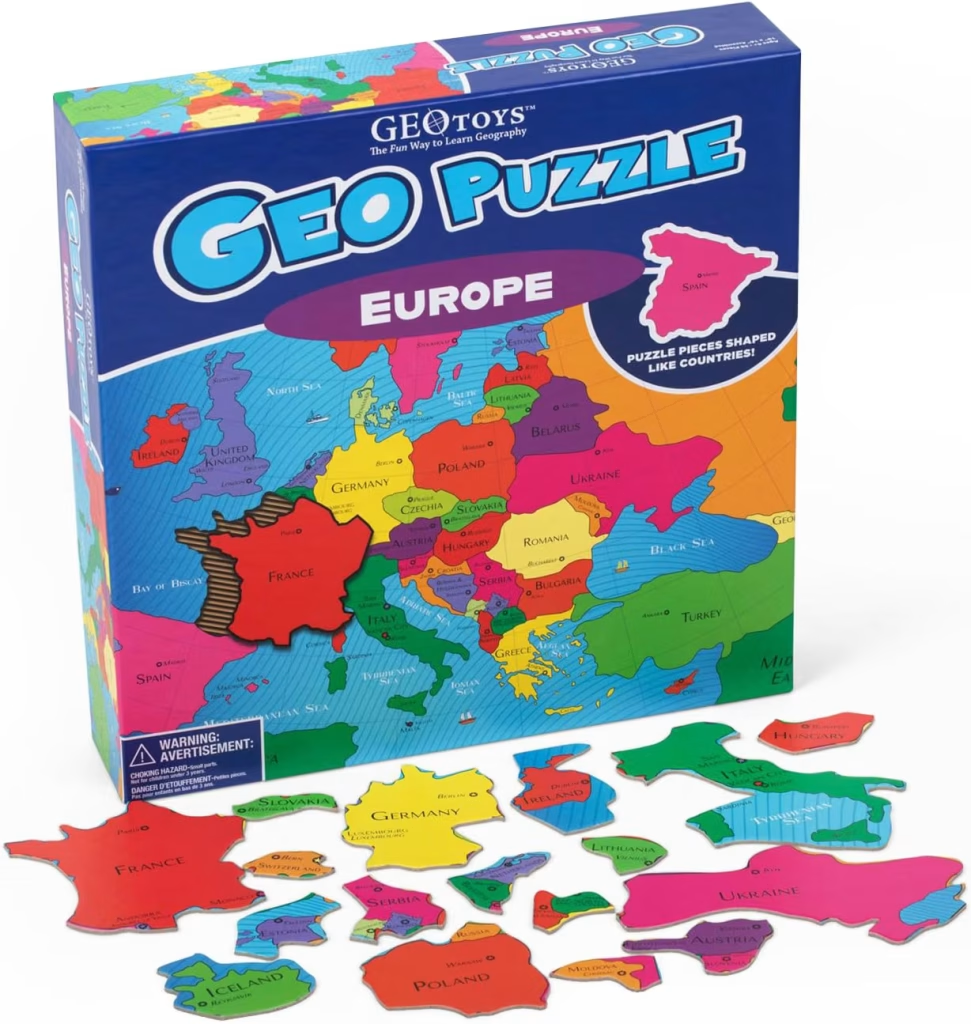
The episode begins with the sky, but it also opens a door to another important question: Where is Lithuania?
The GeoPuzzle Europe turns that question into a hands-on geography challenge. Its 58 pieces are shaped like countries or groups of countries, helping children learn their names, shapes, and locations as they assemble the map.
As children build, help them locate Lithuania along the Baltic Sea. Then find its Baltic neighbors, Latvia and Estonia. Children can also identify the other European countries they recognize, and the bodies of water surrounding the continent.
Unlike a worksheet that may be completed once and forgotten, a geography puzzle can be used repeatedly. Each time children rebuild Europe, they strengthen their visual memory of where countries belong.
This puzzle is a strong choice for:
- Learning where Lithuania is located
- European geography units
Turn it into a listening activity: Start the Faithfully Explore! episode, spread out the pieces, and see whether children can locate Lithuania before the traditional story begins.
Episode 66: The Guaraní Legend of Yerba Mate
This post may contain affiliate links. If you purchase through one of these links, Faithfully Explore! may earn a small commission at no additional cost to you. Your support helps us continue creating stories, educational resources, and printables for curious kids and families.
1. The Little Seed’s Journey (Guarani Edition) by Ahmet Neseli
Best for: Language exploration, bilingual reading, and connecting plants with culture

Finding children’s books that include the Guaraní language can be difficult, which makes The Little Seed’s Journey an especially interesting companion to the episode.
This bilingual picture book presents the story in English and Guaraní using parallel text and phonetic pronunciation support. Children can follow a small seed as it begins its journey while also seeing and trying to say words from a language spoken by Guaraní communities today.
The book creates a natural opportunity to explain that Guaraní is not simply a language from an old folktale. It is a living language used by real people.
After reading, invite children to compare the English and Guaraní text:
- Do any words appear more than once?
- What sounds do you notice?
- Which Guaraní word would you like to learn?
- Why is it important for stories and languages to be preserved?
- How is the seed’s journey similar to the journey of the yerba mate plant in the episode?
Younger children can focus on the illustrations and the seed’s changes. Older children can investigate where Guaraní is spoken and discuss why bilingual books matter.
2. Teatime Around the World by Denyse Waissbluth and Chelsea O’Byrne
Best for: Ages 4–8, global culture studies, and conversations about hospitality

Once children have learned about mate, Teatime Around the World helps them place it within a much larger human story.
This colorful picture book travels through countries including Japan, Thailand, Egypt, Pakistan, India, Russia, Uruguay, and others to show the many ways people prepare and share tea and similar plant-based drinks. It even includes South American mate served in a hollow gourd.
The real strength of this book is not simply the number of drinks it introduces. It shows that offering someone a cup can communicate welcome, care, celebration, respect, or friendship.
Read it after listening to the episode and ask:
- What was similar about the different drink traditions?
- What was different?
- Which drinks were shared with other people?
- How do families make guests feel welcome?
- Does your family have a drink, snack, or meal that brings people together?
Children can also create a “Hospitality Around the World” chart. For each tradition, record the country, the ingredients, the type of cup or container used, and what people do while sharing the drink.
This is an excellent choice for a classroom world-cultures shelf, a homeschool geography unit, or any family raising curious, respectful global learners.
3. The Circles All Around Us by Brad Montague, Brad Montague, and Kristi Montague
Best for: Ages 3–7, social-emotional learning, kindness, and inclusion

The mate cup in the episode moves through a circle of people. The Circles All Around Us transforms that same shape into a powerful metaphor for community.
The story begins with one small circle and gradually expands it to include family, friends, neighbors, the wider community, and eventually the world. Its central message encourages children to make room for others and grow their circles through kindness and inclusion.
This makes it a beautiful thematic match for an episode about a plant shared among friends.
After reading, give each child a piece of paper and ask them to draw several circles, one inside another:
- In the center, draw yourself.
- In the next circle, add the people closest to you.
- In the next circle, add friends, teachers, neighbors, or community helpers.
- In the largest circle, add people, animals, places, or causes you want to treat with care.
Finish by asking, “What is one small act of kindness that could make your circle bigger this week?”
This activity brings the episode’s ideas about generosity and sharing into a child’s everyday life.
4. GeoPuzzle Latin America Jigsaw Puzzle
Best for: Hands-on geography, visual learners, classrooms, and homeschool families

Stories become more meaningful when children can locate where they come from.
The GeoPuzzle Latin America Jigsaw Puzzle gives children a hands-on way to explore. This helps children learn not only country names but also shapes, locations, and neighboring regions.
As children assemble the puzzle, invite them to locate Paraguay and the surrounding region connected with the history of yerba mate. Then look for Argentina, Brazil, and other countries where people enjoy mate today.
Try turning the puzzle into an episode scavenger hunt:
- Find Paraguay.
- Find two countries that share one of its borders.
- Locate the Atlantic Ocean.
- Find the largest country in South America.
- Choose one country you would like to learn more about.
- Trace a pretend journey from your home to the region explored in the episode.
For younger children, complete the puzzle together and talk about colors, shapes, and relative location. Older children can add capital cities, languages, ecosystems, or cultural traditions to their investigation.
Unlike a flat map that children may glance at once, a country-shaped puzzle asks them to examine how the region fits together.
5. Wellegance Twigs Plant Growing Science Kit for Kids
Best for: Ages 8–12, botany, STEM learning, and hands-on investigation

The story of yerba mate begins with a plant, but children may still have questions:
How does a seed wake up? What do roots do? How does water travel through a stem? Can a plant grow without soil?
The Wellegance Twigs Plant Growing Science Kit helps children investigate those questions through hands-on botany. The kit includes activities involving germination, root observation, hydroponics, water movement, and color-changing flowers. It contains 32 tools and materials for 19 experiments and is designed for children ages 8–12.
Children will not be growing a yerba mate tree with this kit, but they will explore the plant processes that allow leaves, roots, and stems to grow.
Pair the kit with a simple science journal. Before each experiment, ask children to record:
- What do I predict will happen?
- What variable are we changing?
- What do I notice today?
- What changed overnight?
- What surprised me?
- What new question do I have?
You can also invite children to draw and label the parts of a plant before listening to the episode. Afterward, ask them to identify which part of the yerba mate plant is harvested to prepare the drink.
This kit is a strong choice for families who want an activity that lasts beyond a single afternoon. Watching a seed or root change over several days helps children understand that plants are living systems—not simply products that appear in a package.
6. Beruth Bombilla Yerba Mate Gourd
Best for: Adult-led demonstrations and families curious about how mate is prepared

A picture can show children a mate cup, but seeing the real tools makes the episode much easier to understand.
The Beruth Bombilla Yerba Mate Gourd is an 8-ounce, double-walled stainless-steel cup. It comes with a lid, two stainless-steel bombillas, and cleaning brushes.
A bombilla is the special filtered straw used to sip mate while keeping most of the loose leaves inside the cup. Children are often fascinated by its design. Let them examine a clean bombilla and predict how its filter works.
Because this set is stainless steel, it is also easier for a beginner to maintain than a traditional natural gourd. It gives grown-ups a practical way to demonstrate the tools discussed in the episode without presenting one modern cup as the only kind of mate vessel.
Try a simple observation activity:
- Examine the holes or filter at the end of the bombilla.
- Predict what would happen with a regular drinking straw.
- Place dry leaves in the cup.
- Let children observe how the bombilla sits among the leaves.
- Refill the cup and pass it around.
7. Yerba Mate Playadito
Best for: To see, smell, and prepare real yerba mate

Playadito provides the final sensory connection to the episode: the leaves themselves.
This 500-gram package contains loose-leaf yerba mate. Before preparing it, pour a small amount onto a white plate and invite children to observe it without tasting:
- What colors do you see?
- Are all the pieces the same size?
- Can you find pieces of leaf and stem?
- What does it smell like?
- How is it different from the tea in a tea bag?
- What clues show that it came from a plant?
A grown-up can then prepare the mate in the Beruth gourd while children watch how the leaves, water, cup, and bombilla work together.
Turn the Resources into a Complete Family Learning Experience
You do not need to use every resource at once. Choose the pieces that fit your child’s age, interests, and learning style.
For a complete afternoon exploration, try this sequence:
1. Listen
Begin with the Faithfully Explore! episode. Encourage children to listen for the characters’ brave choice, the gift they receive, and how Mate becomes connected through friendship.
2. Locate
Use the GeoPuzzle to find Paraguay and the surrounding region. Notice borders, nearby countries, waterways, and South America’s shape.
3. Read
Choose The Little Seed’s Journey for language and plant connections or Teatime Around the World for a wider exploration of hospitality. Read The Circles All Around Us to continue the conversation about kindness and community.
4. Investigate
Use the plant science kit to study seeds, roots, water, and leaves. Ask children to connect what they discover to the yerba mate plant from the episode.
5. Observe
Let children examine the mate gourd, dry leaves, and bombilla. A grown-up can demonstrate how the pieces work together.
6. Reflect
Finish with one question:
How can sharing something simple—time, food, a story, a seat, or a kind word—help people feel that they belong?
Keep Exploring with Faithfully Explore!
The best stories do more than entertain us. They invite us to ask where traditions began, how people care for one another, and what we can learn from cultures beyond our own.
With a bilingual story, a world map, a growing seed, a widening circle, and a small cup passed among friends, children can explore language, geography, science, hospitality, and kindness—all while discovering that learning about another culture begins with curiosity and respect.
Listen to the Faithfully Explore! episode about the Guaraní story of yerba mate, then choose one of these books or activities to continue the journey at home or in your classroom.
Episode 65: Why the Sun and Moon Live in the Sky
Begin With the Story That Inspired the Episode
Why the Sun and the Moon Live in the Sky
by Elphinstone Dayrell, illustrated by Blair Lent
If you choose only one book to accompany this episode, make it this one.

Why the Sun and the Moon Live in the Sky is a beautifully illustrated retelling of the traditional story children hear in the podcast. Sun regularly visits his friend Water, but Water never visits Sun. When Sun asks why, Water explains that his family is far too large for Sun’s home. Sun builds a much bigger house, extends the invitation, and soon discovers that Water’s warning was more serious than he realized.
The familiar story gives children an opportunity to compare two retellings. Which animals arrive in the book? How does Water deliver his warning? When could Sun and Moon have stopped and made another plan? Which funny, dramatic, or descriptive details were added by each storyteller?
Comparing versions also helps children understand an important feature of traditional storytelling: stories passed from person to person can be told in more than one way. The central story remains recognizable, while individual storytellers shape the pacing, descriptions, dialogue, and details for their listeners.
Blair Lent’s distinctive illustrations earned the book a Caldecott Honor, making this an appealing addition to a home, school, or folktale library.
Best for: Ages 4–8, read-alouds, folktale studies, story comparison, and sequencing activities
Try this after listening: Ask children to arrange these events in order: Water gives a warning, Sun builds a house, the creatures enter, the water rises, and Sun and Moon climb into the sky.
Discover the Real Country Behind the Story
Africa, Amazing Africa: Country by Country
by Atinuke, illustrated by Mouni Feddag
The episode begins in southeastern Nigeria, but children may not yet understand where Nigeria is—or how large and diverse the African continent really is.

Written by Nigerian storyteller Atinuke, Africa, Amazing Africa introduces all 55 African countries through lively illustrations and accessible information about geography, people, languages, history, food, animals, music, sports, cities, landscapes, and everyday life.
This is not a book children will read once and place back on the shelf. It is the kind of oversized reference book they can return to whenever a story, celebration, person, or tradition leads Faithfully Explore! to a new part of Africa.
Begin with the section on West Africa and find Nigeria. Then look for the Atlantic coast and the southeastern region associated with the Efik people. Children can compare Nigeria with its neighbors and begin replacing the vague idea of “Africa” with the names, locations, and identities of individual countries.
The bright pages keep the information from feeling like a textbook, while the country-by-country organization makes it useful for older elementary students, homeschoolers, and classrooms.
Best for: Ages 7–12, geography studies, classrooms, homeschool libraries, and globally curious families
Why it is worth owning: It supports far more than one episode. Use it whenever children encounter an African country, historical figure, folktale, animal, language, food, or celebration.
GeoPuzzle Africa & Middle East Jigsaw Puzzle
65-piece geography puzzle

Once children have found Nigeria in a book, let them find it with their hands.
The GeoPuzzle Africa and Middle East set contains 65 pieces, shaped like the countries they represent. Instead of merely memorizing a dot on a map, children begin to notice Nigeria’s size, coastline, location in West Africa, and relationship to neighboring countries.
That physical experience matters. A child who has handled the Nigeria piece, fitted it beside its neighbors, and rebuilt the continent is more likely to remember where the episode’s story comes from.
The completed puzzle is large enough for children to gather around, making it useful for families, learning centers, small groups, and classrooms. It also adds a calm, screen-free activity to an episode-based lesson.
Best for: Ages 6 and older, geography centers, family learning, homeschool morning baskets, and classroom map work
Try this after listening:
- Find Nigeria.
- Identify West Africa.
- Locate the Atlantic Ocean.
- Find three countries that border Nigeria.
- Place a small paper Sun, Moon, or water droplet on the country to mark where the story comes from.
A Is for Africa
by Ifeoma Onyefulu
For younger children, A Is for Africa offers a gentle visual introduction to Nigerian life and cultural traditions.

Author and photographer Ifeoma Onyefulu grew up in eastern Nigeria. Her alphabet book uses vivid photographs to introduce children to family connections, clothing, food, crafts, celebrations, and familiar objects. Each letter provides a new image to examine and a new conversation to begin.
This book is especially valuable because a folktale should not be a child’s only impression of a culture. Traditional stories can introduce history, imagination, and shared values, but children also need opportunities to see real people, families, places, and everyday experiences.
Pairing A Is for Africa with the episode helps children understand that the Efik story is part of a living region with many communities, languages, traditions, and modern experiences.
Best for: Ages 3–7, preschool and early-elementary classrooms, alphabet learning, cultural studies, and visual learners
Try this together: Choose three photographs from the book and ask, “What do you notice? What do you wonder? What would you like to learn more about?”
Turn Water’s Visit Into a Science Investigation
Hey, Water!
by Antoinette Portis
In the traditional story, Water talks, travels, brings guests, and fills Sun and Moon’s home. After enjoying Water as a character, children can investigate water as a real substance that appears all around them.

In Hey, Water!, a curious child notices water in puddles, streams, oceans, weather, household objects, and even her own body. The conversational language and bold illustrations make the book feel playful, but its scientific ideas give children plenty to investigate.
This is an especially effective bridge between folklore and science. Children do not have to choose between imaginative stories and scientific explanations. They can appreciate how earlier storytellers wondered about the natural world and then use observation and experimentation to discover how the world works.
The book also introduces different forms and movements of water, creating a natural opening for conversations about evaporation, condensation, precipitation, collection, and conservation.
Best for: Ages 4–8, early science units, water investigations, nature study, and read-alouds
Ask while reading:
- Where did we encounter water today?
- Can water be present even when we cannot see it?
- How does water travel?
- What happens to a puddle after the Sun comes out?
- Where might the water in a cloud have been before?
Roylco Water Cycle Experiment Kit
After reading about water, let children watch it move.

The Roylco Water Cycle Experiment Kit turns a sunny window into a small science laboratory. Children decorate the illustrated model bags, add water, place them near a window, and observe water evaporating, collecting in droplets, and falling again.
Because the process unfolds over time, children have a reason to return, observe carefully, record changes, and make predictions. What will happen after several hours? Where did the droplets come from? Why are some parts of the bag wetter than others?
The set includes 24 reusable model bags, making it an especially practical choice for classrooms, homeschool co-ops, tutoring centers, libraries, and science clubs. Families can use the additional bags for siblings, friends, repeated trials, or experiments in windows that receive different amounts of sunlight.
This activity also helps children separate the story’s imaginative explanation from scientific investigation. Water did not literally visit Sun’s house—but energy from the Sun really does help move water through Earth’s water cycle.
Best for: Ages 5 and older, classrooms, co-ops, group science lessons, and hands-on learners
Extend the experiment: Place bags in two different windows. Ask children to predict which bag will show changes first and explain their reasoning.
Help Children Understand That Kindness Is Not Always Saying Yes
The Not-So-Friendly Friend: How to Set Boundaries for Healthy Friendships
by Christina Furnival, illustrated by Katie Dwyer
Sun’s invitation begins with kindness. The problem is not that Sun wants to welcome a friend. The problem is that Sun continues agreeing even after the situation becomes unsafe and unmanageable.

That makes The Not-So-Friendly Friend a powerful social-emotional companion to the episode.
Through a child-friendly rhyming story, children learn how to recognize unkind friendship behavior, communicate limits assertively, and seek help when a friend does not respect a boundary. It gives parents and educators language for discussing a situation many children experience but struggle to explain: What should you do when someone calls themselves your friend but repeatedly makes you feel hurt, uncomfortable, pressured, or small?
The book reinforces one of the episode’s most important messages:
Kindness does not require us to agree to everything.
Children can be caring and still say, “Please stop.” They can value a friendship and ask for change. They can make a different plan, step away, or ask a trusted adult for help.
Best for: Ages 4–8, friendship lessons, school counseling, bullying prevention, and family conversations
Talk about it together:
- What does a healthy friend do?
- How can you tell when something does not feel right?
- What words can you use when you need someone to stop?
- Who are the trusted adults you can ask for help?
- Can changing a plan sometimes protect a friendship?
I Can Say No: Help Kids Protect Boundaries and Build Confidence
by Jenny Simmons, illustrated by Kristin Sorra
“No” is a very small word, but many children find it surprisingly difficult to say.

They may worry about disappointing someone, appearing rude, losing a friend, or getting into trouble. They may also have absorbed the message that being kind means always cooperating, sharing, joining, hugging, helping, or agreeing.
I Can Say No helps children understand that they can use their voices. The examples extend beyond personal space to include bullying, friendship pressure, unwanted play, and times when a child simply needs to be alone.
This book fits the Faithfully Explore! episode particularly well because Water gives Sun and Moon several opportunities to pause. They do not need to reject Water as a friend. They simply need to say, “Wait. Our house is full. We need a new plan.”
That distinction matters for children. “No,” “not right now,” and “we need another plan” are not necessarily unkind answers. Sometimes they are the most honest, responsible, and caring answers available.
Best for: Ages 5–10, confidence building, personal-boundary lessons, friendship discussions, and children who have difficulty speaking up
Practice these useful phrases:
- “No, thank you.”
- “I don’t want to do that.”
- “Please stop.”
- “I need some space.”
- “That plan is not working for me.”
- “Let’s find something we can both enjoy.”
- “I need to ask an adult for help.”
Invite Children to Become the Storytellers
Asmodee Rory’s Story Cubes Classic
The Friendship Bridge in the episode reminds children that people around the world have created stories to explore questions about nature:
Why is the Sun in the sky? Why does the Moon appear at night? Why does a certain animal look or move the way it does? Where does thunder come from?
Rory’s Story Cubes let children continue that tradition of imaginative wondering.

The classic set contains nine dice covered with pictures. Children roll the cubes and use the images to invent a story. There is no single correct interpretation and no required ending. A picture might become a character, setting, problem, clue, or surprising solution.
Children who freeze when asked to “write a story” often find picture prompts much less intimidating. They can tell their story aloud, act it out, draw it, record it, or write it down. The game is compact enough for a classroom center, restaurant table, road trip, family game night, or homeschool writing basket.
Best for: Ages 6 and older, oral storytelling, creative writing, family games, language development, and reluctant writers
Create a Faithfully Explore! “why story”:
- Roll three to five cubes.
- Choose something in nature.
- Ask a “why” question about it.
- Use the rolled pictures to invent an imaginative answer.
- Tell the story aloud before writing it.
- End with an idea listeners can carry in their Belief Backpacks.
Children might create stories such as:
- Why the Turtle Carries a House
- Why Rain Taps on Windows
- Why the Crab Walks Sideways
- Why Stars Only Whisper at Night
- Why the River Never Stops Traveling
Listen, Explore, and Make a New Plan
A traditional story can do much more than entertain children for a few minutes.
It can lead them to a map of Nigeria. It can spark a conversation about Africa’s diversity. It can inspire an experiment in a sunny window, help a child practice saying no, or encourage a young storyteller to invent an imaginative answer to a brand-new question.
Most importantly, it can give children an idea to carry with them after the story ends:
Listen carefully before you say yes.
Listen to what someone is actually telling you. Ask questions before making a commitment. Notice when a situation has changed. Remember that it is okay to speak honestly, protect a boundary, or say, “Wait. We need a new plan.”
Listen to the Faithfully Explore! episode Why the Sun and Moon Live in the Sky, choose the resources that fit your family or classroom, and turn this splashy traditional story into a complete cultural, scientific, and social-emotional learning adventure.
Episode 64: Wish Upon a Star
A shooting star flashes across the sky for only a moment, but it can spark questions that last much longer.
What is a shooting star? Why do people make wishes when they see one? How have stars inspired stories, celebrations, art, navigation, and dreams around the world? And what can children do after making a wish?
These books and hands-on learning tools pair with the Faithfully Explore! episode Wish Upon a Star: Why Humans Make Wishes. The collection moves from astronomy and Japanese culture to imaginative stories, real-life inspiration, goal setting, and outdoor observation
Whether you are planning a family stargazing night, creating a classroom listening center, beginning a homeschool astronomy unit, or choosing a meaningful gift, these resources can help children turn one podcast episode into days of exploration.
This post contains affiliate links. If you make a purchase through one of these links, Faithfully Explore! may earn a small commission at no additional cost to you. Thank you for helping us create more educational episodes and resources for children.
1. Wish Upon a Star: The Science, Magic and Meaning of Stars
By Catherine Ard, illustrated by Wenjia Tang
Best for ages 7–11
If you choose only one book to accompany the episode, make it this one.

Wish Upon a Star: The Science, Magic and Meaning of Stars combines astronomy with the many ways people have understood and used stars. Children can investigate constellations and galaxies, learn how scientists study stars, and explore connections among stars, navigation, art, history, and mythology.
That breadth makes it especially valuable for families and educators. It does not treat stars as only scientific objects or only symbols in stories. Instead, it helps children see how the same night sky can invite observation, discovery, creativity, and meaning.
The 64-page hardcover is designed for ages 7–11, making it a strong independent-reading choice for older elementary students and an engaging family reference book for younger children to explore with an adult. Wenjia Tang’s illustrations give it the visual appeal of a gift book while the nonfiction content makes it useful well beyond one reading.
Why parents will appreciate it: This is not a single-use storybook. Children can return to different sections as new questions arise, and it can support astronomy, history, geography, mythology, and art lessons.
Try this after listening: Invite your child to choose one page about science and one page about human connections to the stars. Ask, “What can we learn by studying a star? What can we learn by studying the stories people tell about it?”
2. The Star Festival
By Moni Ritchie Hadley, illustrated by Mizuho Fujisawa
Best for ages 4–8
The Faithfully Explore! episode introduces listeners to Tanabata, Japan’s Star Festival, and the story of Orihime and Hikoboshi. The Star Festival is the strongest choice for children who want to continue exploring that tradition.

The story follows Keiko as she attends Tanabata Matsuri with her mother and grandmother. Through a warm family story, children encounter festival customs, intergenerational connections, and the star story at the celebration’s heart.
This book gives the cultural portion of the episode room to grow. Instead of treating Tanabata as a quick craft theme, it introduces the festival through characters, family relationships, and a continuing Japanese tradition. The book received a Freeman Book Awards Honorable Mention and was included in Bank Street College’s Best Children’s Books of the Year. The publisher also offers a teacher’s guide for extending the story.
Why parents and teachers will appreciate it: Children experience the celebration within a family story, helping them connect festival details with the people for whom the tradition is meaningful.
Try this after listening: Provide narrow strips of colorful paper inspired by tanzaku. On one side, children can write or draw a hope. On the other, they can add one small action connected with that hope.
3. Meteors: National Geographic Kids Readers
By Melissa Stewart
Best for developing and fluent elementary readers
A “shooting star” is not actually a star, and this affordable nonfiction reader helps children investigate what they are really seeing.

Meteors uses vivid photographs, accessible explanations, vocabulary, and engaging facts to explore meteors and related space objects. Its Level 3 format works especially well for children who are ready to read longer nonfiction passages independently but still benefit from strong visual support.
This is an excellent addition to a classroom listening center because students can move directly from hearing meteor science in the episode to locating information in a nonfiction text. It can also help children practice the sometimes-confusing difference among a meteoroid, meteor, and meteorite.
- A meteoroid is still in space.
- A meteor is the streak of light produced as it travels through the atmosphere.
- A meteorite reaches the ground.
Why parents and teachers will appreciate it: It is reasonably priced, easy to add to a science basket, and approachable enough for children to use without turning the topic into a textbook-heavy lesson.
Try this after listening: Have children create a three-part comic showing one space rock traveling from space, through Earth’s atmosphere, and to the ground. Label each stage with the correct scientific word.
4. Genuine Campo del Cielo Meteorite
Includes a 20–32 gram specimen, display case, identification card, and certificate of authenticity
Pictures of meteors are fascinating. Holding a genuine meteorite makes the science feel real.

This Campo del Cielo specimen gives children the opportunity to observe an actual piece of material from space. The included display case, identification card, and certificate make it suitable for a family collection, science shelf, classroom discovery table, or space-themed gift.
A genuine specimen can generate richer questions than a decorative “space rock” toy:
- What do you notice about its color and texture?
- Does it look like an ordinary Earth rock?
- How heavy does it feel for its size?
- What happened before this piece reached the ground?
- Why do scientists study meteorites?
Children can draw the specimen, list observable properties, compare it with local rocks, or research where Campo del Cielo is located.
Why parents and teachers will appreciate it: This is a small item with a major “wow” factor. It can be displayed and reused across lessons about astronomy, rocks, Earth science, and scientific observation.
Important note: This is a small specimen rather than a toy. Supervise young children, keep it away from mouths, and establish clear handling rules before placing it at a classroom station.
5. When You Wish Upon a Star
Illustrated by Eric Puybaret, with a recording by Judy Collins
Best for a family read-aloud or musical storytime
Some books teach through information. Others create a feeling that makes children want to keep exploring. When You Wish Upon a Star belongs to the second group.

Eric Puybaret’s dreamlike illustrations bring the familiar song into a sweeping nighttime world. The book-and-recording edition includes a performance by Grammy Award-winning singer Judy Collins, allowing families to read, look, and listen together.
This is a lovely choice for bedtime, a music-and-literacy center, or a quiet conclusion to a night-sky lesson. It also provides an opportunity to compare the song’s imaginative message with what children learned about real stars and meteors.
Why parents will appreciate it: It feels special enough to give as a gift while remaining calm and familiar enough to become part of a bedtime routine.
Try this after listening: Ask children to create an illustration for one hope they would like to send into the night sky. Then help them name one action they can take without promising that every wish will come true.
6. How to Catch a Star
By Oliver Jeffers
Best for ages 3–7
What would you do if you wanted a star badly enough to try to catch one?

In Oliver Jeffers’s imaginative picture book, a determined child tries to reach a star. When one plan does not work, he considers another. The story is playful and gently absurd, but beneath the humor is an idea children understand: wanting something often leads us to experiment, revise, and try again.
That makes How to Catch a Star a natural bridge between wishing and problem-solving. It does not need to become a formal goal-setting lesson for younger children. Simply noticing the character’s different attempts can begin a conversation about creativity and perseverance.
Why parents will appreciate it: It is short enough for repeated bedtime reading, visually memorable, and open-ended enough to inspire art, building, storytelling, and pretend play.
Try this after listening: Give children paper, blocks, craft sticks, or recycled materials and ask them to design a completely imaginary star-catching invention. What would it do? How would it work? What might they change if the first design failed?
7. Mae Among the Stars
By Roda Ahmed, illustrated by Stasia Burrington
Best for ages 4–8
Wishing can help children recognize what matters to them. Mae Jemison’s story shows what can happen when a dream is supported by learning, encouragement, and action.

Inspired by the childhood of the first Black woman to travel in space, Mae Among the Stars introduces a young Mae who dreams of becoming an astronaut. Her goal is enormous, but the story keeps the message accessible: she begins by believing the dream is worth pursuing and taking the next step toward it.
This makes the book one of the strongest connections to the episode’s Belief Backpack takeaway:
Hopes become stronger when we turn them into actions.
The book also brings representation and real-life STEM history into a collection that could otherwise focus only on imaginary wishes. HarperCollins recommends it for ages 4–8 and describes it as a picture book inspired by Mae Jemison’s life.
Why parents and teachers will appreciate it: Children meet a real person whose childhood interest became a meaningful achievement. It works well for lessons about space, careers, perseverance, women’s history, and Black history.
Try this after listening: Fold a paper into three sections labeled My Dream, My Next Step, and Who Can Help Me. Children can write or draw one response in each section.
8. What Do You Do With an Idea?
By Kobi Yamada, illustrated by Mae Besom
Best for ages 5 and up
A wish is something we hope for. An idea is something we may be able to build, test, share, or bring into the world.

In What Do You Do With an Idea?, a child encounters an unusual idea and initially feels uncertain about it. As the child begins to accept and care for the idea, it grows. The visual transformation of the book makes an abstract concept—nurturing an idea—feel concrete and memorable.
The 10th Anniversary Edition adds commemorative cover details, new introductory illustrations, updated endpapers, and a note from Kobi Yamada about the book’s creation.
This book is especially effective for children who wish to make, invent, write, help, or change something. It encourages them to move beyond “Wouldn’t it be nice if…” and begin asking, “What could I do with this idea?”
Why parents and teachers will appreciate it: The story works across a wide age range. Younger children can respond to its pictures and central metaphor, while older students can use it to begin writing, invention, service-learning, and project-planning activities.
Try this after listening: Invite children to complete these sentences:
- I have an idea for…
- This idea matters because…
- My smallest first step could be…
- Someone who could help me is…
9. Big Life Journal for Kids
Best for ages 7–10
The episode encourages children to choose one hope and take one manageable Star Seed Step. The Big Life Journal provides a place to continue that practice long after the episode ends.

This guided journal combines stories, colorful illustrations, questions, and interactive activities focused on growth mindset and social-emotional learning. Rather than giving children page after page of empty writing space, it offers enough structure to help them reflect, recognize strengths, respond to challenges, and make practical plans.
This is the most substantial purchase in the collection, but it also has the longest useful life. Children can return to it over weeks or months instead of completing it in one sitting.
Why parents will appreciate it: It gives families language for discussing goals, mistakes, perseverance, and progress without turning every conversation into a lecture.
Try this after listening: Use the journal once or twice a week rather than rushing through it. Pair each session with a simple check-in:
- What is one hope you are carrying?
- What step did you take?
- What made that step difficult?
- What could you try next?
Celebrate the action and effort… not only the final outcome.
Episode 63: Moon Phases
Understanding why the Moon Changes Shape can inspire future astronomers.
These moon books, STEM toys, classroom activities, and free digital resources pair especially well with the Faithfully Explore! episode Why the Moon Changes Shape. Together, they can create an engaging moon-phase unit for families, elementary classrooms, homeschoolers, learning stations, or curious young stargazers.
The Best Moon Science Books for Kids
The Moon Book: New & Updated Edition
By Gail Gibbons

Gail Gibbons is known for making complex science approachable through clear illustrations, helpful labels, and child-friendly explanations. In The Moon Book: New & Updated Edition, she introduces children to the Moon’s phases, orbit, surface, tides, eclipses, and history of human exploration.
The updated edition includes newer discoveries and a revised map of the lunar surface. That broader scope makes it a useful anchor text for a complete Moon study rather than a book about phases alone.
Best for: Ages 6–10, elementary science lessons, homeschool units, and children who enjoy fact-filled nonfiction.
Try this after reading: Ask children to choose one labeled diagram from the book and explain it in their own words. Older children can create an illustrated “Moon facts” page using information from the text.
The Moon Seems to Change
By Franklyn M. Branley

The Moon Seems to Change focuses directly on the question children are most likely to ask: Why does the Moon look different from night to night?
Part of the Let’s-Read-and-Find-Out Science series, this illustrated picture book introduces the lunar phases through clear language and accessible diagrams. It is especially helpful for children who need a focused explanation without being overwhelmed by too many additional astronomy topics.
Best for: Ages 4–8, read-aloud science lessons, beginning astronomy units, and children learning the names of the Moon’s phases.
Try this after reading: Give children cards showing the eight major phases and ask them to arrange the cards in order. Then have them identify which phases are waxing and which are waning.
Moon! Earth’s Best Friend
By Stacy McAnulty, illustrated by Stevie Lewis

In Moon! Earth’s Best Friend, the Moon tells its own story with humor, personality, and plenty of fascinating facts.
Children learn about the Moon’s formation, orbit, surface, and relationship with Earth while listening to a playful “autobiography” told from the Moon’s perspective. It is an excellent choice for children who may not immediately reach for a traditional nonfiction book but love funny characters and imaginative storytelling.
Best for: Ages 4–8, entertaining read-alouds, bedtime learning, and introducing astronomy through humor.
Try this after reading: Invite children to write a short letter from Earth to the Moon. What would Earth thank the Moon for? What questions might Earth ask its closest neighbor?
Moon Books That Connect Science and Culture
The Moon is more than an object to study. People have watched its changing appearance for thousands of years, using lunar patterns to organize months, determine religious observances, welcome seasonal festivals, and bring communities together.
These books help children understand that the Moon’s phases are part of living traditions—not simply ancient history or decorative holiday symbols.
Moon’s Ramadan
By Natasha Khan Kazi

In Moon’s Ramadan, the Moon watches Ramadan unfold in communities around the world. As the Moon moves through its phases, readers visit families in countries including Egypt, India, Argentina, Somalia, Indonesia, Turkey, New Zealand, the United Arab Emirates, the United Kingdom, and the United States.
The book brings together lunar science, global diversity, generosity, fasting, reflection, celebration, and the arrival of Eid al-Fitr. It also helps children see that Muslims around the world share a faith tradition while expressing it through many different cultures.
Best for: Ages 4–8, Ramadan and Eid learning, global studies, and discussions about how the Moon helps mark time.
Try this after reading: Return to several illustrations and compare the Moon’s appearance. Can children determine whether Ramadan is beginning, continuing, or nearing its end?
Moon’s Ramadan Activity Pack
Author and illustrator Natasha Khan Kazi offers a free Moon’s Ramadan activity pack as well as an educator guide with cross-curricular ideas.
Use the materials to connect the book with language arts, geography, science, art, and social studies while keeping the lived experiences of Muslim families at the center of the learning.
New Month, New Moon
By Allison Ofanansky, photographs by Eliyahu Alpern

New Month, New Moon follows a family into Israel’s Negev Desert as they camp, observe the sky, and learn about Rosh Chodesh—the beginning of a new month in the Hebrew calendar.
The book’s photographs give children a grounded look at Moon observation as a family experience. It also introduces the relationship between lunar phases and the Hebrew calendar, which coordinates lunar months with the solar year.
Best for: Ages 7–8, Jewish cultural studies, calendar comparisons, nature study, and family Moon observation.
Try this after reading: Compare a Gregorian calendar month with a lunar cycle. Do they begin and end on the same days? What patterns do children notice?
Thanking the Moon: Celebrating the Mid-Autumn Moon Festival
By Grace Lin

In Thanking the Moon, a Chinese American family prepares for the Mid-Autumn Moon Festival with a moonlit picnic, lanterns, tea, fruit, mooncakes, gratitude, and wishes.
Grace Lin’s warm illustrations make this a beautiful family read-aloud while the author’s note provides additional information for adults and educators. The story helps children connect the full Moon with family togetherness, harmony, gratitude, and a festival celebrated in many East and Southeast Asian communities.
Best for: Ages 4–8, Mid-Autumn Festival learning, family and classroom read-alouds, and conversations about gratitude.
Try this after reading: Hold a simple Moon picnic or classroom snack. Invite children to write or draw something they are thankful for while observing the Moon or looking at an image of the full Moon.
Grace Lin’s Mid-Autumn Festival Activities
Grace Lin provides several Thanking the Moon activities, including a Moon Festival question-and-answer resource, lantern instructions, a recipe, and Moon poetry.
These activities allow children to extend the story through art, food, poetry, and family conversation.
Hands-On Moon Models, Puzzles, and Activities
Books explain the Moon’s phases, but physical models can help children understand what is happening in space. These tools work well in science centers, homeschool lessons, small groups, or independent exploration.
Haoxin Sun-Earth-Moon Orbital Model

The English Solar System Sun Earth Moon Orbital Model from Haoxin gives children a physical representation of the relationship between the Sun, Earth, and Moon.
Students can use the model to discuss rotation, revolution, Moon phases, eclipses, and the changing positions of the three objects. Because classroom orbital models are symbolic and not built to scale, they also create an opportunity to discuss how scientific models simplify enormous distances and sizes.
Best for: Teacher demonstrations, visual learners, and elementary astronomy lessons.
Make it more meaningful: Use the model beside a bright lamp. Ask children to observe which half of the Moon is illuminated and how the visible portion changes from Earth’s point of view.
LEGO Technic Planet Earth and Moon in Orbit Building Set 42179

The LEGO Technic Planet Earth and Moon in Orbit set combines engineering and astronomy in a 526-piece build designed for ages 10 and older.
After assembling the gears, children turn a crank to move Earth and the Moon through their orbits. Printed details show months and Moon phases, helping learners connect mechanical movement with repeating astronomical patterns.
This is one of the strongest choices for older children who enjoy figuring out how systems work rather than simply looking at a finished model.
Best for: Ages 10+, independent learners, LEGO fans, engineering connections, and long-term classroom displays.
Extend the activity: Ask the builder to give a younger child a tour of the model. Teaching someone else requires the child to explain the difference between rotation, revolution, and lunar phases.
Fun Express Magic Scratch Moon Phases

The Fun Express Magic Scratch Moon Phases set includes 12 scratch-art activities and scratching tools. Children remove the dark coating to reveal colorful Moon-phase designs underneath.
This activity works particularly well as a classroom science craft, learning-station task, or visual review after children already understand the phase sequence.
Best for: Ages 5–10, classrooms, small groups, library programs, and science-and-art integration.
Teaching tip: Do not use the finished project only as decoration. Ask children to label the phases, place them in order, or write one observation about waxing and waning on the back.
Creative Crafthouse Moon Phases Wood Puzzle

The Creative Crafthouse Moon Phases Wood Puzzle turns the eight major phases of the lunar cycle into a tactile sequencing activity.
Children arrange engraved wooden pieces to recreate the repeating phase pattern. Unlike a paper worksheet, the durable puzzle can be used repeatedly in a classroom science center or homeschool learning shelf.
Best for: Hands-on learners, reusable learning centers, family practice, and children who benefit from manipulating pieces while learning.
Challenge older learners: Remove the labels or cover them with small pieces of paper. Ask children to identify and sequence the phases using appearance alone.
Uncle Milton Moon in My Room

The Uncle Milton Moon in My Room is a wall-mounted illuminated Moon that displays 12 different lunar phases. Children can move through the phases with a remote control or watch them change automatically.
It creates a memorable visual review and can be matched to the Moon visible outside. It does not independently demonstrate why the phases occur, so it is most effective when paired with a Sun-Earth-Moon model or the Why the Moon Changes Shape episode.
Best for: Ages 6+, bedrooms, homeschool spaces, calming science displays, and daily phase check-ins.
Try this: Observe the real Moon, select the closest matching phase on the model, and record both in a Moon journal.
Free NASA and Digital Moon Resources
You do not need an expensive science kit to create a meaningful Moon study. These free resources can turn one podcast episode into several days—or an entire month—of observation and investigation.
NASA Moon Observation Journal
The NASA Moon Observation Journal invites children to observe the Moon each day for a month, record the date and time, and draw what they see.
Children should also record nights when the Moon is not visible. Clouds may be blocking it, it may be below the horizon, or the family may be looking at the wrong time. Learning that “I could not see it” is still a useful scientific observation is an important part of the activity.
Best for: All ages, family science, homework extensions, and long-term observation.
NASA Space Place: What Are the Moon’s Phases?
NASA Space Place’s child-friendly Moon-phase explanation introduces all eight major phases with clear illustrations and accessible language.
Use it before listening to activate background knowledge, after listening to review vocabulary, or when children need a visual reminder of the phase sequence.
Best for: Ages 5–10, independent review, science centers, and visual learners.
NASA/JPL Moon-Phase Model
In the NASA/JPL Moon Phases lesson, students use a light source and a foam ball to model the Sun-Earth-Moon system.
This is one of the most valuable activities in the collection because children experience the phases from Earth’s point of view. They can see that half of the “Moon” remains illuminated even though the amount visible to the observer changes.
The lesson also addresses a common misconception: Earth’s shadow does not cause the regular monthly phases. Earth’s shadow is involved in a lunar eclipse.
Best for: Elementary classrooms, homeschool science, small groups, and misconception checks.
Build a Moon-Phase Calendar and Calculator
NASA’s Moon resource collection includes directions for creating a reusable Moon-Phase Calendar and Calculator.
The project helps children predict major lunar phases throughout a year. Because it involves careful construction, calendar reading, and pattern analysis, it is especially appropriate for ages 8–12.
Best for: Upper-elementary students, STEM projects, calendar math, and independent learning.
Stellarium Web
Stellarium Web is a free online planetarium that displays a realistic view of the sky for a selected location, date, and time.
Children can search for the Moon, determine where it should appear, and explore why it may not be visible during an evening observation. This is particularly useful when clouds, buildings, bedtime, or the Moon’s rising and setting times interfere with real-world viewing.
Best for: Ages 8–12, technology integration, cloudy nights, and learning to navigate the sky.
Which Moon Resource Should You Choose?
If you want one dependable science reference, choose The Moon Book.
If your main goal is explaining lunar phases to younger children, choose The Moon Seems to Change.
If your child enjoys humor and character-driven nonfiction, choose Moon! Earth’s Best Friend.
If you want to connect the lunar cycle with Ramadan, choose Moon’s Ramadan.
If you are exploring Rosh Chodesh and the Hebrew calendar, choose New Month, New Moon.
If you are learning about the Mid-Autumn Festival, choose Thanking the Moon.
If you want a reusable hands-on model for older children, choose the LEGO Technic Planet Earth and Moon in Orbit set.
If you need an affordable classroom activity for several students, choose the Magic Scratch Moon Phases set.
If you want a free activity that produces real scientific observations, begin with the NASA Moon Observation Journal.
Episode 62: Ursa Major
The Big Dipper is often one of the first star patterns children learn to recognize—but finding those seven bright stars can open the door to much more.
In the Faithfully Explore! episode about the Big Dipper, children discover how the same stars have inspired different stories, including Greek and Haudenosaunee traditions. They also learn how people have used the Big Dipper’s pointer stars to locate Polaris and find north.
These books, guides, and activities can help young explorers continue that journey by reading about the stars, locating them outside, recording their observations, and creating constellation art.
This post may contain affiliate links. If you purchase through one of these links, Faithfully Explore! may earn a small commission at no additional cost to you.
The Big Dipper
By Franklyn M. Branley, illustrated by Molly Coxe

The Big Dipper is an approachable introduction for children who are just beginning to explore the night sky. Part of the trusted Let’s-Read-and-Find-Out Science series, this illustrated nonfiction book helps young readers recognize the Big Dipper and use it to find the Little Dipper.
The simple explanations and colorful illustrations make it especially useful for younger listeners who may need to see the star pattern on a page before trying to locate it outside.
Best for: Ages 4–8, beginning stargazers, family read-alouds, and early elementary science lessons.
Pair it with the episode: After reading, ask children to find the two stars at the outer edge of the Big Dipper’s bowl. These are the pointer stars that lead toward Polaris, the North Star.
Seeing Stars: A Complete Guide to the 88 Constellations
By Sara Gillingham

For children ready to explore beyond the Big Dipper, Seeing Stars introduces all 88 constellations officially recognized in modern Western astronomy.
Each constellation is presented through bold artwork, star patterns, information, and stories. Children can locate Ursa Major—the larger constellation containing the Big Dipper—and then investigate the other people, animals, creatures, and objects people have imagined in the sky.
This is a beautiful reference book that children can return to as their knowledge and curiosity grow.
Best for: Ages 7–12, visually motivated learners, classroom libraries, and children interested in both astronomy and mythology.
Pair it with the episode: Compare the constellation system in the book with the Greek and Haudenosaunee traditions shared in the episode. Remind children that people from different cultures have looked at the same stars and connected them in different ways.
The Night Sky 30°–40° North Latitude Planisphere
By David Chandler Company

A planisphere is a rotating star map that shows which stars and constellations should be visible at a particular date and time. Unlike a phone app, it allows children to explore the sky without adding another screen to the experience.
The Night Sky 30°–40° North Latitude Planisphere includes instructions on the back and can be rotated to match the night children are observing. Once it is aligned, young stargazers can search for the Big Dipper, Ursa Major, Polaris, and other seasonal constellations.
The large plastic version is particularly practical for repeated use outdoors.
Best for: Family stargazing, homeschool astronomy, science clubs, camping trips, and outdoor classroom observations.
Before purchasing: Planispheres are designed for particular latitude ranges. Check your location’s latitude to make sure the 30°–40° north version is right for you. David Chandler also offers versions for other latitude ranges.
Pair it with the episode: Use the planisphere to find the Big Dipper. Then trace an imaginary line through the bowl’s two pointer stars to see whether it leads you toward Polaris.
Astronomy Log Book for Kids
By Bennie V. Hunt

Looking at the sky once is exciting. Returning to it over several weeks helps children begin to notice patterns.
The Astronomy Log Book for Kids gives young sky watchers a dedicated place to keep track of their night-sky observations. Children can record what they notice, sketch the position of stars, and return on another evening to see what has changed.
A child might draw the Big Dipper early in the evening, observe it again later, or compare its position during different seasons. These repeated observations help transform stargazing from a one-time activity into a genuine scientific investigation.
Best for: Ages 6–12, homeschool portfolios, astronomy units, nature study, and children who enjoy drawing or keeping journals.
Pair it with the episode: Invite children to create a “Finding North” observation page. They can sketch the Big Dipper, mark its pointer stars, draw a line toward Polaris, and record which direction they were facing.
Constellations Scratch & Sketch
By Peter Pauper Press

Constellations Scratch & Sketch adds a creative, hands-on element to a night-sky study.
Children use the included wooden stylus to trace constellation patterns on black-coated pages. As they scratch away the surface, glittering gold, silver, and colorful designs appear beneath it. The book includes 20 constellation drawings, brief accompanying information, and additional pages for children to create their own art.
It is a fun choice for children who learn best by tracing, drawing, and working with their hands.
Best for: Ages 5 and up, art centers, quiet-time activities, travel, and hands-on astronomy enrichment.
Pair it with the episode: After tracing the published constellations, invite children to arrange seven dots in the shape of the Big Dipper. What new picture or character could they imagine among those stars? Their creation does not replace a traditional cultural story—it simply shows how humans naturally search for shapes and meaning in the sky.
Create a Big Dipper Stargazing Kit
Combine several of these items to create an easy family or classroom stargazing kit:
- Read The Big Dipper before going outside.
- Use the planisphere to determine where the Big Dipper should appear.
- Listen to the Faithfully Explore! episode to hear how different communities have understood the stars.
- Record the date, time, weather, and observations in the astronomy log book.
- Explore more star patterns with Seeing Stars.
- Finish with a constellation Scratch & Sketch activity.
You do not need an expensive telescope to begin exploring the night sky. A clear evening, a simple star guide, and a willingness to look carefully are enough.
Start with seven familiar stars. Follow them toward north. Then keep exploring—because once children learn how to look up, the sky becomes a place filled with science, stories, questions, and wonder.
Listen to the Big Dipper episode on Faithfully Explore! and begin your family’s next night-sky adventure.
Episode 61: The Milky Way
The Milky Way is more than a pale band stretching across the night sky. It is our galactic home—a vast collection of stars, planets, gas, and dust that has inspired scientific discovery, breathtaking art, and some of humanity’s biggest questions.
After listening to “The Milky Way: River, Path, and Bridge” from Faithfully Explore!, continue the adventure with these beautiful and informative books. Some explain how galaxies work, others capture the wonder of being made from stardust, and one introduces children to a real scientist helping us understand our place in the universe.
Together, they make an excellent collection for young astronomers, curious families, classrooms, and homeschool science shelves.
Galaxies, Galaxies!

By Gail Gibbons
Where is Earth in the universe? What is a galaxy, and how many different kinds are there?
Gail Gibbons introduces these enormous collections of stars through clear explanations and her recognizable nonfiction illustrations. Young readers can learn about spiral, elliptical, and irregular galaxies while discovering that Earth is located inside the Milky Way—the cloudy band of light visible across a dark night sky.
This is an especially useful choice for children who enjoy straightforward facts, labeled pictures, and books they can revisit while completing a science lesson.
Why it pairs with the episode:
The episode begins by explaining what the Milky Way is and why it looks like a glowing band from our position inside it. This book helps children expand that understanding by comparing our galaxy with others throughout the universe.
Best for: Elementary astronomy lessons, independent readers, homeschool science, and children who love facts and diagrams.
The Stuff of Stars

By Marion Dane Bauer, illustrated by Ekua Holmes
Before there were people, planets, or even stars, there was the beginning of the universe.
In lyrical language, Marion Dane Bauer traces the universe from its earliest moments through the formation of stars, Earth, living things, and each unique child. Ekua Holmes’s vivid collage illustrations fill the pages with swirling color, light, and movement.
The result is a picture book that feels both scientific and deeply personal. It reminds readers that the same elements created inside ancient stars eventually became part of planets, plants, animals, and us. The book received the 2019 Coretta Scott King Illustrator Award for Holmes’s artwork.
Why it pairs with the episode:
The Milky Way episode asks listeners to wonder where we come from and where we belong. This book offers a poetic scientific response: we are part of the universe, and the materials inside us are connected to the lives of stars.
Best for: Read-alouds, art and science connections, reflective family discussions, and children who respond to poetic language and striking illustrations.
The Secret Galaxy

By Fran Hodgkins, with photography by Mike Taylor
The Milky Way can look like a soft, mysterious cloud in the sky, but hidden inside that glow are countless stars and extraordinary cosmic events.
The Secret Galaxy combines a gentle read-aloud narrative with accessible scientific sidebars. Mike Taylor’s night-sky photography appears alongside NASA images showing stars and galaxies forming, changing, and dying.
This combination allows younger children to enjoy the main story while older or especially curious readers can dig into the additional facts. It is a wonderful bridge between the peaceful experience of stargazing and the powerful science happening far beyond what our eyes can see.
Why it pairs with the episode:
The episode explains that the Milky Way’s hazy glow is created by the combined light of many distant stars. The photographs in this book help children see what lies inside that seemingly cloudy band.
Best for: Family read-alouds, visual learners, bedtime stargazing themes, and mixed-age groups.
The Mysteries of the Universe

By Will Gater
Some space books begin with the planets and move outward. This one invites readers to open the universe like a treasure chest.
The Mysteries of the Universe explores 100 remarkable objects, from familiar planets and moons to stars, galaxies, nebulae, black holes, and other distant wonders. Each entry combines photographs and illustrations with story-like explanations, facts, discoveries, and occasional connections to myths.
Because readers do not need to move through it from beginning to end, it works especially well as a browsing book. A child can choose one object, spend a few minutes exploring it, and return later to investigate something completely different.
Why it pairs with the episode:
The Milky Way is one part of an enormous universe filled with structures and mysteries. This book helps children zoom outward and see how our galaxy fits into a much bigger cosmic story.
Best for: Older elementary readers, reference shelves, curious browsers, gift giving, and children who never stop asking space questions.
Galaxy Mapper: The Luminous Discoveries of Astrophysicist Hélène Courtois

By Allie Summers, illustrated by Sian James
How do you create a map of something so enormous that you cannot stand outside it and look down?
This picture-book biography introduces astrophysicist Hélène Courtois and follows her path from an observant child in a small French village to a scientist mapping the large-scale structure of our local universe. Her research helped identify Laniākea, the vast supercluster that contains the Milky Way and thousands of other galaxies.
Written in consultation with Courtois, the book combines lyrical text, luminous illustrations, and informative back matter. It also shows that scientific discoveries are often built through curiosity, careful observation, persistence, mathematics, technology, and international teamwork.
Why it pairs with the episode:
Children learn in the episode that we observe the Milky Way from inside it. Courtois’s story reveals how scientists use movement, distance, data, and mapping to understand our galaxy’s place within a structure far larger than the Milky Way itself.
Best for: STEM biographies, women-in-science studies, older elementary readers, and children interested in how scientific discoveries are actually made.
Build a Milky Way Book Basket
These five books approach space from very different directions:
- Galaxies, Galaxies! builds foundational scientific knowledge.
- The Stuff of Stars connects astronomy with art, identity, and wonder.
- The Secret Galaxy combines approachable explanations with remarkable photography.
- The Mysteries of the Universe encourages children to browse and investigate.
- Galaxy Mapper introduces the real scientist behind an extraordinary cosmic discovery.
Read one after the episode or place all five in a themed book basket. Children can compare how each author presents the universe through facts, photographs, illustrations, poetry, or biography.
You might invite young explorers to consider:
Which book helped you understand the science most clearly?
Which image made the universe feel especially large or beautiful?
What new question would you ask an astronomer?
Which part of the universe would you most like to map or explore?
The Milky Way may be our home galaxy, but learning about it can be the beginning of a much larger journey. Listen to the episode, open a book, and keep looking up.
Episode 60: Orion and Stargazing
After listening to Orion the Hunter, keep the curiosity going with books, observation tools, and hands-on activities that invite children to explore the night sky for themselves.
These resources offer several ways to continue learning—from discovering constellation stories carried by cultures around the world to identifying real stars, observing the Moon, and building glowing constellations at home.
This post may contain affiliate links. If you purchase through one of these links, Faithfully Explore! may earn a small commission at no additional cost to you.
Star Stories: Constellation Tales from Around the World

By Anita Ganeri, illustrated by Andy Wilx
For thousands of years, people have connected the stars to create heroes, animals, monsters, and other meaningful figures. Star Stories brings together 23 legends from cultures including those of ancient Greece, Egypt, China, India, North America, and the South Pacific.
This is an especially strong companion to the Orion episode because it reinforces one of its central ideas: people can look at the same night sky and discover different pictures and stories. The detailed illustrations also make it a beautiful choice for reading aloud or displaying in a homeschool or classroom library.
Best for: Multicultural learning, mythology studies, family read-alouds, and ages 6–11.
What We See in the Stars: An Illustrated Tour of the Night Sky

By Kelsey Oseid
This beautifully illustrated guide blends astronomy with the myths, history, and human discoveries connected with the sky. Its 160 pages introduce readers to constellations, stars, planets, the Moon, comets, eclipses, and other celestial wonders.
The book is a particularly good choice for older children, teens, and adults who want to go deeper into the science introduced in the episode. Families can use it to learn more about Orion, Betelgeuse, Rigel, the Orion Nebula, and the many objects that fill the sky beyond this familiar constellation.
Best for: Older elementary readers, family reference, astronomy units, and curious grown-ups.
110 Night Sky Treasures to See with a Telescope

By Atlas Explorers Press
Once children know how to find Orion, they may begin wondering what else they can discover overhead. This beginner-friendly guide introduces 110 objects to look for, including planets, stars, constellations, nebulae, and distant galaxies.
The book includes basic telescope guidance, seasonal sky information, navigation tips, and facts about different celestial objects. It can help transform stargazing from a one-night activity into an ongoing family adventure.
Best for: Beginning stargazers, family observation nights, and children learning to use a telescope.
NASA Lunar Telescope for Kids

A first telescope gives children an exciting opportunity to move from reading about the sky to observing it.
This tabletop lunar telescope includes two eyepieces, a finder scope, a tripod, and up to 90x magnification. It is primarily designed to give young observers a closer look at the Moon and its surface features. Its compact tabletop design may also feel less intimidating than a large telescope for children who are just beginning.
Although this is a lunar telescope rather than an advanced deep-sky instrument, observing the Moon can be a wonderful first step toward a lasting interest in astronomy.
Best for: Ages 8–12, beginner observation, family Moon nights, and introductory astronomy.
Constellations Stargazing Cards

These 88 flashcards combine star maps with mythology, history, interesting facts, and practical observing tips. Children can study the patterns indoors and then take selected cards outside to see whether they can locate the same constellations in the real sky.
The cards can also be used for sorting, matching, independent research, or a constellation scavenger hunt. Try beginning with Orion and then choosing two or three nearby winter constellations to investigate next.
Best for: Visual learners, travel, independent study, review games, and family stargazing.
Constellation Map Craft Kit

Some children understand star patterns best when they can build them with their own hands. This craft kit includes 24 constellation cards, 120 pipe cleaners, and glow-in-the-dark star-shaped beads.
Children can study a constellation map, connect the stars with pipe cleaners, and create a model that glows when the lights go out. The activity combines astronomy with art and fine-motor practice while helping children notice the unique arrangement of stars in each constellation.
After building one of the traditional patterns, invite children to rearrange the materials and invent a constellation of their own. What picture do they see, and what story would they tell about it?
Best for: Hands-on learners, homeschool projects, classroom centers, and family craft nights.
Create a Complete Stargazing Experience
Pair one book, one hands-on activity, and an evening outside to create a memorable family or classroom lesson:
- Listen to Orion the Hunter.
- Read a constellation story or explore an illustrated sky guide.
- Build Orion with glowing stars or study its pattern on a flashcard.
- Step outside and search for Orion’s three bright belt stars.
- Talk about why different communities have imagined different pictures in the same part of the sky.
Whether your child prefers stories, science, crafts, or real-world observation, these resources can help them keep looking up—and remind them that one sky can hold many discoveries.
Episode 59: The Rabbit in the Moon
Books to Continue the Adventure
Keep exploring the stories, traditions, and wonder of the Moon with these beautifully illustrated books. Some connect directly with Moon-rabbit folklore, while others expand the episode’s themes through mythology, imagination, and unforgettable journeys.
Luna and the Moon Rabbit
By Camille Whitcher

Luna follows a mysterious rabbit through a quiet, dreamlike nighttime world filled with moonlight and gentle magic. Inspired by the author’s Japanese heritage and Asian Moon-rabbit folklore, this soothing picture book is a lovely choice for bedtime or a calm classroom read-aloud.
Why it pairs with the episode: Children can compare this imaginative Moon rabbit with the rabbits making mochi, medicine, and acts of kindness in the episode.
The Moon Rabbit
By Eva Wong Nava, illustrated by Jason Chuang

During a Mid-Autumn Festival celebration, a young girl hears the Chinese story of Hou Yi, Chang’e, and the Moon Rabbit. The book combines family storytelling with detailed illustrations inspired by traditional Chinese paintings, scrolls, and stamp art.
Why it pairs with the episode: This is an excellent companion to the episode’s Chinese section and helps children see how the story of Chang’e and the Jade Rabbit remains connected to a living family celebration.
Ancient Night
By David Bowles, illustrated by David Álvarez

Inspired by Mesoamerican traditions, this striking picture book follows Rabbit as she helps keep the natural rhythm of night and day in balance. Its poetic storytelling and dramatic artwork create an imaginative introduction to Indigenous stories about the Moon, Rabbit, and the Feathered Serpent.
Why it pairs with the episode: It provides another way to explore Mesoamerican Moon-rabbit traditions while opening conversations about balance, responsibility, nature, and the many versions found within traditional storytelling.
Where the Mountain Meets the Moon
By Grace Lin

Minli lives in a poor village and loves listening to her father’s stories about dragons, magical creatures, and the Old Man of the Moon. Hoping to change her family’s fortune, she begins an extraordinary journey inspired by Chinese folklore. This Newbery Honor novel is filled with adventure, friendship, generosity, and beautifully interwoven tales.
Why it pairs with the episode: Although it is not primarily a Moon-rabbit story, it helps older children explore the wider world of Chinese folklore and consider how traditional stories can guide characters through difficult choices.
Read, Compare, and Wonder
As you read, invite children to think about:
- How is the Moon represented in each book?
- What qualities does each rabbit or main character show?
- Which details come from cultural traditions, and which are imaginative additions?
- How do the illustrations affect the mood of each story?
- What lessons about kindness, courage, family, or responsibility appear?
Together, these books show that the Moon can become a doorway into many kinds of stories—quiet dreams, family traditions, ancient legends, and life-changing adventures.
Episode 57: Books about LDS Prophets
Books to Pair with Our Episode on Latter-day Saint Prophets
If your family enjoyed our Faithfully Explore! episode about what Latter-day Saints believe about living prophets, these books can help children keep exploring. Each one offers a kid-friendly way to learn more about prophets, church history, scripture stories, and inspiring people from The Church of Jesus Christ of Latter-day Saints.
Follow the Prophet: LDS Children’s Hardcover Flap Book
by Val Chadwick Bagley

This interactive flap book is a fun choice for younger children who are learning about prophets in a simple, hands-on way. With bright illustrations and lift-the-flap surprises, kids can explore how prophets teach, guide, and help people follow God. It pairs especially well with the episode’s “guide with a lantern” image, helping children think about what it means to follow wise spiritual guidance.
Standout Saints: Church History Heroes From Around the World
by Sierra Wilson, illustrated by Emily Shay Tueller

This book expands the conversation beyond well-known church leaders by introducing children to Latter-day Saints from around the world who showed courage, faith, service, and perseverance. It is a wonderful reminder that faith history is made not only by famous leaders but also by everyday people who try to do good where they are. This is a great companion for families who want to talk about how people live out their beliefs in many different places and cultures.
The Lord Needed a Prophet
by Susan Arrington Madsen

This book focuses on the Latter-day Saint belief that God calls prophets to guide His people. It can help children better understand why prophets matter in the Latter-day Saint faith and how members of the Church connect modern prophets with the pattern of prophets found in scripture. Families may want to read this one together and talk about how different faith traditions understand guidance, leadership, and listening for God.
My First Book of Mormon Stories
by Deana Draper Buck, illustrated by Jerry Harston

For children who are new to Latter-day Saint beliefs, this book offers a gentle introduction to stories from the Book of Mormon, one of the sacred texts of The Church of Jesus Christ of Latter-day Saints. The simple retellings and illustrations make it accessible for young readers and can help families understand some of the scripture stories that are important to Latter-day Saint children and communities.
Why These Books Work Well with the Episode
Our episode introduces children to the Latter-day Saint belief in a living prophet as a spiritual guide who helps people follow Jesus through faith, kindness, prayer, service, and good choices. These books extend that learning by showing children how prophets, scripture stories, and faithful people are part of Latter-day Saint life and identity.
As always, Faithfully Explore! encourages families to read with curiosity and respect. These books can open meaningful conversations about how different communities seek wisdom, follow spiritual leaders, remember sacred stories, and try to live with love.
Episode 57: Books about Rabbis
This week on Faithfully Explore!, we’re learning: What is a Rabbi?
Rabbis are teachers, guides, storytellers, interpreters of Jewish texts, and community helpers. They help people ask big questions, celebrate joyful moments, and find wisdom for everyday life.
To go along with the episode, here are a few books that help children and grown-ups learn more about rabbis, Jewish wisdom, and the power of learning from tradition.
📚 Dream by Dream: The Story of Rabbi Isaac Mayer Wise
by Geri Kolesar, illustrated by Sofia Moore

A picture book biography about Rabbi Isaac Mayer Wise, whose dreams and determination helped shape Jewish life in America. This is a great choice for families who enjoy stories about leaders, courage, and building community.
📚 Drop by Drop: A Story of Rabbi Akiva
by Jacqueline Jules, illustrated by Yevgenia Nayberg

A beautiful story about Rabbi Akiva and the idea that learning can begin at any age. Just like drops of water can slowly shape stone, small steps in learning can lead to great wisdom.
📚 Rabbi Benjamin’s Buttons
by Alice B. McGinty, illustrated by Jennifer Black Reinhardt

A warm and humorous story about a beloved rabbi, his community, and the joy of sharing holidays together. This one is especially sweet for introducing children to the everyday kindness and connection rabbis can bring to a community.
📚 Stories of the Rabbis: Tales of Inspiration, Tradition, and Resilience
by Richard Ho, illustrated by Brie Schmida

A collection of stories that introduces readers to rabbinic wisdom through tales of courage, creativity, faith, and resilience. A wonderful pick for families who want to explore Jewish storytelling and values more deeply.
📚 The Rock, the Road, and the Rabbi: My Journey into the Heart of Scriptural Faith and the Land Where It All Began
by Kathie Lee Gifford and Rabbi Jason Sobel

This one is best for grown-ups who want to keep exploring. It offers an adult-level journey into biblical places, scriptural context, and Jewish connections that can deepen understanding after listening with kids.
Whether you’re reading with children or continuing the learning on your own, these books are a wonderful way to keep the conversation going after the episode.
✨ Listen to What is a Rabbi? on Faithfully Explore! and discover how rabbis help people learn, ask questions, celebrate, and live with kindness.
Episode 56: Books about Islam
Looking for gentle, kid-friendly books to help children learn more about Islam?
This week’s Faithfully Explore! episode introduces kids to imams, mosques, Muslim prayer, and the beautiful idea that leaders can guide with kindness, listening, and learning. These books are wonderful companions for families who want to keep the conversation going at home.
My First Book About Allah

by Sara Khan, illustrated by Alison Lodge
A simple, warm introduction for young children learning about Allah and foundational Islamic beliefs.
This Is Why We Pray: A Story About Islam, Salah, and Dua

by Ameenah Muhammad-Diggins, illustrated by Aaliya Jaleel
A beautiful story that helps children understand Muslim prayer, including salah and dua, in a way that feels relatable and meaningful.
But…Who is Allah?

by Bachar Karroum, illustrated by Tanja Varcelija
A thoughtful picture book that helps answer one of the biggest questions children may have when learning about Islam.
https://amzn.to/4xNwbH4
30 Bedtime Stories for 30 Values from the Quran

by Bachar Karroum, edited by Tamara Rittershaus
A collection of short stories that connect Islamic teachings with values children can understand, such as kindness, patience, gratitude, honesty, and compassion.
https://amzn.to/4oOwbT6
Saleem the Cat Learns to Say Alhamdulillah

by Sameera Sajjad
A sweet rhyming story for young children that introduces gratitude through the phrase “Alhamdulillah,” which means “praise be to God” or “thanks be to God.”
https://amzn.to/3Sr01Ry
These books can help children build background knowledge, ask respectful questions, and notice the values many faith traditions share: kindness, prayer, gratitude, service, and caring for others.
As always, Faithfully Explore! encourages curiosity, respect, and learning together—one story at a time.
Episode 55: Books about the Pope
Books to Pair with This Episode: Learning About the Pope
If your child was curious about the Pope, Vatican City, Catholic leadership, or the idea of kind leadership after listening to this episode, these books are a wonderful way to keep the conversation going. Some are written especially for children, while others are better suited for older readers or adults who want to learn more about Pope Francis’s life, faith, and message of hope.
Dear Pope Francis: The Pope Answers Letters from Children Around the World

by Pope Francis
View the book here
This beautiful book features real letters from children around the world and Pope Francis’s thoughtful responses. Kids ask honest, heartfelt questions about life, faith, family, sadness, kindness, and God. It is a gentle reminder that children’s questions matter—and that spiritual leaders can listen with warmth and care.
Why we like it:
This book pairs perfectly with the episode because it shows the Pope not just as a world leader, but as someone who listens to children. It can spark wonderful family conversations about big questions, compassion, prayer, and how leaders respond with kindness.
OSV Kids Discover: The Pope

by Colleen Pressprich
View the book here
This kid-friendly resource helps children understand who the Pope is, what he does, and why he matters to Catholics around the world. It is a great choice for families who want a clear, accessible introduction to the Pope’s role in the Catholic Church.
Why we like it:
This is a helpful companion for children who want to go a little deeper after the episode. It explains Catholic leadership in an approachable way for young readers and makes an abstract role easier to understand.
Who Was Pope Francis?

by Stephanie Spinner
View the book here
Part of the popular “Who Was?” biography series, this book introduces young readers to the life of Pope Francis—from his childhood in Argentina to his role as the leader of the Catholic Church. It gives kids a broader look at the person behind the white robe and helps them understand how his life shaped his message of humility, service, and care for others.
Why we like it:
This is a great pick for children who enjoy biographies. It connects well with the episode’s theme of kind leadership and helps kids see that leaders have stories, childhoods, challenges, and choices that shape who they become.
Look and Learn: Words for Catholic Kids

by Casey Pawelek
View the book here
This simple, visual book introduces young children to Catholic words, symbols, and ideas. It is especially helpful for kids who are new to Catholic vocabulary or who heard words in the episode and want to understand them better.
Why we like it:
This book is a strong choice for younger listeners or visual learners. It can help children build background knowledge about Catholic traditions in a calm, clear, age-appropriate way.
Hope: The Autobiography

by Pope Francis
View the book here
This one is best for adults or older teens who want to learn more about Pope Francis in his own words. In this autobiography, Pope Francis reflects on his life, experiences, faith, and the meaning of hope in a complicated world.
Why we like it:
For grown-ups, this book offers a deeper look at the values many children hear about in the episode: humility, compassion, service, courage, and caring for people who are often forgotten. It is a meaningful adult companion to the kid-friendly conversation about leadership and love.
Keep Exploring Together
After reading, try asking:
- What surprised you about the Pope?
- What do you think makes someone a good leader?
- How can leaders show kindness?
- Why do you think children’s questions are important?
- What is one way you can be a kind leader this week?
These books help children and families continue exploring Catholicism, the Pope, and the bigger idea that true leadership is not about being the loudest or most powerful person in the room. It is about listening, serving, welcoming, and helping others feel seen.
Episode 54: Books about Forgiveness
Forgiveness is a big feeling for little hearts. It can be hard to say “I’m sorry,” hard to let go of hurt feelings, and even harder to rebuild a friendship after something goes wrong. These books pair beautifully with our episode “Letting Go: What Forgiveness Means” because they explore apologies, friendship, anger, repair, and the brave choice to move forward with a lighter heart.
Hot Day on Abbott Avenue
by Karen English, illustrated by Javaka Steptoe

On a hot summer day, two friends are not speaking to each other. The heat outside matches the heat of their hurt feelings, and the whole neighborhood seems to feel the tension. But as the story unfolds, readers see how friendship can soften anger and open the door to forgiveness.
This is a wonderful picture book for helping children understand that friendship conflicts can feel big, even when they begin with something small. The illustrations bring the neighborhood to life with warmth, movement, and emotion, making it a beautiful choice for conversations about cooling down, reconnecting, and choosing friendship again.
Pair it with the episode because:
It shows forgiveness in a realistic childhood friendship, where hurt feelings need time to heal.
Talk about it:
What did the girls feel before they were ready to make up?
How can you tell when someone wants to be friends again?
What helps cool down angry feelings?
The Owl Who Stole The Moon
by J.P. Anthony Williams

This gentle story from Tales from the Enchanted Forest: Life Lessons for Little Hearts uses animals and imagination to explore friendship, mistakes, and forgiveness. Through the character of Owl, children can think about what happens when someone makes a poor choice and how forgiveness can help restore peace.
The forest setting makes this a sweet pick for younger listeners who connect well with animal stories. It gives children a little distance from real-life conflict while still helping them understand important emotional lessons.
Pair it with the episode because:
It connects forgiveness with friendship, responsibility, and learning from mistakes.
Talk about it:
Why do you think Owl made the choice he did?
What does it mean to make things right?
How can friends forgive and still learn from what happened?
Forgive and Let Go!: A Book About Forgiveness
by Cheri J. Meiners, illustrated by Elizabeth Allen

This straightforward, child-friendly book helps children understand what forgiveness is and what it is not. It gives practical language for handling hurt feelings, accepting apologies, and letting go of anger in a healthy way.
This is an especially useful book for parents, teachers, counselors, and caregivers because it offers clear examples children can recognize: arguments, mistakes, unfair moments, and the hard work of moving forward. It fits perfectly with the episode’s image of forgiveness as “dropping the heavy rock of anger.”
Pair it with the episode because:
It gives children practical tools for forgiving, calming down, and choosing peace after conflict.
Talk about it:
What does it feel like to hold onto anger?
Does forgiving mean what happened was okay?
What can you do when you are not ready to forgive yet?
For Grown-Ups: Forgiving What You Can’t Forget
by Lysa TerKeurst

While the children’s books on this list focus on friendship, apologies, and everyday conflicts, this adult book explores forgiveness more deeply. Lysa TerKeurst writes about painful memories, emotional healing, and the complicated process of moving forward when hurt does not disappear easily.
This can be a meaningful companion for parents and educators who want to think more deeply about forgiveness in their own lives. It also offers an important reminder: forgiveness is not the same as pretending something did not hurt, and it does not always mean immediate reconciliation. Sometimes forgiveness includes boundaries, grief, time, and honest healing.
Pair it with the episode because:
It gives adults a deeper framework for understanding forgiveness while helping children learn the first steps in an age-appropriate way.
Reflect on it:
How do I model apology and repair for the children in my life?
Do I give children space to feel hurt before asking them to forgive?
How can I teach forgiveness without minimizing pain?
Why These Books Work Together
Together, these books help children and adults see forgiveness from several angles:
Friendship can be repaired.
Anger can cool down.
Mistakes can become chances to grow.
Forgiveness does not erase hurt, but it can help hearts feel lighter.
Saying “I’m sorry” and choosing to forgive are both brave acts.
After listening to “Letting Go: What Forgiveness Means,” these stories can help families and classrooms keep the conversation going—with books, questions, and gentle reminders that every heart sometimes needs a second chance.
Episode 53: Books about Small Actions Making a Big Difference
This week’s Faithfully Explore episode reminds kids that even the smallest actions can make a big difference. Pip the parrot may be tiny, but her brave little drops of water help inspire something much bigger. These picture books beautifully extend that same message through stories of kindness, courage, care for the earth, and hope.
The Curious Garden
by Peter Brown

In The Curious Garden, one child discovers a struggling garden and decides to care for it. At first, the garden is small and fragile, but with patience and attention, it begins to spread and transform the world around it.
This book pairs beautifully with Pip’s story because it shows children that change often begins with one person noticing something that needs care. Just like Pip carries one drop of water at a time, Liam tends one small garden at a time. Both stories remind kids that small, steady actions can grow into something wonderful.
Pair it with the episode by asking:
What is one small thing you could care for this week?
Something, Someday
by Amanda Gorman, illustrated by Christian Robinson

Something, Someday is a hopeful story about seeing a problem and choosing to begin anyway. It gently shows children that big challenges can feel overwhelming, but one small action can lead to another—and another—until change starts to grow.
This is a perfect companion to Pip’s “tiny hero” message. Kids may not be able to fix every problem by themselves, but they can still do something. A kind word, a helping hand, a brave choice, or one small act of care can matter more than they realize.
Pair it with the episode by asking:
Have you ever seen a problem and wondered, “What can I do?”
Be Kind
by Pat Zietlow Miller, illustrated by Jen Hill

Be Kind helps children understand that kindness is not always one big, dramatic gesture. Sometimes kindness looks like noticing someone, including them, helping quietly, or simply trying again when a first attempt does not go perfectly.
This book connects especially well with the “drops of kindness” idea from the episode. Pip gives what she can, one tiny drop at a time. Be Kind helps children see that their everyday choices can be tiny drops too—sharing, listening, encouraging, apologizing, or helping someone feel less alone.
Pair it with the episode by asking:
What is one “drop of kindness” you could give today?
The Great Kapok Tree: A Tale of the Amazon Rain Forest
by Lynne Cherry
In The Great Kapok Tree, readers travel deep into the Amazon rainforest, where animals speak up for the trees, the forest, and the home they all share. It is a beautiful way to help children think about nature, responsibility, and why protecting habitats matters.
This book pairs naturally with Pip’s jungle setting and forest-saving courage. Both stories invite children to care about the living world around them and to understand that forests are full of life. It also opens the door for thoughtful conversations about environmental care in a way children can understand.
Pair it with the episode by asking:
Why do forests matter to animals, people, and the earth?
Keep Exploring
After listening to the episode and reading these books, invite kids to start their own Tiny Hero Moments challenge. They can look for small ways to help at home, at school, outside, or with a friend.
Because just like Pip reminds us:
Even small actions can make a big difference.
Episode 52: Books About Honesty
Honesty can be hard—especially when telling the truth means admitting a mistake, facing embarrassment, or standing alone. These picture books pair beautifully with The Courage of the Empty Pot and help children explore truthfulness, integrity, courage, and accountability in kid-friendly ways.
The Empty Pot
by Demi

This is the perfect companion book for the episode because it tells the classic story of Ping, a young boy in China who loves flowers and must decide whether to bring an empty pot to the Emperor or pretend he grew something beautiful. The publisher describes it as Demi’s picture book about “an honest schoolboy,” and the story centers on courage, truth, and integrity.
Why it pairs well:
Children can compare the book version with the Faithfully Explore episode and talk about why Ping’s empty pot was actually the bravest and most beautiful thing he could bring.
Talk about it:
What made Ping brave? Why do you think it was hard for him to tell the truth?
Ruthie and the (Not So) Teeny Tiny Lie
by Laura Rankin

Ruthie loves tiny things, so when she finds a little camera on the playground, she wants to keep it—even though it does not belong to her. This gentle and humorous story helps children see how even a “teeny tiny” lie can start to feel very big inside. Bloomsbury describes the book as a reassuring look at how standing up for the truth can make even a big mistake feel smaller.
Why it pairs well:
Like Ping, Ruthie has to choose between hiding the truth and doing the brave, honest thing.
Talk about it:
Have you ever had a small mistake feel bigger because you were afraid to tell the truth?
Tell the Truth, B.B. Wolf
by Judy Sierra, illustrated by J. Otto Seibold

This playful fairy-tale twist gives the Big Bad Wolf a chance to tell the real story. It is a fun pick for talking about honesty, reputation, accountability, and second chances. The book is by Judy Sierra and illustrated by J. Otto Seibold.
Why it pairs well:
This story helps kids think beyond “telling the truth” and into what it means to own your choices and make things right.
Talk about it:
Can someone who made a mistake still choose to be honest later?
Pig the Fibber
by Aaron Blabey

Pig the Pug is back, and this time he is telling lies to get what he wants—and to get Trevor the sausage dog in trouble. This silly, high-energy story gives kids a humorous way to see how dishonesty can hurt others and create bigger problems. Barnes & Noble’s description notes that Pig lies to get his own way and causes trouble for Trevor.
Why it pairs well:
Ping’s honesty builds trust. Pig’s fibs break trust. Reading both gives children a clear contrast between integrity and selfishness.
Talk about it:
How did Pig’s lies affect Trevor? What could Pig have done differently?
Closing Thought
Each of these books gives children a different “Empty Pot Moment”—a time when a character has to decide whether to hide, pretend, blame, exaggerate, or tell the truth. Together, they make a wonderful honesty-themed book basket for families, classrooms, libraries, or companion reading after the episode.
Episode 51: Greek Myths
Illustrated Stories from the Greek Myths
by Lesley Sims

This beautifully illustrated collection is perfect for younger readers just beginning their mythology journey. With six classic myths retold in a clear, engaging way, it introduces children to figures like Zeus, Athena, and Hercules without overwhelming them.
✨ Why families love it:
- Bright, engaging illustrations that bring stories to life
- Simple, accessible language for early readers
- Great read-aloud option for ages 5–9
🎒 Belief Backpack Connection:
A wonderful way to introduce big ideas like bravery, cleverness, and consequences through story.
D’Aulaires’ Book of Greek Myths
by Ingri d’Aulaire & Edgar Parin d’Aulaire

A true classic! This book has been introducing children to Greek mythology for generations. The storytelling is rich but still accessible, and the illustrations have a timeless, almost magical quality.
✨ Why it stands out:
- Comprehensive overview of Greek gods and myths
- Iconic illustrations that feel like stepping into ancient art
- Ideal for ages 7+ and great for families to read together
🎒 Belief Backpack Connection:
Helps kids see how stories were used to explain the world—thunder, seasons, love, and even human emotions.
Treasury of Greek Mythology
by Donna Jo Napoli

This collection dives deeper into the world of Greek mythology, featuring gods, heroes, and monsters in a more detailed narrative style. It’s perfect for curious kids who want more than just the basics.
✨ Why it’s a great pick:
- Rich storytelling with more detail and depth
- Includes a wide range of myths and characters
- Beautifully illustrated and engaging
🎒 Belief Backpack Connection:
Encourages kids to explore themes like courage, choices, and consequences—and how stories shape culture.
Mythos
by Stephen Fry

This one is for older kids, teens, and adults. Stephen Fry retells Greek myths with humor, personality, and incredible storytelling flair. It’s witty, engaging, and packed with fascinating details.
✨ Why it shines:
- Hilarious and modern storytelling style
- Perfect for teens and grown-ups
- Great audiobook narration by the author
🎒 Belief Backpack Connection:
Shows how ancient stories can still feel relevant—and even funny—today.
Final Thoughts
Greek mythology is more than just exciting stories—it’s a window into how people long ago understood the world around them. Whether your child is just starting out or ready to dive deeper, these books offer something for every stage.
You might even try pairing these reads with your Faithfully Explore! episode on mythology—pausing to imagine, act out scenes, or build your own “mythical creature” for your Belief Backpack.
Episode 50: Books About the Lost Sheep: Stories of Love That Never Gives Up
If you’re exploring the parable of the lost sheep, these beautiful children’s books bring the story to life in meaningful, engaging, and age-appropriate ways.
Each one highlights a powerful truth we love to tuck into our Belief Backpack:
✨ Everyone matters. No one is forgotten.
🐑 The Sheep That No One Could Find
by Anthony DeStefano & illustrated by Richard Cowdrey

This heartfelt retelling focuses on the emotional journey of the shepherd who refuses to give up on even one missing sheep. The gentle storytelling and warm illustrations help children feel the deep love and determination behind the story.
Why we love it:
- Simple, clear message for younger kids
- Strong emotional connection
- Perfect for read-aloud moments
🎒 Belief Backpack takeaway:
You are never too far, too small, or too lost to be loved.
Where Is Sheep 100?
by Susie Crosby & illustrated by Sebastien Braun

This clever story blends math and meaning by using skip-counting to tell the Good Shepherd story. Kids practice counting while discovering that even the 100th sheep matters.
Why we love it:
- Combines faith + learning
- Great for early math skills
- Interactive and engaging
🎒 Belief Backpack takeaway:
Even when you’re one in a hundred… you still matter.
Who Counts?
by Amy-Jill Levine, Sandy Eisenberg Sasso & illustrated by Margaux Meganck

This beautifully illustrated book weaves together three parables—the lost sheep, the lost coin, and the prodigal son—into one powerful story about being seen, valued, and loved.
Why we love it:
- Encourages deeper thinking and discussion
- Connects multiple stories into one theme
- Great for slightly older kids
🎒 Belief Backpack takeaway:
Everyone counts—no matter who they are or where they’ve been.
Episode 49: Stories of Ganesha and Hindu Wisdom
Whether you’re introducing little learners to Ganesha’s cleverness, diving into colorful mythology, or exploring timeless spiritual teachings, these books create a beautiful bridge into Hindu traditions for kids and families.
My First Shaped Board Book: Lord Ganesha
by Wonder House Books

This adorable shaped board book is perfect for tiny hands and curious minds. Designed for ages 2+, it introduces children to Lord Ganesha, the elephant-headed deity known for wisdom, kindness, and removing obstacles.
✨ Why families love it:
- Bright, engaging illustrations
- Durable board book format
- Gentle, simple introduction to Hindu beliefs
🎒 Belief Backpack Connection: A wonderful first step in helping kids understand how different cultures honor wisdom and new beginnings.
Inez My First Mythology Tale (Set of 5)
by Maple Press

This colorful set introduces children to some of the most beloved stories in Hindu tradition—Ganesha, Krishna, Hanuman, the Ramayana, and the Mahabharata—in a way that’s easy to understand and fun to read aloud.
✨ Why it stands out:
- Bite-sized stories perfect for young listeners
- Bright, inviting illustrations
- Great for building cultural awareness
🎧 Perfect pairing with your podcast episode—each story opens the door to deeper exploration and meaningful conversations.
101 Tales: The Great Panchatantra Collection
by Wonder House Books

The Panchatantra is filled with clever animal stories that teach lessons about friendship, honesty, and wise decision-making—just like many of the themes in a Ganesha story!
✨ Why kids (and grown-ups) love it:
- Fun, story-based life lessons
- Memorable animal characters
- Encourages critical thinking and kindness
🌉 Friendship Bridge: These stories connect beautifully to fables from around the world—showing that wisdom can come from many voices.
Bhagavad Gita
by Bhagavad Gita

For older readers (or adults exploring alongside kids), the Bhagavad Gita offers deep spiritual insights about purpose, courage, and doing what is right—even when it’s hard.
✨ Why include this:
- A foundational text in Hindu philosophy
- Encourages reflection on values and choices
- Great for “grow-with-me” family learning
💡 For parents & educators: You can share simplified ideas from this text—like doing your best and acting with kindness—in ways kids can understand.
Episode 48: Yoruba Books
This week on Faithfully Explore!, we journeyed into the storytelling traditions of Yorubaland—where stories aren’t just told… they’re felt, shared, and passed from heart to heart.
If your explorers are ready to keep the adventure going, here are three beautiful books to deepen the journey:
Her Stories: African American Folktales, Fairy Tales, and True Tales by Virginia Hamilton

A powerful, award-winning collection that brings African American folktales, legends, and real-life stories to life. These stories highlight courage, resilience, and wisdom—perfect for sparking meaningful conversations with older kids and families.
Ijapa àti àwọn ìmọ́lẹ̀ alẹ́: Ijapa and the Fireflies by Funso Kolade

A gentle, bilingual Yoruba–English bedtime story featuring the beloved trickster tortoise, Ìjàpá. This story focuses on patience, calm, and rest—offering a softer, more reflective side of the character kids met in our episode.
Kaaro Tomi, Good Morning Tomi by Abimbola Anifowoshe

A joyful introduction to Yoruba language and daily greetings for little learners. Bright, simple, and perfect for toddlers and preschoolers just beginning their cultural exploration.
💡 Why these books matter:
Stories from different cultures help children:
- See the world through new eyes
- Build empathy and understanding
- Discover shared values like kindness, patience, and community
🌍 Try this at home or in the classroom:
- Read one of these stories and ask: What lesson did this story teach?
- Practice a Yoruba greeting like “Káàárọ̀!” (Good morning!)
- Compare how different stories teach the same idea—like sharing or patience
🎒 As we say in Faithfully Explore!…
Zip up your Belief Backpack and take this with you:
Stories may come from different places—but the lessons they teach can help us all grow.
Episode 47: Shinto and Japan
Bring the ideas from this episode to life with these engaging, family-friendly books that connect beautifully to Shinto, storytelling, and Japanese culture:
Anzu the Great Kaiju by Benson Shum

A playful and heartwarming story about a misunderstood giant who just wants to help. This book pairs perfectly with our theme that true strength is kindness, just like Okuninushi in the episode. Kids will love the humor and action, while adults will appreciate the deeper message about empathy and seeing beyond appearances.
Japanese Traditions: Rice Cakes, Cherry Blossoms and Matsuri by Setsu Broderick & Willamarie Moore

Step into a full year of Japanese celebrations! This book introduces seasonal festivals (matsuri), foods, and customs that help children understand how traditions connect people to nature—an important part of Shinto practice. It’s a wonderful way to extend learning into real-life cultural experiences.
All About Japan: Stories, Songs, Crafts and Games for Kids by Willamarie Moore

Perfect for hands-on learners! This book includes interactive activities, stories, and crafts that make Japanese culture come alive. Great for classrooms or family learning time, especially if you want to do something after listening to the episode.
Once Upon a Time in Japan by Japan Broadcasting Corporation (translated by Roger Pulvers)

A beautiful collection of traditional Japanese folktales, offering deeper insight into the storytelling traditions that shape cultural values—like the story of the White Rabbit of Inaba featured in this episode. Ideal for read-aloud time or independent readers ready for richer stories.
Shinto: The Kami Spirit World of Japan by Sokyo Ono

Best suited for adults or older learners, this book provides a clear and thoughtful introduction to Shinto beliefs, practices, and philosophy. It’s a great companion if you want to go beyond the basics and better understand the concept of kami and the sacred connection to nature.
Episode 46: Books That Help Kids See the Magic in Everyday Things
If your child loved our story about the living objects and the idea of mottainai—caring for what we have—these books are the perfect next step. Each one gently reminds us that what we own isn’t just “stuff”… it holds stories, meaning, and even a little bit of magic.
Mottainai Grandma – Mariko Shinju

Mottainai Grandma pops up whenever something is being wasted—food, time, or even small everyday items—and she always has something to say about it! In a fun and slightly silly way, this book helps kids understand the Japanese idea of mottainai: don’t waste, and appreciate what you have.
It’s simple, memorable, and incredibly effective for starting conversations about gratitude and responsibility.
💛 Why it pairs well:
This book brings the episode’s big idea to life in a way kids can easily remember and repeat.
The Gift of Nothing – Patrick McDonnell

What do you give someone who already has everything?
In this sweet and thoughtful story, Mooch tries to find the perfect gift for his friend Earl… only to discover that maybe the best gift isn’t a thing at all.
It’s a gentle reminder that presence, love, and attention matter more than possessions.
💛 Why it pairs well:
It helps shift the focus from collecting things to appreciating relationships—an important extension of mottainai.
The Keeping Quilt – Patricia Polacco

This beautiful, multi-generational story follows a quilt passed down through a family, gathering memories with every stitch.
What starts as scraps of fabric becomes something deeply meaningful—used for weddings, babies, and everyday life.
💛 Why it pairs well:
It shows how objects can carry history, love, and identity, helping kids see that “old” doesn’t mean “worthless.”
Beautiful Oops! – Barney Saltzberg

Spilled paint? Torn paper? A mistake?
Not in this book!
Each “oops” turns into something creative and unexpected. It’s interactive, playful, and perfect for helping kids reframe mistakes as opportunities.
💛 Why it pairs well:
Just like kintsugi in the episode, this book teaches that broken or imperfect things can still be beautiful.
🎒 Bringing It All Together
These books all connect to one powerful idea:
What we have matters. How we treat it matters even more.
You can extend the learning by:
- Asking your child to pick a favorite object and tell its “story”
- Practicing your episode challenge—thanking something you use every day
- Talking about ways to fix, reuse, or care for belongings
Because when kids learn to value what they have…
they begin to see the world differently.
Not as a place full of disposable things—
but as a place full of meaning, memory, and quiet magic ✨
Episode 45: Earth Guardians
If your child just listened to our Guardians of the Earth episode, their Belief Backpack is probably bursting with ideas—reciprocity, gratitude, stewardship, and action.
But what happens after the episode ends?
That’s where books come in.
Stories give kids a way to see themselves as helpers, protectors, and everyday heroes for the planet. The books below beautifully connect to the ideas we explored—helping children move from learning… to living it.
Stand Up Like a Water Protector

We Are Water Protectors
By Carole Lindstrom & Michaela Goade
This Caldecott Medal-winning story is powerful, poetic, and deeply moving.
Inspired by Indigenous-led water protection movements, it teaches children that water is sacred—and worth protecting.
The story follows a young girl who takes a stand against a threat to her community’s water. Her courage shows kids that even small voices can stand strong for something big.
💡 Faithfully Explore Connection:
This is your “Guardian Voice” book—perfect for helping kids understand that protecting the Earth sometimes means speaking up.
Practice the “Big Thank You”

Giving Thanks: A Native American Good Morning Message
By Chief Jake Swamp
This gentle, rhythmic book is based on the Haudenosaunee Thanksgiving Address—a message of gratitude for the Earth and all living things.
It walks children through thanking:
- The water
- The plants
- The animals
- The sun
…and reminds us that everything is connected.
💡 Faithfully Explore Connection:
This is the perfect book to read at bedtime or morning circle time—helping kids practice being grateful guardians.
Repair the World, One Small Spark at a Time

One Small Spark: A Tikkun Olam Story
By Ruth Spiro
This beautiful story introduces children to the Jewish idea of Tikkun Olam—repairing the world.
It shows how one small act of kindness can grow into something bigger, spreading from one person to another like a spark.
💡 Faithfully Explore Connection:
This is your “High Five Repair” book—helping kids see that picking up litter, helping others, and caring for the Earth all count.
🌱 Simple Actions = Big Impact
10 Things I Can Do to Help My World
By Melanie Walsh
This interactive, hands-on book gives kids real, simple actions they can take right away:
- Turn off the lights
- Recycle
- Save water
- Reuse materials
💡 Faithfully Explore Connection:
This is the “Power Pose Practice” book—helping kids turn ideas into everyday habits.
🎒 Try This After Reading
- Ask: “What kind of guardian do you want to be?”
- Pick one small action to practice this week
- Start a family “Guardian Chart” to track acts of care
- Pair reading time with your episode’s weekly missions
Episode 44: Raven the Trickster
If your family loved the story of Raven and the tides, these books are a wonderful way to keep exploring the clever, curious, and sometimes mischievous world of Raven. Across many Indigenous cultures of the Pacific Northwest and Alaska, Raven appears again and again—not as a perfect hero, but as a trickster who helps shape the world in surprising ways.
Here are some meaningful reads to continue the journey:
Raven: A Trickster Tale from the Pacific Northwest by Gerald McDermott

A Caldecott Honor–winning classic, this beautifully illustrated picture book introduces children to Raven as the one who brings light to the world. The bold, colorful artwork and simple storytelling make it especially engaging for younger children. It’s a great starting point for understanding Raven’s role as a transformer and culture hero.
How Raven Stole the Sun by Maria Williams, illustrated by Felix Vigil

This version of the Raven story focuses on how light came into the world. It highlights Raven’s cleverness and determination while staying rooted in cultural storytelling traditions. The illustrations bring warmth and depth, making it a strong companion to conversations about sharing and balance.
Raven Squawk, Orca Squeak by Roy Henry Vickers and Robert Budd

Perfect for younger readers, this board book pairs simple, rhythmic language with stunning West Coast–inspired artwork. While lighter in tone, it introduces children to Raven and other animals in a culturally grounded, visually rich way.
Tricky Raven Tales: Book 4 by Chris Schweizer, illustrated by David Witt

A more playful and comic-style take on Raven stories, this book leans into humor and adventure. It’s a fun option for kids who enjoy graphic storytelling while still engaging with Raven’s trickster personality.
Raven Tales: Stories of the Raven by Dennis Waller

This collection brings together multiple Raven stories from different Indigenous traditions, including Tlingit, Haida, Tsimshian, Inuit, and Athapascan cultures. It’s a great choice for older kids or families who want to explore how Raven appears across regions and stories, each with its own unique perspective.
Why These Stories Matter
Raven stories are more than entertaining tales—they carry cultural teachings about balance, sharing, creativity, and the natural world. As you read together, you might notice that Raven isn’t always “good” or “bad”—and that’s part of the learning. These stories invite curiosity, conversation, and a deeper respect for Indigenous traditions that are still alive today.
Try This: After reading, ask your child:
What did Raven do in this story? Was it helpful? Was it fair? What would you have done?
These books are a beautiful way to extend your Faithfully Explore journey—bringing story, culture, and meaningful conversation right into your home.
Episode 43: Easter
Sometimes when I create an episode, I can easily find books that match the topic exactly.
This was not one of those times.
When I went looking for children’s books that clearly explain the real story behind the Easter Bunny—
the Osterhase, German traditions, immigration to America, and how it all transformed over time…
I realized something surprising:
👉 There really isn’t a single kid-friendly book that puts all of those pieces together.
Which honestly makes this episode even more special—because it’s filling a gap that isn’t widely covered in children’s literature.
But! I did find a few wonderful books that connect to different parts of the story, and together they help build a fuller picture.
🥚 Rechenka’s Eggs by Patricia Polacco

This beautiful story focuses on egg-decorating traditions and the meanings behind them.
While it doesn’t mention the Easter Bunny, it does a wonderful job of showing how eggs became powerful symbols of life, care, and tradition. It’s also rich in culture and storytelling, making it a perfect companion to the “symbols have meaning” part of this episode.
🐰 The Story of the Easter Bunny by Katherine Tegen

If you’re looking for the closest match to the Osterhase story, this is it.
This book gently tells a story rooted in German tradition, showing how a rabbit became connected to eggs and children. It doesn’t go deeply into the full history, but it captures the heart of the tradition in a warm, accessible way for younger kids.
🌍 Coming to America: The Story of Immigration by Betsy Maestro

This one might seem like a surprising addition—but it connects to one of the most important parts of the episode.
The Easter Bunny didn’t start in America. It came here because families brought their traditions with them.
This book helps children understand how immigration shapes culture, showing how stories, celebrations, and traditions travel across oceans and evolve over time.
💛 Why These Books Matter Together
No single book tells the whole story—but together they help children explore:
- 🐇 Why rabbits became symbols of new life
- 🥚 Why eggs are connected to spring and Easter
- 🌍 How traditions travel and change over time
And that’s really the heart of this episode.
🎒 A Little Faithfully Explore Reflection
This is also a great reminder that not all learning comes from one source.
Sometimes understanding something fully means:
- listening to a story
- reading different books
- asking questions
- and putting the pieces together
Just like we did in this episode.
Episode 42: Ramadan
🍲 Ramadan on Rahma Road: A Recipe Storybook
by Razeena Omar Gutta & Faaiza Osman

This book is a feast for the senses. Set on a lively street during Ramadan, it weaves together storytelling and recipes as neighbors prepare for iftar. Children are introduced to the joy of community, generosity, and sharing food across cultures.
Why we love it:
- Celebrates global Muslim cultures through food
- Encourages connection through cooking and sharing
- Perfect for hands-on family experiences
👉 Try pairing this book with your own “family iftar night” where kids help prepare a simple dish!
🌙 Moon’s Ramadan
by Natasha Khan Kazi

Told from the perspective of the moon, this gentle and poetic story guides children through the rhythms of Ramadan—fasting, kindness, prayer, and reflection.
Why we love it:
- Unique storytelling perspective (the moon!)
- Soft, calming tone—great for bedtime
- Emphasizes kindness and emotional connection
👉 A beautiful read-aloud for helping younger children feel the spirit of Ramadan.
🎁 The Gift of Ramadan
by Rabiah York Lumbard

This heartfelt story follows a young girl who wants to fast like her older family members. Along the way, she discovers that Ramadan is about more than just not eating—it’s about intention, kindness, and growing inside.
Why we love it:
- Relatable for kids who are not yet fasting
- Explores emotional growth and understanding
- Perfect tie-in to your episode’s themes of self-control and empathy
👉 Great conversation starter: What does it mean to grow on the inside?
🎉 Treasury of Eid Talehttps://amzn.to/4bOZos7s
by Fawzia Gilani-Williams

A joyful collection of stories celebrating Eid from different perspectives and cultures. This book highlights the diversity and beauty of Eid traditions around the world.
Why we love it:
- Multiple stories = multiple perspectives
- Celebrates global diversity within Islam
- Perfect for reading over several nights
👉 Use this as a “countdown to Eid” read—one story each day!
📓 Ramadan Reflections: A Guided Journal
by Aliyah Umm Raiyaan

Designed for deeper reflection, this guided journal invites older kids, teens, or adults to pause, think, and grow during Ramadan.
Why we love it:
- Encourages mindfulness and intentional living
- Supports spiritual and emotional reflection
- Great companion for adults listening alongside kids
👉 Even outside of Ramadan, families can adapt prompts for daily gratitude or kindness reflections.
🌟 Bringing It All Together
These books beautifully echo the core themes from today’s episode:
- Self-control (waiting, growing, choosing wisely)
- Kindness & generosity (sharing meals, helping others)
- Gratitude (noticing blessings big and small)
- Community (celebrating together across cultures)
Reading together helps children move from understanding a tradition… to truly feeling it.
So whether you’re cooking, reflecting, or cuddling up for a story—these books are a perfect way to keep your Belief Backpack growing.
Episode 41: Green Tara and Compassion
Sometimes the inspiration for a Faithfully Explore episode begins in a quiet, unexpected moment. For the episode about Tara, the Mother of Compassion, that moment happened while browsing a used bookstore.
Tucked on a shelf was a beautiful picture book called My Friend Tara: And Her Rainbow of Compassion by Lasha Mutual and Ivan Bercholz. The story introduces children to Tara, a beloved figure in Buddhist traditions who represents compassion, courage, and the willingness to help others.
That discovery helped spark the idea for the episode exploring what it means to hear the quiet whisper in our hearts that says: “Go help.”
Below are several wonderful books that explore kindness, empathy, and compassion—the very themes that inspired the story.
My Friend Tara: And Her Rainbow of Compassion

This beautifully illustrated picture book introduces children to Tara in a warm, imaginative way. Tara is often described in Buddhist traditions as a compassionate helper who responds quickly to those in need. In this story, she appears as a friend who helps children notice the colors of compassion in everyday life.
The “rainbow” in the title reflects the many ways kindness can show up—through listening, helping, comforting, and standing beside someone who feels alone.
For young readers, the story gently teaches that compassion doesn’t require special powers. Sometimes it simply means taking one step closer to someone who needs a friend.
Finding this book at a used bookstore was the spark that inspired the Faithfully Explore episode about Tara and the courage it takes to act on kindness.
Kindness Is My Superpower

This popular children’s book encourages kids to see kindness as a real-life superpower. Through playful rhymes and relatable situations, it helps children recognize how their actions can brighten someone else’s day.
The message is simple but powerful: small acts of empathy—sharing, helping, including others—create ripples of positivity.
For families exploring compassion together, this book offers a joyful reminder that every child already has the ability to make the world a little better.
Listening with My Heart

This thoughtful story focuses on an important part of compassion that children sometimes forget being kind to themselves.
When the main character struggles with mistakes and self-doubt, she learns how to listen to her heart with patience and understanding. The story encourages mindfulness, emotional awareness, and gentle self-talk.
It’s a wonderful companion for conversations about feelings, resilience, and learning from challenges.
I Am Love: A Book of Compassion

Part of the beloved “I Am” series, this book explores compassion through lyrical language and expressive artwork. It encourages children to pause, breathe, and remember that kindness begins with awareness.
The story helps young readers understand that compassion can grow even during difficult moments—when we slow down, notice others, and choose love over anger.
It’s a gentle, reflective read that pairs beautifully with conversations about empathy.
For Grown-Ups Who Want to Learn More About Tara
Tara: The Liberating Power of the Female Buddha

For adults curious about the deeper spiritual traditions behind Tara, this book offers a thoughtful exploration of her role in Buddhist practice.
Tara is often called the Mother of Liberation, representing fearless compassion and swift protection. In many traditions, she appears in different forms—each symbolizing a way compassion helps people overcome fear, suffering, and obstacles.
While the children’s stories introduce Tara as a kind helper and friend, books like this provide a richer understanding of her historical and spiritual significance.
Why These Stories Matter
Stories about compassion help children practice something the world always needs more of: the courage to care.
Whether it’s Tara stepping forward to help someone in need or a child choosing to include someone who feels left out, the lesson is the same.
Kindness doesn’t have to be big or dramatic.
Sometimes it’s just noticing someone sitting alone on the playground…
and taking one step closer.
Episode 40: Dalai Lama
This week, we’re exploring books inspired by the life and teachings of Dalai Lama, a spiritual leader in Tibetan Buddhism who teaches the world about peace, compassion, and caring for others… even when life is hard.
Whether you’re reading with little ones, older kids, or diving deeper as an adult, these books help families explore what it means to live with courage, joy, and a soft heart.
For Younger Explorers (Ages 4–8)
The Seed of Compassion: Lessons from the Life and Teachings of His Holiness the Dalai Lama
by His Holiness the Dalai Lama & illustrated by Bao Luu
This beautifully illustrated picture book tells the story of the Dalai Lama’s childhood — when he was just a curious little boy named Lhamo Thondup. Through gentle storytelling and warm artwork, children learn how small acts of kindness grow into big waves of change.
The message is simple but powerful:
Compassion isn’t something you wait to feel when you’re older.
It’s something you practice right now.
Perfect for bedtime conversations about:
- What kindness looks like
- How to respond when someone is hurting
- Why helping others makes our own hearts feel bigger
For Curious Middle-Grade Readers (Ages 7–12)
Who Is the Dalai Lama?
by Dana Meachen Rau & illustrated by Dede Putra

Part of the popular Who Was? series, this biography introduces kids to the Dalai Lama’s life in a way that feels accessible and engaging. It explains:
- What Tibet is
- Why he had to leave his home
- What it means to live in exile
- How he became a global voice for peace
This is a great bridge book for kids who love history, leaders, and stories of resilience. It gently introduces complex topics like political conflict and cultural identity in age-appropriate ways.
For Teens & Grown-Ups
If your child asks bigger questions or if you want to deepen your own understanding these books offer thoughtful reflections on joy, resilience, and emotional well-being.
The Art of Happiness: A Handbook for Living
by the Dalai Lama

This book blends Buddhist wisdom with modern psychology. It explores practical questions like:
- What actually makes us happy?
- How do we respond to suffering?
- Can compassion reduce anxiety?
It’s reflective without being heavy — ideal for parents who want to model mindful living.
The Book of Joy: Lasting Happiness in a Changing World
by the Dalai Lama and Desmond Tutu

In this moving conversation between two global spiritual leaders, the Dalai Lama and Desmond Tutu laugh, tease each other, and talk honestly about hardship, forgiveness, and choosing joy anyway.
For adults especially, this book reminds us that joy isn’t the absence of struggle… it’s the decision to meet struggle with compassion.
It’s a beautiful companion read for families exploring faith, justice, and emotional resilience.
Why These Books Matter for Families
In Faithfully Explore!, we often talk about packing our “Belief Backpack” with ideas we want to carry into the world.
The Dalai Lama’s core teaching is simple:
Be kind whenever possible. It is always possible.
These books help children understand that:
- Kindness is strength
- Compassion is courageous
- Joy can be practiced
- Peace begins inside one small heart
Episode 39: Books about and written by Ruby Bridges
Hearing History in Her Own Words: Books by Ruby Bridges
When we tell the story of Ruby Bridges on Faithfully Explore, we step into history through courage, faith, and steady brave steps.
But here’s something even more powerful:
These books aren’t just about Ruby Bridges.
They are written by Ruby Bridges herself.
That means when your child opens these pages, they are hearing history directly from the six-year-old who walked through those school doors now grown, reflecting on what it meant, why it mattered, and what she hopes children understand today.
There is something deeply meaningful about learning history from the voice of the person who lived it.
Here are five incredible books written by Ruby Bridges for different ages and stages:
I Am Ruby Bridges

This beautifully illustrated picture book introduces Ruby’s story in a way that feels empowering and accessible for younger readers.
With vibrant artwork by Nikkolas Smith, Ruby speaks directly to children, helping them understand what happened — and reminding them that bravery isn’t about being fearless. It’s about taking the next step anyway.
Perfect for ages 5–9.
Ruby Bridges Goes to School: My True Story

This early reader version is ideal for children who are beginning to read independently.
Written in simple language, Ruby tells her own story clearly and gently, making it perfect for classroom read-alouds or first independent history books.
Great for emerging readers.
Ruby Bridges: A Talk with My Teacher

In this newer release, Ruby reflects on the importance of teachers and conversations that change hearts.
It highlights the powerful role educators play in shaping fairness, empathy, and courage — making it especially meaningful for classrooms and families who value open dialogue.
An inspiring bridge between past and present.
This Is Your Time

Written as a letter to young people during a time of national reflection, this book speaks directly to older children and teens.
Ruby connects her experience in 1960 to today’s world, encouraging young readers to use their voices and choose courage when they see injustice.
Best for ages 8+ and powerful for family discussion.
Through My Eyes

This memoir offers a deeper, more detailed look at Ruby’s experience, including historical photographs and personal reflections.
It provides adults and older children with important historical context, making it an excellent companion for educators or families who want to explore the Civil Rights Movement more fully.
Why These Books Matter
There are many wonderful books about Ruby Bridges.
But these are different.
They are written by the girl who walked through the crowd.
They carry her voice.
Her memory.
Her reflection.
When children read them, they don’t just learn about history.
They hear it firsthand.
And that makes all the difference.
If you’re building a Belief Backpack library at home or in your classroom, these books are powerful tools for teaching courage, fairness, resilience, and hope.
Because sometimes the most important stories are the ones told by the person who lived them.
Episode 38: Theodore Roosevelt, John Muir, and the National Parksv
he Camping Trip that Changed America: Theodore Roosevelt, John Muir, and Our National Parks
by Barb Rosenstock & Mordicai Gerstein

This beautifully illustrated picture book brings the 1903 Yosemite adventure to life with sweeping art and lyrical storytelling. Young readers experience the snow-dusted campsite, towering sequoias, and campfire conversations that helped shape the future of Yosemite National Park.
Perfect for:
- Ages 5–10
- Classroom read-alouds
- Introducing conservation history in a visual, engaging way
It pairs wonderfully with our podcast episode and opens natural conversations about leadership, friendship, and protecting wild places.
Quest in Yosemite National Park: A Mystery Adventure
by Aaron Johnson & India Johnson

Ready to turn history into an adventure? This mystery story invites kids to explore Yosemite through puzzles, clues, and problem-solving. It’s an exciting way to help older elementary readers connect to park geography and wildlife in a hands-on way.
Perfect for:
- Ages 7–12
- Independent readers
- Families planning a Yosemite trip
Good Night, National Parks
by Jen Taylor

For your littlest explorers, this sweet board book gently introduces America’s parks with calming illustrations and simple language. It’s a cozy bedtime way to spark big love for wild spaces early on.
Perfect for:
- Toddlers & preschoolers
- Gift baskets
- National Park–themed baby showers
National Parks of the USA
by Kate Siber & Chris Turnham

This gorgeously illustrated guide highlights dozens of parks across the country with vibrant art and fascinating facts. It’s like a travel dream book for kids.
Perfect for:
- Ages 8–14
- Geography and science units
- Families building a National Park bucket list
National Geographic Complete National Parks of the United States
by National Geographic

This comprehensive guide is ideal for adults or families planning real adventures. With over 400 sites covered—including monuments, battlefields, scenic trails, and recreation areas—it’s a powerful reminder of how far Roosevelt’s conservation vision has grown.
Perfect for:
- Trip planning
- Homeschool geography
- Coffee table inspiration
Why This Matters
When Theodore Roosevelt and John Muir camped together in 1903, they couldn’t have imagined families a century later reading books about their adventure. Yet here we are—still walking beneath protected trees, still hearing owl calls at dusk, still benefiting from their “future-thinking” vision.
Whether you’re raising a toddler or planning your 30th National Park visit, these books help keep that campfire story alive.
Because the wild places we love today?
They exist because someone chose to protect them.
Episode 37: Sylvia Rivera- Trans and LGBTQ+
🌈 Stories of Courage, Identity, and Change
Books to explore alongside our Sylvia Rivera episode
In our Belief Backpack Heroes episode on Sylvia Rivera, we meet a brave changemaker who stood up for herself and her community—especially when it wasn’t safe or easy. Stories like Sylvia’s help kids understand fairness, courage, and why some people have to fight harder to be seen and protected.
These books offer thoughtful, age-appropriate ways to continue those conversations at home, in classrooms, and in libraries.
💛 For Little Explorers (Preschool–Early Elementary)

Love Makes a Family
This joyful board book celebrates families of all kinds with bright illustrations and simple, loving language. It’s a perfect reminder that what makes a family isn’t who you are—it’s how you love.
Great for: introducing inclusion, family diversity, and love as a core value.

Julián Is a Mermaid
A tender, beautifully illustrated story about a child who discovers joy in self-expression—with the loving support of a grown-up who truly sees him. Gentle, affirming, and full of heart.
Great for: conversations about identity, imagination, and being yourself.
✨ For Growing Readers (Elementary–Middle Grades)

Sylvia and Marsha Start a Revolution!
This powerful picture book tells the true story of Sylvia Rivera and Marsha P. Johnson, two transgender women of color whose courage helped spark the Stonewall uprising and the modern LGBTQ+ rights movement.
Great for: history lessons, Belief Backpack Heroes connections, and learning how change often starts with brave people on the margins.

Queer Heroes: Meet 53 LGBTQ Heroes From Past and Present!
An engaging, illustrated collection highlighting LGBTQ+ heroes from many backgrounds, time periods, and walks of life. Each profile shows how courage can look different—but still change the world.
Great for: expanding representation, independent reading, and sparking curiosity about history.
📚 For Teens, Educators, and Adults

The Stonewall Reader
A thoughtfully curated collection of firsthand accounts, essays, and historical documents surrounding the Stonewall uprising and LGBTQ+ activism. This is a deeper, more complex look at the movement Sylvia Rivera helped shape.
Great for: adults, educators, and anyone wanting historical context beyond children’s books.
🌉 Why These Books Matter
Together, these stories help kids (and grown-ups) understand that:
- Some people have to be extra brave just to exist safely
- Standing up for yourself can also mean standing up for others
- Change often begins with community, not comfort
They echo the heart of our Sylvia Rivera episode—reminding us that fairness, dignity, and belonging are worth fighting for.
✨ These are affiliate links. When you purchase through them, you help support Faithfully Explore and keep these stories reaching curious, compassionate kids.
Episode 36: Sacred Scrolls
📜 Sacred Scrolls: Books That Changed the World
Explore the world’s most influential texts—together
In our Sacred Scrolls episode, we journeyed across time and cultures to discover books that have guided people for thousands of years. These texts aren’t just old—they’re alive with stories, wisdom, values, and big questions about how to live, love, and treat one another.
Below are thoughtfully chosen family and classroom-friendly resources to help children, parents, and educators explore these sacred books with curiosity, respect, and age-appropriate understanding.
✡️ Judaism: The Torah & Tanakh

The Children’s Illustrated Jewish Bible
This beautifully illustrated introduction brings stories from the Hebrew Bible to life in a way that’s engaging and accessible for children. Clear storytelling, vibrant art, and thoughtful explanations make it ideal for families beginning their exploration of Jewish sacred texts.
Great for: read-alouds, visual learners, and introducing Jewish stories with warmth and clarity.

JPS Hebrew-English TANAKH (Student Edition)
A respected dual-language edition used in synagogues and classrooms, this Tanakh includes Hebrew text alongside an English translation. It’s a wonderful resource for older students, teens, and adults ready to go deeper.
Great for: study, reference, and seeing how sacred texts are preserved and read today.
☪️ Islam: The Qur’an

101 Quran Stories and Dua
Written especially for children, this book shares stories inspired by the Qur’an along with short prayers (duas), helping kids understand Islamic values like kindness, gratitude, and trust in God.
Great for: family reading, values discussions, and kid-friendly storytelling.

The Holy Quran Arabic Text English Translation
A classic bilingual edition presenting the Qur’an in Arabic alongside English translation. This is ideal for adults or older students seeking to understand how the Qur’an is read and honored around the world.
Great for: reference, interfaith learning, and respectful study.
✝️ Christianity: The Bible

ESV Holy Bible for Kids
Designed with children in mind, this Bible uses clear language and engaging illustrations to help young readers connect with Biblical stories and themes.
Great for: independent reading, family devotionals, and classroom use.

ESV Study Bible
A trusted study Bible packed with notes, maps, charts, and explanations. This is a go-to resource for parents, educators, and adults wanting deeper historical and theological context.
Great for: deeper study, lesson prep, and thoughtful exploration.
🕉️ Hinduism: The Bhagavad Gita

Bhagavad Gita for Children
This child-friendly retelling introduces big ideas—like doing your best and acting with integrity—in language kids can understand.
Great for: families, classrooms, and introducing Hindu wisdom gently.

Bhagavad Gita
A beautiful edition of one of the world’s most influential philosophical texts, exploring duty, purpose, devotion, and inner peace through a timeless dialogue.
Great for: adults, philosophy lovers, and interfaith exploration.
☸️ Buddhism: The Teachings of the Buddha

My First Dharma Book
A gentle introduction for children to Buddhist values like kindness, mindfulness, and compassion, grounded in the Five Precepts and everyday examples.
Great for: young kids, social-emotional learning, and values-based conversations.

In the Buddha’s Words
A respected anthology of teachings from the Pali Canon, thoughtfully organized and introduced. Best suited for adults and serious learners exploring Buddhist philosophy and practice.
Great for: adult study, mindfulness exploration, and deeper understanding.
🌍 Why These Sacred Scrolls Matter
Across traditions, these books help people ask big questions:
- How should we treat others?
- What gives life meaning?
- How do we live with kindness and courage?
Exploring them side-by-side helps children grow curiosity instead of fear—and understanding instead of assumptions.
✨ These are affiliate links. Supporting them helps keep Faithfully Explore adventures going. Thank you for learning with us and helping build bridges of understanding.
Episode 35: Kung Fu Panda
Keep the Kung Fu Panda Wisdom Going at Home
Loved our Kung Fu Panda Wisdom episode on Faithfully Explore!?
If Po’s journey sparked big thoughts about inner peace, emotions, and believing in yourself, these family-favorite picks are wonderful ways to keep that learning alive—through movies, books, and play.
Whether you’re curling up for movie night, reading together, or laughing around the table, these resources turn wisdom into something kids can feel and practice.

🎬 Kung Fu Panda: 4-Movie Collection (Blu-ray + Digital)
Po’s full journey—from noodle-loving dreamer to confident Dragon Warrior—is packed with humor, heart, and surprisingly deep lessons about perseverance, self-acceptance, and calm in the middle of chaos.
Perfect for:
- Family movie nights
- Talking about confidence and growth
- Revisiting favorite scenes tied to your episode themes
💡 Grown-up tip: Pause after key moments and ask, “What do you think Po learned right here?”

📘 Po’s Guide to Being Zen
This playful, kid-friendly book brings Zen ideas to life through Po’s voice—full of humor, warmth, and simple wisdom. It’s a great bridge between story and mindfulness without feeling heavy or preachy.
Perfect for:
- Short read-aloud moments
- Introducing calm, balance, and self-reflection
- Kids who like wisdom with giggles
🌿 Pairs beautifully with breathing or stillness moments from the episode.

😤💛 Ninja Life Hacks Emotions and Feelings (8-Book Box Set)
These quick, relatable stories help kids name, understand, and manage big emotions—just like Po learning to work with his feelings instead of fighting them.
Perfect for:
- Emotional literacy
- Social-emotional learning
- Kids who feel things BIG (and parents who love simple tools)
🎒 A great Belief Backpack companion for building emotional awareness.

🍜🎲 Kung Fu Panda Street Food Showdown
Fast-paced, silly, and strategic, this family card game lets kids jump into Po’s world through playful competition and teamwork. It’s easy to learn and big on laughs.
Perfect for:
- Family game night
- Ages 8+
- Practicing patience, flexibility, and good sportsmanship
🥟 Bonus: food-themed fun always wins.
🧘♀️ Why We Love These Picks
Each of these resources echoes the heart of our Kung Fu Panda Wisdom episode:
- You don’t have to be perfect to be powerful
- Feelings are teachers, not enemies
- Calm and courage grow with practice
They invite kids to watch, read, play, and reflect—turning wisdom into something they can carry with them every day.
Episode 34: Folktales from China

Lon Po Po: A Red-Riding Hood Story from China by Ed Young is a beautifully illustrated picture book adaptation of the traditional Chinese folktale often known as Grandma Wolf. Through striking artwork and lyrical storytelling, Young presents a version of the tale in which three sisters must use clever thinking and teamwork to outwit a wolf disguised as their grandmother. The book is widely praised for introducing Western audiences to a Chinese variant of a familiar fairy tale and for its distinctive visual style.
Important note for listeners and readers:
The Faithfully Explore! podcast episode was based on the traditional Chinese folktale itself, not on Ed Young’s book or its specific wording, structure, or illustrations. Like many folktales, Lon Po Po existed in oral and cultural traditions long before modern picture book adaptations. This book is one well-known retelling, but it represents one interpretation among many, rather than the original or only version of the story.

A Bilingual Treasury of Chinese Folktales is a thoughtfully curated collection of ten traditional Chinese folktales presented side by side in Chinese and English, making it an excellent resource for families, educators, and language learners. Each story reflects themes commonly found in Chinese folklore—cleverness, moral insight, family bonds, and respect for wisdom passed down through generations.
A standout feature of this book is the inclusion of free online audio recordings, allowing readers to hear the stories read aloud in Chinese. This supports correct pronunciation, listening comprehension, and a deeper appreciation of oral storytelling traditions. The bilingual format makes the book especially valuable for classrooms, heritage language learners, and curious readers who want to explore how meaning, rhythm, and expression travel between languages.

Chinese Children’s Favorite Stories: Fables, Myths and Fairy Tales by Mingmei Yip is a welcoming collection of classic Chinese stories carefully selected for young readers and families. Bringing together fables, myths, and fairy tales, this book introduces children to the rich storytelling traditions of China through engaging narratives that have been shared across generations.
Chinese Children’s Favorite Stories serves as a strong entry point into Chinese mythology and folktales, offering young readers a chance to discover how stories from another culture can feel both wonderfully new and surprisingly familiar.
Episode 33: Zen

Zen Shorts (and all of Jon J. Muth’s Stillwater books)
These stories are pure calm. Inspired by Zen teachings, Stillwater the panda gently helps children explore patience, kindness, and perspective. They’re quiet, thoughtful, and surprisingly powerful—favorites for ages 4–10.

Peaceful Piggy Meditation
A classic for introducing meditation to kids. Simple language, friendly illustrations, and practical breathing ideas make this one perfect for classrooms and families just starting out.

Sitting Still Like a Frog Activity Book
Packed with 75 mindfulness games, this is a hands-on favorite. Great for energetic kids who need movement and calm—ideal for homeschoolers, teachers, and parents alike.

What Does It Mean to Be Present?
This book beautifully explains mindfulness in a way kids can really understand—being here, now, with curiosity and kindness. A wonderful conversation starter.

Wherever You Go, There You Are
This is a personal favorite!! More for adults and older teens, but deeply grounding. A reminder that mindfulness isn’t something we add—it’s something we return to, again and again.

Go Slowly, Breathe and Smile
A gentle blend of wisdom and art, inspired by Thich Nhat Hanh’s teachings. This one feels like a visual meditation—perfect for quiet reflection together.
These books remind us that stillness isn’t empty—it’s full of noticing, compassion, and connection. They’re a beautiful way to build a Belief Backpack filled with calm, presence, and kindness.
Episode 32: New Years
The New Year is a magical moment for kids and grown-ups alike—a time to look back, laugh a little, and dream about what’s next. These books and tools help families celebrate the countdown, talk about hopes and goals, and start the year feeling connected and inspired.

The Night Before New Year’s
By Natasha Wing, illustrated by Amy Wummer
A playful twist on the classic Night Before rhyme, this story captures the excitement of staying up late, watching the clock, and welcoming a brand-new year. It’s perfect for a cozy New Year’s Eve read-aloud and helps younger kids feel included in the celebration—even if midnight comes a little early.

The Worst New Year’s Book in the Whole Entire World
By Joey Acker
Silly, chaotic, and laugh-out-loud funny, this book reminds kids that New Year’s doesn’t have to be perfect to be fun. Great for easing pressure around resolutions and reminding everyone that mistakes, messes, and giggles are part of being human.

Squirrel’s New Year’s Resolution
By Pat Miller, illustrated by Kathi Ember
When Squirrel sets a New Year’s resolution, things don’t go exactly as planned—but that’s where the heart of the story shines. This gentle, thoughtful book opens up conversations about trying your best, adjusting expectations, and learning along the way.

This Year I Will…: Weekly Prompts to Create the Life You Want
By Tiffany Louise, LCSW
Designed for teens and adults, this guided prompt book encourages reflection, intention-setting, and self-compassion throughout the year. A lovely companion for parents or educators who want to model thoughtful goal-setting beyond simple resolutions.

Lamare 2026 Habit Tracker Calendar
This premium daily habit tracker and goal journal helps turn hopes into doable steps. With space for routines, wellness goals, and productivity tracking, it’s a practical way for families (or grown-ups!) to build positive habits one day at a time.
Why we love this collection:
Together, these stories and tools show kids that the New Year isn’t about being perfect—it’s about trying again, dreaming big, laughing often, and growing a little at a time. Whether you’re counting down with confetti or setting gentle goals for the months ahead, this collection helps make New Year traditions meaningful and joyful for the whole family.
Episode 30-31: Hannukah

The Story of Hanukkah
A clear, engaging retelling of the Hanukkah story, perfect for helping kids understand why this holiday is celebrated and why the menorah’s light matters so much.

Hanukkah Bear
A warm, humorous folktale about an unexpected guest, a kind bubbe, and a very confused bear—full of heart, laughter, and Hanukkah spirit.

Holidays Around the World: Celebrate Hanukkah
An inviting look at how Hanukkah is celebrated today, featuring food, games, traditions, and the meaning behind the Festival of Lights.

Best-Loved Jewish Songs for Kids
A hands-on sound book that introduces children to beloved Jewish songs connected to Hanukkah, Shabbat, and other holidays—perfect for singing together.

The Dreidel Company – Wooden Hanukkah Dreidels
Classic blue-and-white wooden dreidels with English transliteration and game cards, making it easy for kids (and grown-ups!) to learn and play together.
✨ Together, these stories, songs, and games create a joyful, meaningful way for children to explore Hanukkah through light, laughter, and tradition.
Episode 29: Good Samaritan
📘 1. The Good Samaritan and Other Parables
by Tomie dePaola

Tomie dePaola’s warm illustrations and gentle tone make this a perfect introduction to the Good Samaritan for children. He retells several parables with clarity and charm, creating a book families return to again and again.
Best for: Ages 4–8
Why we love it: It’s classic, comforting, and visually beautiful. A wonderful way to talk about kindness at bedtime.
📗 2. The Good Samaritan (Level 2 — I Can Read! / Adventure Bible)
by Zondervan, illustrated by David Miles

Perfect for early readers, this book blends simple storytelling with early-reader independence. The sentences are short, the pacing is quick, and the illustrations help children follow the action.
Best for: Ages 5–8 learning to read independently
Why we love it: It empowers kids to read themselves — and feel proud doing it.
📙 3. The Science of the Good Samaritan: Thinking Bigger about Loving Our Neighbors
by Dr. Emily Smith

This one is for grown-ups! Dr. Emily Smith, an epidemiologist known as “The Friendly Neighbor,” explores why loving our neighbors is both deeply human and scientifically measurable.
Best for: Parents, teachers, and anyone hungry for modern meaning
Why we love it: It shows that kindness isn’t random — it’s powerful, contagious, and actually changes communities.
📕 4. The Good Samaritan
by John Marrs (2025 — NOT FOR KIDS)

A psychological thriller loosely inspired by the idea of “helping,” this book is not appropriate for kids but worth mentioning for your adult readers. It’s gripping, twisty, and dark… the total opposite tone of the parable.
Best for: Adults who enjoy suspense
Why we included it: Same title, very different journey!
Episode 28: Haudensaunee
When we teach kids about the Haudenosaunee (often called the Iroquois Confederacy), we’re inviting them into one of the oldest living democracies in the world — a tradition rooted in peace, community, balance, and shared leadership. These three books offer families and educators meaningful, accessible ways to explore Haudenosaunee stories, values, and real-world influence.
Whether you’re reading together before our Three Sisters Faithfully Explore! episode or just looking to broaden your home library with Indigenous voices, these titles are a beautiful place to begin.
1. The Haudenosaunee (First Americans) by Virginia Driving Hawk Sneve

If you want one book that gives children a strong foundation in Haudenosaunee history and daily life, this is it. Written by award-winning author Virginia Driving Hawk Sneve, this beautifully illustrated book introduces young readers to the traditions, governance, seasonal rhythms, and core values of the Haudenosaunee people. It honors their past while showing their continued presence and influence today — an essential reminder that Indigenous cultures are living, evolving, and thriving.
This is an excellent choice for classroom shelves, home libraries, and families who want a respectful, informative overview.
2. The Protector of Peace: A Haudenosaunee Story by Eahwahewi’ Carrier of News

This storytelling treasure introduces children to one of the Haudenosaunee’s most important legends — a tale of peace, healing, and the courage required to end cycles of harm. Told by a Haudenosaunee author, the book preserves the voice and spirit of its original oral tradition, inviting kids to reflect on what it truly means to become a “protector of peace.”
It’s a wonderful read-aloud for ages 6–12, especially if your family enjoys mythic storytelling, character lessons, or cultural tales that spark meaningful conversations.
If you loved the peace teachings in our Ubuntu or Shabbat episodes, this story will feel right at home in your library.
3. We Want Equal Rights!: The Haudenosaunee Influence on the Women’s Rights Movement by Sally Roesch Wagner

Did you know early American suffragists were inspired by Haudenosaunee women?
This eye-opening book makes an often-missing part of U.S. history accessible for young readers: women in Haudenosaunee society have long held political voice, property rights, authority, and leadership — centuries before the United States granted these rights to women.
Through stories, primary sources, and powerful examples, Wagner shows how these matrilineal traditions shaped the early women’s rights movement. It’s a fantastic companion for kids studying civics, history, or social movements… and a great springboard for discussions about fairness, leadership, and equality.
Why These Books Matter
These stories do something essential:
They help kids see Indigenous communities not just in the past, but in the present.
They highlight values like peace, community, and equality.
And they remind all of us that many of the ideas we consider “modern” were lived realities for the Haudenosaunee for centuries.
Whether you’re an educator, a homeschooling parent, or a curious explorer, these books open doors to deeper respect and understanding.
Episode 27: Rastafari
These six books bring the spirit of reggae and Rastafari to your bookshelf — celebrating music, heritage, and the joy of being exactly who you are. Whether you’re reading with a preschooler or jamming with your tween, this list will help your family feel the beat of One Love.
And if you want to dive deeper, check out the Faithfully Explore! podcast episode “One Love, One Heart: Exploring Rastafarian Beliefs” where kids and grown-ups journey through Jamaica’s colors, rhythms, and messages of unity.
🎵 1. Every Little Thing
By Cedella Marley, based on the song by Bob Marley | Illustrated by Vanessa Brantley-Newton

“Don’t worry about a thing…” might just be the best advice a kid could ever hear!
In this bright, bouncy picture book, Bob Marley’s classic song becomes a story of optimism and resilience. The illustrations radiate warmth — beachy skies, smiling faces, and joy that jumps right off the page. Perfect for morning affirmations or bedtime reassurance.
Try this: After reading, sing the chorus together and list three things you’re grateful for. Instant good-vibe reset.
🎶 2. Cali’s Books Reggae Musical Book for Toddlers
By Cali’s Books

Little hands, big rhythm! This sound book lets toddlers press buttons to hear snippets of Bob Marley favorites like “One Love” and “Three Little Birds.” It’s a wonderful first introduction to reggae and helps tiny learners connect movement, sound, and emotion.
Perfect for: Music time, dance breaks, or soothing transitions (even cleanup time feels fun when “One Love” is playing!).
🌿 3. Locs, Not Dreads
By Tonya Abari | Illustrated by Chasity Hampton

A lyrical, empowering celebration of natural hair and identity. Abari’s poetic words explain that locs are not “dreadful,” but beautiful full of strength, history, and pride.
Hampton’s artwork shines with color and confidence, making this a must-read for classrooms and homes alike.
Belief Backpack moment: Talk about how what we call things — and how we describe people — matters. Words can lift or limit. How can we use ours to uplift?
🌍 4. Who Was Bob Marley?
By Katie Ellison, Who HQ | Illustrated by Gregory Copeland

Curious older kids (ages 8–12) will love this chapter-style biography that tells Bob Marley’s real-life story from growing up in Jamaica to spreading messages of unity and peace through music. It’s simple, fast-paced, and great for independent reading or family read-alouds.
Activity idea: Make a “Peace & Unity” poster inspired by one of Bob’s lyrics. Use colors of the Rastafarian flag — red, gold, and green!
🎤 5. Music Is in Everything
By Ziggy Marley | Illustrated by Ag Jatkowska

Bob’s son, Ziggy Marley, continues his father’s message with this joyful book that shows how music lives everywhere in rain, laughter, footsteps, and the heartbeat of life.
It’s poetic, rhythmic, and full of movement a perfect book for mindfulness moments or dance breaks.
Try this: Go on a “Sound Safari.” Close your eyes and listen for the music around you — birds, wind, your own breathing. What rhythms do you find?
📖 6. So Much Things to Say: The Oral History of Bob Marley
By Roger Steffens | Introduction by Linton Kwesi Johnson

This one’s for parents, educators, and older teens ready to go deeper. Steffens, one of the world’s leading reggae historians, weaves together interviews with people who knew Marley personally from bandmates to family. It’s like sitting around a storytelling fire, listening to the legend unfold in many voices.
Why include it: Understanding the real stories behind the songs helps us teach kids that music isn’t just entertainment it’s history, hope, and heritage.
Episode 26: Persephone
The story of Persephone, the Greek goddess who journeys between the underworld and the earth above, is one of the oldest and most meaningful myths ever told. It’s about light and darkness, change and renewal, mother and daughter, endings and beginnings.
Whether you’re a teacher exploring Greek mythology with your students, a parent reading bedtime tales about courage and transformation, or an adult drawn to the myth’s deeper symbolism, there’s a book on Persephone’s path for you.
For Young Listeners and Learners
1️⃣ Persephone

By Sally Pomme Clayton, illustrated by Virginia Lee
📘 Ages 6–10
This gorgeous picture book retells Persephone’s story with lyrical grace and emotional warmth. Sally Pomme Clayton’s poetic voice brings to life Demeter’s grief, Hades’ lonely world, and the first blooms of spring. Virginia Lee’s artwork glows with sunlight and shadow, making it ideal for classroom storytime, homeschool mythology units, or gentle bedtime conversations about change and courage.
💡 Classroom Idea:
Pair this book with a “Seasons Flow” yoga activity (like the one in our Persephone’s Journey podcast episode!) so kids can move through the cycles of light and dark with their own bodies.
🎧 Listen & Learn:
[Faithfully Explore! Podcast — Persephone’s Journey: A Greek Myth Yoga Story for Kids]
2️⃣ D’Aulaire’s Book of Greek Myths

By Ingri and Edgar Parin d’Aulaire
📗 Ages 7–12
A classic for a reason! This beautifully illustrated collection has been a favorite for generations. It’s packed with adventure, unforgettable gods and goddesses, and timeless lessons about power, love, and nature. The d’Aulaires’ version of Persephone’s story captures the wonder of myth without being too dark for children.
💬 Tip for Teachers:
Use it as a read-aloud during your Greek mythology unit, or let kids choose one god or goddess to “interview” as a creative writing project.
3️⃣ Treasury of Greek Mythology: Classic Stories of Gods, Goddesses, Heroes & Monsters

National Geographic Kids
📙 Ages 8–13
This National Geographic treasure adds a modern sparkle to ancient tales. The storytelling is engaging, full of fun facts and dramatic retellings, while the illustrations feel epic and cinematic. Kids who already love Percy Jackson will devour this!
🎒 Belief Backpack Connection:
This book helps children explore how myths once explained natural cycles… like how Persephone’s descent and return marked winter’s sleep and spring’s rebirth.
4️⃣ Tales of Brave and Brilliant Girls from the Greek Myths

By Rosie Dickins & others
📕 Ages 8–14
Finally, a collection that shines a light on the women of Greek mythology. From clever Athena to determined Persephone, each story celebrates strength, intelligence, and compassion.
💪 Why Kids Love It:
These retellings make heroines relatable and inspiring — perfect for class discussions about what bravery looks like in different forms.
For Adults Exploring Myth and Meaning
5️⃣ Persephone’s Pathway: Wisdom, Magick & Growth

📘 By Jane Meredith (or similar spiritual author; confirm your edition)
This book reimagines Persephone’s myth as a spiritual and psychological journey: a guide for women exploring personal growth, intuition, and transformation. It’s reflective and rich, offering meditations and rituals inspired by Persephone’s descent and return.
🕯️ Why It Belongs on Your Shelf:
Perfect for readers interested in feminine archetypes, Wiccan spirituality, or self-development through myth. Think of it as the grown-up mirror of the gentle lessons we teach kids: sometimes you must go through the darkness to find your own light.
For a Spicier Spin
6️⃣ Abducted: A Hades and Persephone Romance

By Bella Klaus
📱Adults only!
This one’s definitely not for the classroom, but it’s wildly popular among adult readers who love fantasy romance. It dives into the myth’s darker, passionate side- exploring desire, power, and redemption in a lush underworld setting.
💬 Reader Note:
If you’ve ever wondered what would happen if the myth were retold with modern intensity and romance-novel flair, this is your guilty-pleasure read.
Why Persephone Still Speaks to Us
Persephone’s journey from sunlight to shadow and back again reminds us that change is natural and growth often begins in the dark. It’s a story that comforts children learning about seasons or big emotions and it empowers adults navigating transformation and renewal.
No matter your age, there’s a version of this myth that meets you right where you are.
Want to Go Deeper?
Listen to the Faithfully Explore! podcast episode
🎧 “Persephone’s Journey: A Greek Myth Yoga Story for Kids” coming 11/5/25
and download our Seasons Flow Movement Printable a guided yoga and mindfulness activity inspired by Persephone’s path from winter to spring.
Episode 25: Creature Lengends
1. Mythopedia: An Encyclopedia of Mythical Beasts and Their Magical Tales

by Good Wives and Warriors
This gorgeously illustrated encyclopedia is pure magic. It’s part storybook, part art museum, and part world tour — featuring dragons, mermaids, thunderbirds, and more. Each spread feels like a treasure map leading kids through global myths, with rich colors and imaginative details that spark hours of wonder.
Perfect for ages 7+, curious readers, and kids who love to draw or invent new creatures.
2. The Great Book of Monster Legends: Stories and Myths from Around the World

by Tea Orsi, illustrated by Anna Lang
Adventure meets mythology! This stunning hardcover brings Bigfoot, Nessie, and other famous “monsters” to life with travel-style storytelling and fascinating cultural context. It’s part globe-trot, part campfire tale — exactly the kind of read-aloud that gets kids shouting, “Wait, could that be real?”
Great for classroom or bedtime reading when you want goosebumps without nightmares.
3. Supernatural Creatures: Mythical and Sacred Creatures from Around the World

by DK
This feels like a grown-up companion to DK’s earlier mythical books — but still totally kid-friendly. It weaves together mythology, art, and cultural reverence for sacred animals and spirits. Expect everything from feathered serpents in Mesoamerica to celestial lions in China.
A brilliant choice for homeschoolers or parents teaching cultural respect alongside imagination.
4. The Atlas of Monsters: Mythical Creatures from Around the World

by Sandra Lawrence, illustrated by Stuart Hill
This one looks like an explorer’s journal straight from a dusty old ship cabin. Maps, notes, sketches, and “specimen tags” bring a sense of adventure and authenticity to each page. It’s like National Geographic meets fantasy field guide — a delight for curious kids who love discovery and travel.
Ideal for ages 8–12 or anyone building their own “Belief Backpack” of stories and artifacts.
5. Cryptid Creatures: A Field Guide to 50 Fascinating Beasts

by Kelly Milner Halls, illustrated by Rick Spears
Not all legends stay in the past! This field guide to cryptids mixes myth, mystery, and modern science. Each entry feels like a real investigator’s notebook — with “eyewitness reports,” habitat notes, and fascinating creature lore.
Great for kids who love science and stories… and maybe want to start their own cryptid-spotting club!
6. The Mythical Creatures Bible: The Definitive Guide to Legendary Beings

by Brenda Rosen
This one’s for older kids, teens, or grown-ups who want to go deeper. It’s encyclopedic, reverent, and full of cross-cultural insights. A true “bible” of myths that traces how belief and imagination shape the stories we tell.
A wonderful family reference to keep next to your Faithfully Explore! listening corner.
Episode 24: Norse Myths

A Child’s Introduction to Norse Mythology
By Heather Alexander, Illustrated by Meredith Hamilton
Best for ages 8–12 (and great for reading aloud to younger explorers)
This beautifully illustrated guide gives young readers their very first tour through the nine realms of Norse mythology. It’s packed with stories of Odin the All-Father, mighty Thor, clever Loki, and of course, the World Tree itself. What makes this book special is how it blends fun facts, creature profiles, and cultural background so kids can connect the stories to the ancient Norse people who told them.
🧝♂️ Expect: Myth maps, pronunciation guides, and even Norse runes you can try writing yourself!
🪓 Great companion to the characters kids met in Yggdrasil’s Bedtime Odyssey.

Norse Mythology for Kids: Tales of Gods, Creatures, and Quests
By Mathias Nordvig
Best for ages 6–10
This lively and accessible book retells classic Norse stories in short chapters ideal for bedtime or classroom read-alouds. From Thor’s battle with a giant serpent to the trickster antics of Loki, it’s action-packed while keeping things kid-appropriate and easy to understand.
🔍 It also includes discussion questions and definitions to help kids think more deeply about each story.
🎒 A great pick for your “Belief Backpack” if your child loves epic adventures with clear takeaways.

Norse Mythology
By Neil Gaiman, Narrated by the Author
Recommended for grown-ups and older kids (ages 12+)
This one’s a personal favorite. I chose it not just because Neil Gaiman is one of my all-time favorite authors, but because he brings an extraordinary reverence and warmth to ancient myths. Gaiman retells the original Norse stories with clarity, imagination, and heart — staying true to their roots while making them feel alive for a modern audience.
🎧 His voice, as the narrator, makes this a perfect listen for family car rides or quiet evenings.
📖 It’s also a fantastic introduction to how stories shape beliefs across time.
Episode 23: What Happens After

Annabelle & Aiden: What Happens When We Die?
By J.R. Becker • Illustrated by Max Rambaldi
When curious Annabelle wonders what happens after we die, she and her friend Aiden embark on a heartfelt adventure of imagination, science, and hope. Guided by their wise friends Tardigrade Tom and Skeptisaurus, the duo explore whimsical ideas of heaven, atoms, and the universe discovering that everything and everyone remains connected in the grand cycle of life.
Beautifully illustrated and gently told, this story helps children understand loss through wonder rather than fear. Blending scientific curiosity with emotional warmth, What Happens When We Die? invites readers to celebrate life, remember loved ones, and find comfort in knowing that nothing truly disappears… it simply changes form.

When Someone You Love Has Died: Talking to Young Children About Death
By Stephanie Seidler • Illustrated by Berk Ozturk
Gentle and honest, When Someone You Love Has Died helps parents and caregivers talk with young children about loss. Using simple language and tender illustrations, it explains what death means, how feelings of grief might appear, and how love and memories continue even after someone is gone.
With warmth and clarity, Stephanie Seidler offers age-appropriate ways to answer hard questions, express emotions, and create meaningful rituals of remembrance. A comforting resource for families, teachers, and counselors guiding children through grief with empathy and hope.

Something Very Sad Happened: A Toddler’s Guide to Understanding Death
By Bonnie Zucker • Illustrated by Deborah Melmon
This gentle picture book helps toddlers and young children find safety and clarity when sad events like death enter their world. With warm, reassuring language and comforting illustrations, Something Very Sad Happened explains that sadness is okay and gives children simple tools for managing their feelings and talking about loss.
Through repeated phrases and sensitive guidance, Zucker helps children name their emotions, understand that adults may feel sad too, and know they are not alone. A wonderful resource for parents, caregivers, and early childhood educators wanting to support little hearts through difficult times with love, honesty, and compassion.

Lifetimes: The Beautiful Way to Explain Death to Children
By Bryan Mellonie & Robert Ingpen
Tender, truthful, and deeply comforting, Lifetimes helps children understand that every living thing—people, animals, even plants—has its own special beginning, middle, and end. Through simple language and luminous illustrations, Mellonie and Ingpen show that birth and death are natural parts of the same beautiful cycle of life.
Rather than avoiding difficult conversations, this timeless classic invites families to talk openly about loss, love, and remembrance. It reassures young readers that while every lifetime ends, the memories and connections we share continue to shape the world around us. Perfect for parents, educators, and caregivers, Lifetimes has become a cherished resource for introducing children to the idea that endings can also be full of meaning and peace.
Episode 22: Amaterasu

Women of Myth: From Deer Woman and Mami Wata to Amaterasu and Athena, Your Guide to the Amazing and Diverse Women from World Mythology
by Jenny Williamson (Author), Genn McMenemy (Author), Sara Richard (Illustrator)
This dazzling collection celebrates powerful women from myths and legends around the world. From the wisdom of Athena and the radiance of Amaterasu to the strength of Deer Woman and the mystery of Mami Wata, readers are introduced to heroines, goddesses, and spirits whose stories have inspired generations. With vibrant illustrations and engaging storytelling, Women of Myth brings global folklore to life, showing how women’s courage, creativity, and resilience shine across cultures and time. Perfect for anyone who loves mythology, history, or discovering fierce and fascinating women of legend.

Amaterasu: Return of the Sun [A Japanese Myth] (Graphic Myths and Legends)
by Paul D. Storrie (Author), Ron Randall (Illustrator)
This vivid graphic novel retells the legendary Japanese myth of Amaterasu, the Sun Goddess. When her mischievous brother plunges the world into darkness, Amaterasu hides away in a cave. The fate of the heavens and earth rests on her return. With bold illustrations and dramatic storytelling, readers are drawn into a tale of light, renewal, and the power of community. Part of the Graphic Myths and Legends series, this book makes ancient stories accessible and exciting, blending cultural history with the action and energy of a comic.

Yoga Pretzels: 50 Fun Yoga Activities for Kids & Grownups (Barefoot Books Activity Decks)
by Tara Guber (Author), Leah Kalish (Author), Sophie Fatus (Illustrator)
This colorful deck of 50 cards turns yoga into a playful adventure for the whole family. With cheerful illustrations and easy-to-follow instructions, kids and grown-ups can stretch, balance, breathe, and relax together. From partner poses to mindfulness games, Yoga Pretzels makes movement fun while helping children build strength, focus, and calm. Perfect for classrooms, family time, or rainy days indoors, these activities invite everyone to bend, twist, and giggle their way to well-being.

Yoga for Children: 200+ Yoga Poses, Breathing Exercises, and Meditations for Healthier, Happier, More Resilient Children
by Lisa Flynn (Author)
This comprehensive guide brings yoga to kids in a joyful, practical way. With over 200 poses, breathing practices, and simple meditations, children can explore movement and mindfulness that build strength, focus, and emotional balance. Step-by-step instructions and playful variations make the practices easy to adapt at home, in classrooms, or in group settings. Designed by yoga educator Lisa Flynn, Yoga for Children helps young people develop lifelong tools for relaxation, confidence, and resilience… all while having fun.
Episode 21: Ubuntu

I Am You: A Book about Ubuntu
by Refiloe Moahloli (Author), Zinelda McDonald (Illustrator)
This heartfelt picture book introduces children to the African philosophy of Ubuntu “I am because you are.” Through lyrical storytelling and warm, expressive illustrations, young readers learn how kindness, empathy, and community weave people together. Families and classrooms alike will find inspiration in this gentle reminder that our lives are brighter and stronger when we see ourselves in one another.

Hu-Ubuntu: I Am Because We Are
by Patrick Makokoro (Author), Danika Runyan (Illustrator)
This moving story brings the wisdom of Ubuntu to life for young readers. With gentle words and vibrant illustrations, it shows how every act of kindness, sharing, and connection ripples through families and communities. Children will discover that “I am because we are” is more than a saying… it’s a way of living that celebrates our shared humanity and the joy of belonging.

Everyday Ubuntu: Living Better Together, the African Way
by Mungi Ngomane (Author), Nontombi Naomi Tutu (Narrator)
This inspiring audiobook introduces listeners to Ubuntu, the Southern African philosophy that reminds us our humanity is bound together. With wisdom drawn from Archbishop Desmond Tutu’s legacy, Mungi Ngomane shares 14 simple lessons for living with compassion, forgiveness, and unity. Narrated by Nontombi Naomi Tutu, the stories and reflections invite families and individuals alike to discover practical ways to create more kindness, connection, and joy in daily life.

The Lessons of Ubuntu: How an African Philosophy Can Inspire Racial Healing in America
by Mark Mathabane (Author)
Blending personal stories with timeless wisdom, Mark Mathabane explores the African philosophy of Ubuntu “I am because we are” as a path toward healing and unity in America. With honesty and hope, he shows how Ubuntu’s call to recognize each other’s shared humanity can break down barriers of race and division. This powerful book invites readers of all ages to imagine communities built on empathy, respect, and belonging.
Episode 20: Mi’kmaq People

Mi’kmaq Campfire Stories of Prince Edward Island
by Julie Pellissier-Lush (Author), Laurie Ann Marie Martin (Illustrator)
This beautifully crafted collection brings Mi’kmaq legends to life, inviting children to gather around the campfire and listen to stories passed down through generations. With vibrant illustrations, young readers can explore the wisdom, humor, and values of Mi’kmaq culture, keeping these timeless tales alive for today’s families.

La petite robe rouge / Apje’ji’jk Mekwe’k Mtoqan / The Little Red Dress
by Julie Gagnon, Jule Pellisier-Lush, Kenneth Prosper, Emma Hassencahl-Perley (Authors) Bouton D’Or Acadie (Illustrator)
This poignant trilingual picture book shares the story of the Little Red Dress, a symbol of remembrance and healing for missing and murdered Indigenous women and girls. Written in French, Mi’kmaw, and English, and accompanied by powerful illustrations, it introduces children to themes of respect, awareness, and resilience, helping families honor stories that matter and carry forward lessons of empathy and care.

The Creator’s Plan
by Richard Pellissier-Lush (Author), Jessica Jerome (Illustrator)
This inspiring picture book introduces children to the Mi’kmaq creation story, weaving together words and artwork that reflect the beauty of the natural world. Through vivid storytelling and striking illustrations, young readers discover how the Creator shaped the land, waters, animals, and people, offering timeless lessons about balance, gratitude, and respect for all living things.
Episode 18: Jainism

Jainism For Children: The 24 Founders
by Nish Lalit Shah (Author), Roberto Gonzalez (Illustrator)
This engaging book introduces children to the 24 Tirthankaras, the spiritual teachers who shaped Jain philosophy. Through storytelling and bright artwork, kids can learn about each teacher’s life and the timeless lessons they taught, making ancient history feel alive and relevant.

Jainism for Kids
by Aryan Jain (Author), Arman Jain (Author), Sulabh Jain (Author)
This book is designed especially for children, offering simple explanations of Jain beliefs, values, and traditions. Expect colorful illustrations, easy-to-understand language, and relatable examples that help kids see how Jain principles, like kindness to all living beings, can fit into their daily lives.

Mahavira: The Hero of Nonviolence (Wisdom Tales)
by Manoj Jain (Author), Demi (Illustrator)
Perfect for read-aloud time, this beautifully illustrated story shares the life of Mahavira, the last Tirthankara, whose example of fearless compassion continues to inspire. Demi’s intricate artwork and Manoj Jain’s storytelling make it both a work of art and a gentle introduction to Jain values.

That Which Is: Tattvartha Sutra
by Umasvati (Author), Nathmal Tatia (Translator)
For older children, teens, or families ready to go deeper, this is one of Jainism’s most important texts. The Tattvartha Sutra lays out the key principles of Jain philosophy in concise aphorisms. This English translation makes it accessible for modern readers while staying true to its ancient wisdom.
Episode 17: Fatima Al-Firhri

One Wish: Fatima al-Fihri and the World’s Oldest University
By M. O. Yuksel, illustrated by Mariam Quraishi
📚 Best for: Ages 4–8
A poetic, gorgeously illustrated picture book that tells Fatima’s story as a tale of hope and determination. Yuksel’s lyrical words and Quraishi’s rich artwork transport readers to 9th-century Morocco, where one woman’s dream reshaped the future of education. Perfect for reading aloud and sparking conversations about how one person’s vision can impact the world.

Behind My Doors: The Story of the World’s Oldest Library
By Hena Khan, illustrated by Nabila Adani
📚 Best for: Ages 5–9
Told from the perspective of Morocco’s Qarawiyyin Library itself, this imaginative picture book invites readers to step inside centuries of knowledge. Hena Khan’s warm storytelling paired with Nabila Adani’s vibrant illustrations make history feel personal and alive. A wonderful companion to learning about Fatima al-Fihri’s university.

Fatima Al-Fihri: Founder of the World’s Oldest University
By Our Story Media & Young Trees Education
📚 Best for: Ages 8–12
Part of the “Our Story” series, this engaging biography gives upper-elementary and middle-grade readers a deeper look at Fatima’s life, her faith, and the historical context of her achievements. Includes maps, timelines, and discussion questions, making it great for homeschool or classroom use.

My First Book about the Qur’an
By Sara Khan, illustrated by Alison Lodge
📚 Best for: Ages 3–7
A gentle, colorful introduction to the Qur’an for very young children. This board book explains key ideas of the Islamic holy book in simple, age-appropriate language. Perfect for giving context to the faith that shaped Fatima’s values and vision.

Extraordinary Women from the Muslim World
By Natalie Maydell & Sep Riahi, illustrated by Heba Amin
📚 Best for: Ages 8–12
A collection of inspiring biographies featuring trailblazing Muslim women from past and present. Fatima al-Fihri’s chapter sits alongside stories of scientists, rulers, artists, and activists, giving young readers a broad picture of Muslim women’s contributions across centuries.

The Genius of Islamr: How Muslims Made the Modern World
By Bryn Barnard
📚 Best for: Ages 10–14
A visually stunning nonfiction book that introduces young readers to the many ways Muslim scholars, inventors, and artists shaped science, art, and culture. While not solely about Fatima al-Fihri, it places her story in the bigger picture of Islamic civilization’s golden age.
Episode 16: Zoroastrianism

Nature’s Guardians: Protecting Our Planet in Zoroastrianism
by Psalm Carnoustie
Perfect for ages 6–12
This inspiring children’s book weaves Zoroastrian teachings about nature into an eco-conscious story perfect for kids today. It gently introduces the key value of asha (truth, order, and righteousness) through characters who protect the earth, reminding young readers that caring for nature is a sacred responsibility.

The Navjote Book
Best for all ages, with grown-up support
Navjote is the Zoroastrian initiation ceremony, welcoming children into the faith. This beautifully illustrated resource explains the meaning behind the ceremony, its symbolism, and the prayers involved. It’s especially great for kids participating in a Navjote — or for non-Zoroastrian families wanting to understand the ritual in a respectful, child-friendly way.

Indian Religions for Kids
by Asha Singh
Ages 7–12
This overview of Indian religions includes Zoroastrianism along with Hinduism, Sikhism, Buddhism, and Jainism. It introduces each faith with warmth and clarity, featuring colorful illustrations and digestible facts. Zoroastrianism’s place in India’s rich religious landscape shines through, especially for families studying comparative religion or interfaith history.

Zoroastrianism
by John W. Waterhouse
Grown-up-friendly or advanced readers 12+
This short, clear, and well-respected introduction covers Zoroastrian history, theology, and influence. Originally published in the early 20th century, it’s still useful today for parents, older kids, or anyone preparing for a deep dive into the life of Zoroaster and the evolution of the faith.
The Zend Avesta Trilogy
These three volumes offer translated selections from the core sacred texts of Zoroastrianism the Avesta. While the language is complex, the books are valuable for reference and exploration alongside adult guidance.

Part 1: The Vendidad
by George Robert Stow Mead
Covers purification laws, cosmic dualism, and ancient Zoroastrian rules for ethical living and community health.

Part 2: The Sirozahs, Yasts and Nyayis
by Justin H. McCarthy
Includes hymns to divine beings, days of the month, and poetic prayers that reveal Zoroastrian cosmology and reverence for nature.

Part 3: The Yasna, Visparad, Afrinagan, Gahs and Miscellaneous Fragments
by Edward Raymond Turner
Contains ritual texts and spiritual liturgy. These are the foundational prayers often used in ceremonies like Navjote or during festivals like Nowruz.
Episode 15: Creation Stories

In the Beginning: Creation Stories from Around the World
By Virginia Hamilton • Illustrated by Barry Moser
Ages 8–12
Virginia Hamilton’s masterful collection brings together 25 origin stories from cultures all over the globe- Inuit, Yoruba, Maori, Egyptian, Navajo, and more. Hamilton doesn’t just retell the myths- she curates them with a sense of reverence and beauty that honors each tradition.
Barry Moser’s delicate watercolor illustrations give the book a timeless feel. Some stories are poetic, others humorous or strange and all of them spark big questions and wide-eyed wonder.

How the Stars Fell into the Sky: A Navajo Legend
By Jerrie Oughton • Illustrated by Lisa Desimini
Ages 6–10
This lyrical picture book retells the Navajo story of how the stars were scattered across the night sky. When First Woman tries to write the laws of the people using starlight, chaos ensues and with it, the vast, unpredictable beauty of the stars.
Desimini’s bold collage illustrations make this tale feel magical and mysterious, while the story gently explores themes of order, chaos, and meaning.

Creation Myths: How the World Began, in 15 Origin Legends
By Gilly Cameron Cooper • Illustrated by Patricia Ludlow
Ages 7–12
This rich anthology includes 15 creation stories from places like China, Greece, West Africa, and Oceania. The stories are short, varied in tone, and easy to follow, making it a great intro to comparative mythology for kids.
Each story includes cultural context, maps, and symbolism offering opportunities for discussion, classroom lessons, or homeschool enrichment. Ludlow’s lush illustrations help bring each origin story to life.

Sun Mother Wakes the World: An Australian Creation Story
By Diane Wolkstein • Illustrated by Bronwyn Bancroft
Ages 6–10
Adapted from an Aboriginal Australian Dreamtime story, this book tells how Sun Mother brought light, life, and animals into the world. Bancroft, a celebrated Aboriginal artist, fills each page with striking patterns and radiant colors.
Wolkstein’s poetic prose honors the oral storytelling tradition, making this a respectful and resonant introduction to Aboriginal beliefs about creation, nature, and family.

Feathered Serpent and the Five Suns: A Mesoamerican Creation Myth
By Duncan Tonatiuh
Ages 6–11
In this action-filled retelling, Tonatiuh brings to life the Aztec legend of Quetzalcoatl, the feathered serpent god, who journeys through underworlds to bring the fifth sun to Earth. The book’s stylized Mixtec-inspired artwork and graphic-novel flair captivate even reluctant readers.
Kids will learn how each sun (or world age) came and went and how Quetzalcoatl used courage and cleverness to create the world we know today.
Episode 14: The Church of Jesus Christ of Latter-Day Saints

Agnes’s Rescue: The True Story of an Immigrant Girl
By Katrina E. Hall
Based on a remarkable true story, Agnes’s Rescue follows a young Scottish girl who courageously joins the Latter-day Saint pioneers on their journey to Zion. After leaving everything behind in her homeland, Agnes faces harsh terrain, freezing rivers, and heartbreaking loss as she travels with the ill-fated Willie Handcart Company. Told through the eyes of a child and brought to life with rich historical detail, this moving story honors the strength and faith of early immigrants who paid a high price for their beliefs. A compelling read for older children, teens, and families wanting to better understand the human side of pioneer sacrifice.

Pioneer Day: A Journey Worth Remembering
By Katrina Hallenback, illustrated by Duane Hallenback
Celebrate faith, courage, and community in this heartfelt tribute to the Latter-day Saint pioneers. Pioneer Day: A Journey Worth Remembering invites young readers to explore the true story behind Utah’s beloved July 24 holiday. With warm illustrations and accessible storytelling, the book brings to life the sacrifices and hope that fueled a thousand-mile journey toward freedom. Perfect for family reading or Primary lessons, this beautifully crafted picture book helps children understand why Pioneer Day isn’t just history it’s a legacy of belief, resilience, and togetherness.

A Pioneer Sampler: The Daily Life of a Pioneer Family in 1840
By Barbara Greenwood, illustrated by Heather Collins
Step back into the 1840s and experience pioneer life through the eyes of the fictional Robertson family in this richly detailed and highly interactive book. A Pioneer Sampler blends historical fiction, hands-on activities, and fascinating facts to bring daily pioneer living to life churning butter, making candles, planting crops, and surviving on the frontier. While not LDS-specific, it offers a vivid and accessible window into the world many early Latter-day Saint pioneers lived in. Perfect for homeschoolers, classrooms, or curious readers ages 8 and up who love learning by doing.

I Walked to Zion
By Susan Arrington Madsen
Step into the shoes of real pioneer children in this moving collection of first-person accounts from the Mormon Trail. I Walked to Zion shares the true experiences of 12 young Latter-day Saints who crossed plains, rivers, and mountains on foot, filled with faith and determination. Their voices reveal what it was like to leave home behind, sleep under the stars, and press forward through hardship. With each story comes a powerful reminder that even the youngest pioneers helped shape a legacy of courage. Perfect for middle grade readers, family study, or anyone seeking to connect with the pioneer spirit.

In Their Own Words: Pioneer Women of Faith
By Sandra Rast and Julie Rogers
This heartfelt hardcover celebrates the voices of early Latter-day Saint women by weaving together their powerful firsthand accounts of sacrifice, courage, and unwavering faith. In Their Own Words: Pioneer Women of Faith shares vivid personal stories of trials, triumphs, and spiritual resilience as these sisters journeyed westward and helped build a new community. Beautifully illustrated by Sandra Rast and Julie Rogers, this book invites young readers and families to listen, learn, and be inspired by the strength of these pioneer women—whose words still echo across generations

The Price We Paid: The Extraordinary Story of the Willie and Martin Handcart Pioneers
By Andrew D. Olsen
This deeply researched and emotionally powerful book tells the unforgettable true story of the Willie and Martin handcart companies, two groups of Latter-day Saint pioneers, who faced devastating trials on their journey west. The Price We Paid brings to light personal accounts, journal entries, and historical records that honor the faith, sacrifice, and suffering of these men, women, and children. Andrew D. Olsen paints a vivid picture of their journey, not just as a chapter in history, but as a testament to spiritual conviction and human endurance. A must-read for adults, educators, and anyone seeking a profound understanding of the cost and courage of the pioneer trail.
Episode 13: Karma

Our Best Friend Karma
By Kimberly Hirsch, illustrated by Natalia Gubanova
Welcome little ones into the gentle wisdom of karma with this playful and heartwarming story about the power of choice. Our Best Friend Karma follows two lively brothers as they discover how every word, thought, and action sends out ripples that eventually return to us. This colorful picture book helps children understand how kindness and responsibility shape their world. With themes of empathy, self-awareness, and positive decision-making, it’s a joyful and meaningful addition to any child’s bookshelf.

My Magical Choices
By Becky Cummings, illustrated by Zuzana Svobodova
Welcome little ones into a world where every day is filled with powerful choices that shape who they become. My Magical Choices invites children to explore values like kindness, responsibility, patience, and courage in simple, affirming language that empowers young minds. With vibrant illustrations and joyful rhymes, this uplifting book encourages kids to see themselves as capable of making thoughtful, positive decisions. Centered on themes of self-awareness, confidence, and emotional growth, it’s a cheerful and inspiring addition to any child’s bookshelf.

Each Kindness
By Jacqueline Woodson, illustrated by E. B. Lewis
Welcome young readers into a moving story about the quiet power of kindness and the lasting impact of our actions. Each Kindness follows a girl named Chloe who misses the chance to show compassion to a new classmate and learns a poignant lesson when it is too late. With lyrical language and expressive watercolor illustrations, this award-winning picture book encourages reflection, empathy, and the importance of including others. Centered on themes of remorse, kindness, and making better choices, it is a deeply meaningful read that stays with children and grown-ups alike.

What Should Danny Do?
By Adir Levy and Ganit Levy, illustrated by Mat Sadler
Welcome young readers into an exciting day full of possibilities and powerful choices with this interactive, choose-your-own-story adventure. What Should Danny Do? follows Danny, a superhero-in-training, as he faces everyday challenges and learns that his choices shape his day. With bright illustrations and nine different story paths, this engaging picture book empowers children to think critically, build confidence, and understand the value of making positive decisions. Centered on themes of personal responsibility, growth, and emotional learning, it is a fun and inspiring read that invites kids to become the heroes of their own stories.

Karma: A Yogi’s Guide to Crafting Your Destiny
By Sadhguru
Welcome thoughtful readers into a powerful exploration of karma that redefines it not as punishment or reward, but as a path to freedom and self-mastery. Karma: A Yogi’s Guide to Crafting Your Destiny invites readers to understand karma as the subtle process by which we shape our lives through intention and awareness. Drawing on ancient yogic wisdom and his signature clarity, Sadhguru offers practical insights for living consciously and breaking cycles that no longer serve us. With themes of choice, mindfulness, and personal transformation, this accessible spiritual guide opens the door to living with greater purpose and inner peace.
Episode 12: Baptism

My Baptism Book (Board Book Edition)
By Sophie Piper, illustrated by Dubravka Kolanovic
Welcome little ones into the Christian faith with this gentle and heartfelt introduction to baptism. My Baptism Book offers a collection of simple prayers, blessings, and reflections that speak directly to young children with warmth and clarity. Written by Sophie Piper and softly illustrated by Dubravka Kolanovic, this board book creates a sense of peace and love, perfect for reading aloud during quiet moments or as part of a baptism celebration. With themes of belonging, hope, and God’s presence, it’s a meaningful keepsake that families will treasure for years to come.

Baptized in the Water: Becoming a Member of God’s Family
By Glenys Nellist, illustrated by Anna Kazimi
Celebrate the sacred journey of baptism through this tender, beautifully illustrated picture book perfect for children ages 4–8. Baptized in the Water uses lyrical prose and poetic reflections to explain how baptism symbolizes becoming part of God’s family. Anna Kazimi’s vibrant illustrations show diverse ages and traditions, infant baptisms, adult baptisms, reminding readers that although practices vary, the meaning remains the same: we all belong to God. With a gentle spiritual tone, clear storytelling, and heartfelt imagery, this 32‑page hardcover serves as a meaningful gift and keepsake for baptism ceremonies, families, and faith formation

A Kid’s Guide to Baptism
By Terry Glaspey
Help kids explore the meaning of baptism with this engaging and interactive workbook designed just for them. A Kid’s Guide to Baptism walks young readers through what it means to follow Jesus, why baptism is important, and how to prepare for the big day. With fun activities, reflection questions, and space to write and draw, this guide makes spiritual learning personal and approachable. Whether used at home, in Sunday school, or as part of a baptism class, this workbook gives kids a clear understanding of their faith journey and helps them celebrate the step of being baptized with confidence and joy.

Baptism: For Kids and Parents
By Jacob Riggs
Guide your family through the meaning and message of baptism with this thoughtful, easy-to-understand book for kids and their grown-ups. In Baptism: For Kids and Parents, Jacob Riggs offers a warm, conversational explanation of what baptism is, why it matters, and how it connects us to Jesus and the church. With simple language, engaging questions, and discussion prompts, this book is perfect for families preparing for baptism or exploring faith together. Whether used at home or in Sunday school, it helps kids feel confident and excited about taking this big spiritual step.

Baptism: Three Views
By David F. Wright, with contributions from Sinclair B. Ferguson, Bruce A. Ware, and Anthony N. S. Lane
Dive deep into one of Christianity’s most discussed practices with this thoughtful exploration of baptism from three theological perspectives. Baptism: Three Views brings together respected scholars to present and respond to differing views on infant baptism, believer’s baptism, and the role of baptism in salvation. With clarity, respect, and scholarly depth, each contributor makes a case rooted in Scripture and tradition while engaging with opposing positions. Ideal for pastors, students, and thoughtful readers seeking to understand the spectrum of Christian belief, this book fosters dialogue and reflection on an essential part of the faith.
Episode 11: Star Stories

The Little Kiwi’s Matariki
By Nikki Slade Robinson
Soar through the starry skies of Aotearoa in this tender and enchanting introduction to the Māori New Year. In The Little Kiwi’s Matariki, Nikki Slade Robinson’s warm, expressive illustrations and gentle storytelling invite young readers into a nighttime forest where sleepy animals awaken for a very special celebration. As the Matariki stars rise above the treetops, Little Kiwi gathers friends for feasting, remembering, and hopeful wishing. Rooted in cultural tradition yet easy for little ones to follow, this picture book is a cozy, luminous way to discover the meaning of Matarikiits stories, its stars, and its spirit of togetherness.

Star Stories: Constellation Tales from Around the World
By Anita Ganeri, illustrated by Andy Wilx
Step into the night sky and discover how cultures across the globe have looked up and told stories through the stars. In Star Stories, Anita Ganeri’s rich storytelling and Andy Wilx’s dreamy, metallic illustrations take young readers on a celestial journey from Ancient Greece to India, North America, Africa, and beyond. Each constellation comes alive with myth, legend, and imagination, turning astronomy into a captivating adventure across time and tradition. With fascinating facts and dazzling visuals, this book connects science with storytelling in a way that makes every star feel like part of a bigger, magical picture.

Constellations for Kids: Stories and Activities That Inspire Wonder
By Ann Russell Pearson
Explore the stars like never before with this hands-on guide to the night sky. Constellations for Kids blends fascinating myths, beginner-friendly astronomy, and fun activities to help young stargazers connect the dots—literally. Author Ann Russell Pearson introduces famous constellations like Orion and Cassiopeia through bite-sized stories that bring ancient legends to life, then invites readers to find them in the sky, draw them, or even create their own. Perfect for curious kids and families ready to head outside, this book turns stargazing into an inspiring journey full of wonder, learning, and creativity.

Once Upon a Starry Night: A Book of Constellations
By Jacqueline Mitton, illustrated by Christina Balit
Gaze up at the sky and let the stars tell their tales in this vibrant, myth-filled introduction to the constellations. Once Upon a Starry Night pairs Jacqueline Mitton’s clear, engaging storytelling with Christina Balit’s luminous, mosaic-style illustrations to bring the legends of the night sky to life. From the mighty Orion to the graceful Andromeda, each constellation shines with its own unforgettable story drawn from Greek mythology. Perfect for young astronomers and dreamers alike, this book turns every stargazing moment into a journey through epic adventures, heroic quests, and dazzling celestial wonders.

Matariki: The Star of the Year
By Dr. Rangi Matamua
Discover the deeper meaning behind the Māori New Year with this illuminating guide to the stars and traditions of Matariki. In Matariki: The Star of the Year, award-winning scholar Dr. Rangi Matamua blends science, storytelling, and cultural wisdom to explore the history, significance, and celestial beauty of the Matariki star cluster. Drawing on ancestral knowledge and modern astronomy, this accessible book invites readers of all ages to see the skies through a Māori lens, reconnect with seasonal rhythms, and celebrate the values of remembrance, hope, and renewal. A rich and thoughtful read for families, educators, and stargazers alike
Episode 10: Humanism

It Started with a Big Bang: The Origin of Earth, You and Everything Else
By Floor Bal, illustrated by Sebastiaan Van Doninck
Journey through 13.8 billion years in one dazzling picture book as Floor Bal’s lively narrative and Sebastiaan Van Doninck’s bold illustrations whisk young readers from the first spark of the Big Bang to the swirling birth of stars and planets, the rise and fall of dinosaurs, and the dawn of humanity packed with simple analogies, “Did you know?” sidebars, and clear timelines that make gravity, plate tectonics, and evolution feel as thrilling as a bedtime story.

Elle the Humanist
By Elle Harris and Douglas Harris
Nine-year-old author Elle Harris (with co-author Douglas Harris) offers a warm, clearly expressed introduction to humanism in this beautifully illustrated children’s book. Explaining how empathy, kindness, and critical thinking guide us even without a creed, complete with simple examples, thought-provoking questions, and a foreword by philosopher Daniel Dennett that invites young readers to treat others with the “Platinum Rule” and explore what it means to live by humanist values.

What If Everybody Did That?
By Ellen Javernick, illustrated by Colleen M. Madden
In this delightfully mischievous picture book, a curious child discovers how just one small thoughtless action like tossing candy wrappers on the ground, jumping into a muddy puddle, or teasing a friend could spiral into a world of chaos if everyone did the same thing. Using simple, rhythmic text and vibrant illustrations to spark conversations about kindness, responsibility, and how our everyday choices shape the world around us.

The Three Questions
By Jon J. Muth, based on the story by Leo Tolstoy
In this serene, watercolor-laced retelling of Leo Tolstoy’s classic, young Nikolai seeks answers to three big questions When is the right time to act? Who matters most? What is the best thing to do? Only to discover, through friendships with a wise turtle and a playful otter, that the greatest wisdom lives in each moment of kindness and presence.

You Are Stardust
By Elin Kelsey, illustrated by Soyeon Kim
With gentle, poetic text and soft watercolor illustrations, You Are Stardust traces the journey of atoms from ancient stars to the air we breathe and the cells in our bodies. Weaving simple science and warm reflection into an invitation for young readers to see themselves as part of a vast, living universe sharing the same stardust as trees, oceans, animals, and the night sky above.

The Little Book of Humanism: Universal Lessons on Love, Hope, and Happiness
By John Cornwell
In this uplifting little guide, John Cornwell distills the heart of humanism into clear, relatable lessons. Showing how reason, empathy, and creativity can help us find meaning, connect with others, and build a kinder world even without religious beliefs. Through inspiring anecdotes and practical prompts that invite readers to live with compassion, curiosity, and courage every day.

How to Be Perfect: The Correct Answer to Every Moral Question
By Michael Schur
From the Emmy-winning co-creator of The Good Place, Michael Schur takes readers on a hilarious and heartfelt tour through life’s toughest moral dilemmas asking everything from “Should you always return the shopping cart?” to “What’s the right thing to do when no one’s watching?”and offers clear, laugh-out-loud guidance rooted in philosophy, compassion, and real-world examples that show how striving for “perfection” in kindness and ethics can be as delightfully human as it is aspirational.
Episode 9: Hajj

My First Book About Hajj (Board Book)
by Sara Khan
This beautifully illustrated board book introduces young children to the sacred journey of Hajj in a simple, gentle, and engaging way. With easy-to-understand language and vibrant images, it helps little ones explore the meaning, rituals, and spiritual lessons of this important Islamic pilgrimage. Perfect for ages 3–7.

A Cat Like Me!: A Fun Hajj Tale
by Emma L Halim
Join a curious cat on a heartwarming journey to Mecca in this playful and educational story about Hajj! Told through the eyes of a furry narrator, this book introduces children to the sacred pilgrimage with humor, vibrant illustrations, and gentle Islamic lessons. Perfect for kids ages 4–8, it’s a delightful way to spark curiosity about faith, travel, and the spirit of Hajj—cat-style!

Going to Mecca
With lyrical rhymes and stunning illustrations, Going to Mecca takes young readers on a poetic journey through the sacred pilgrimage of Hajj. From donning special clothes to circling the Kaaba, this beautiful picture book captures the awe, joy, and unity of Muslims from around the world traveling to Mecca. Perfect for ages 4–8, it’s an inspiring introduction to one of Islam’s most important spiritual traditions.

Why We Go to Hajj: Islamic Bed Time Story For Kids
Perfect for snuggly storytime, this gentle bedtime book introduces young children to the meaning and purpose of Hajj. Through simple storytelling and warm illustrations, kids learn why Muslims make this sacred journey—and how it teaches faith, patience, and unity. Designed for ages 3–7, it’s a heartwarming way for families to explore the beauty of Hajj together, one bedtime at a time.

What are the 5 Pillars of Islam
by Nawal F Mohamoud
This kid-friendly guide introduces the Five Pillars of Islam in a simple and engaging way—perfect for young readers beginning to explore their faith. With clear explanations, large print, and helpful illustrations, it teaches children the importance of belief, prayer, charity, fasting, and pilgrimage (Hajj). Ideal for ages 5–10, it’s a great resource for classrooms, homeschool, or family learning time.

Kids Hajj Puzzle Set
Make learning about Hajj hands-on and fun with this colorful 24-piece floor puzzle! Designed especially for kids, this engaging puzzle features a vibrant Hajj-themed scene that helps young learners visualize the key steps of the pilgrimage. As they piece it together, children will discover important rituals like circling the Kaaba, praying at Mount Arafat, and more. Perfect for ages 4–8, it’s a wonderful activity for classrooms, homeschool settings, or family time during Ramadan or Dhul-Hijjah. Bonus: The completed puzzle becomes a poster for continued learning and discussion!
Episode 8: Confucius

Who Was Confucius?
By Michael Burgan
Part of the popular Who Was? series, this kid-friendly biography introduces readers to the life and teachings of Confucius—China’s great philosopher of respect, wisdom, and harmony. With engaging text and fun illustrations, it’s a perfect entry point for ages 8–12 to learn how his ideas shaped cultures and continue to inspire people around the world.

Big Ideas for Little Philosophers: Kindness with Confucius
By Duane Armitage, illustrated by Maja Andersen
This sweet board book introduces little learners to Confucius and the big idea of kindness. With simple language and playful illustrations, it helps toddlers and preschoolers explore what it means to be kind, thoughtful, and respectful—just like the great teacher Confucius taught. A perfect first philosophy book for ages 0–4.

Big Thinkers and Big Ideas: An Introduction to Eastern and Western Philosophy for Kids
By Sharon Kaye, Ph.D.
This fun and accessible guide introduces kids to 20 of the world’s greatest thinkers—including Confucius! With short bios, big questions, and thought-provoking activities, it’s a great way for readers ages 9–13 to explore wisdom from both Eastern and Western traditions. Perfect for classrooms, homeschoolers, or curious minds ready to dive into big ideas.

The Analects
By Confucius (Penguin Classics edition)
This foundational text gathers the teachings of Confucius—timeless wisdom on respect, learning, family, and good character. Thoughtful and poetic, The Analects has shaped cultures for over two thousand years. This accessible translation is ideal for adults and teens seeking a deeper understanding of Confucian philosophy and its lasting influence on Eastern thought.
Episode 7: Shabbat and Judaism

Shabbat Shalom!
By Douglas Florian
This sweet, rhyming picture book gently introduces young children to the weekly celebration of Shabbat. With simple words and joyful illustrations, it walks readers through the traditions of lighting candles, sharing challah, and spending peaceful time with loved ones. A warm and welcoming read for families of all backgrounds.

Goodnight Bubbala
By Sheryl Haft, illustrated by Jill Weber
A joyful Jewish twist on Goodnight Moon, this playful bedtime book is filled with Yiddish flair, loving family moments, and a delicious Shabbat dinner. With rhyming text, charming illustrations, and a whole lot of kvelling, Goodnight Bubbala is perfect for reading aloud and celebrating tradition with a smile.

Lights in the Night
By Chris Barash, illustrated by Maya Shleifer
This beautifully illustrated book captures the quiet wonder of Shabbat through a child’s eyes. From lighting candles to sharing a meal, it celebrates the warmth, peace, and family connection that come with welcoming the Sabbath. A calming read perfect for bedtime, reflection, or introducing little ones to Jewish traditions

The Children’s Illustrated Jewish Bible
By DK
This beautifully illustrated collection brings 55 classic stories from the Hebrew Bible to life for young readers. With accessible language, vibrant artwork, and helpful context, it introduces children to important figures, traditions, and teachings from Jewish faith and heritage. A timeless resource for families and classrooms exploring sacred stories together.

All-of-a-Kind Family
By Sydney Taylor
Set in early 1900s New York City, this beloved classic follows five spirited sisters in a Jewish immigrant family as they share adventures, celebrate holidays, and stick together through thick and thin. Rich with tradition, heart, and everyday moments, it’s a beautiful introduction to Jewish life, history, and the joy of family. Perfect for independent readers or cozy family read-alouds.

24/6: Giving up Screens One Day a Week to Get More Time, Creativity, and Connection
By Tiffany Shlain
In this modern guide to unplugging, filmmaker and internet pioneer Tiffany Shlain shares how her family’s weekly “Tech Shabbat” transformed their lives. Blending personal stories, neuroscience, and ancient wisdom, she shows how taking one day off screens each week can lead to more connection, creativity, rest, and joy. Inspiring and practical, 24/6 is perfect for anyone craving more meaning and less scrolling.
Episode 6: Prayer

What Happens When I Talk to God?
By Stormie Omartian
This gentle picture book helps kids understand that prayer is a powerful way to talk to God anytime, anywhere. With simple language and comforting illustrations, it shows how God listens, cares, and responds with love. A perfect introduction to prayer for young children learning to build a personal connection with faith.

In My Mosque
By M. O. Yuksel, illustrated by Hatem Aly
Step inside a mosque and discover a world of warmth, community, and worship. This beautifully illustrated picture book celebrates Muslim traditions through the eyes of children, highlighting acts of kindness, prayer, learning, and togetherness. A joyful and welcoming introduction to Islamic faith and culture for kids of all backgrounds.

Maybe God Is Like That Too
By Jennifer Grant, illustrated by Benjamin Schipper
When a young boy asks his grandma where God is, she encourages him to look for God in everyday acts of love, joy, peace, and kindness. This thoughtful picture book gently introduces the concept of seeing God through the fruits of the Spirit—perfect for sparking conversations about faith, empathy, and how we reflect the divine in daily life.

When I Pray for You
By Matthew Paul Turner, illustrated by Kimberley Barnes
This tender, lyrical book is a love letter from parent to child, celebrating all the hopes, dreams, and prayers we carry for those we love. With vibrant illustrations and a message full of warmth and wonder, it’s a beautiful reminder that every prayer is an act of love. A perfect gift for baby showers, bedtime snuggles, or moments when you want to say, “You are cherished.”

An Altar in the World: A Geography of Faith
By Barbara Brown Taylor
In this beautifully written guide to everyday spirituality, Barbara Brown Taylor invites readers to discover the sacred in ordinary life. Whether walking the dog, folding laundry, or sharing a meal, she shows how simple acts can become meaningful spiritual practices. With gentle wisdom and grace, this book helps adults find connection, reverence, and a sense of prayer far beyond church walls.

Open Mind, Open Heart
By Thomas Keating
This spiritual classic introduces readers to the practice of centering prayer—a form of silent, contemplative prayer rooted in ancient Christian tradition. With clarity and compassion, Father Thomas Keating explains how stillness, surrender, and inner listening can open the heart to God’s presence. Perfect for those seeking a deeper, quieter way to pray and grow spiritually.
Episode 5: Buddha, Vesak, and Mindfulness

The Life of the Buddha
By Heather Sanche, illustrated by Tara di Gesu
A gentle, beautifully illustrated introduction to the life of Siddhartha Gautama—from his early days as a prince to his journey toward enlightenment. Perfect for young readers, this book brings Buddhist teachings to life with warmth, clarity, and peaceful imagery. A wonderful way to spark conversations about mindfulness, compassion, and the search for truth.

Where Is the Buddha?
By Thich Nhat Hanh
In this peaceful picture book, beloved teacher Thich Nhat Hanh gently invites children to discover that the Buddha can be found in kindness, awareness, and within themselves. Simple words and soft illustrations introduce mindfulness in a way that’s perfect for young hearts and thoughtful family moments.

My Vesak: Day of Buddha
From the My Festival Series (releases May 30, 2025)
Celebrate Vesak through the eyes of a child! This joyful picture book introduces young readers to the traditions, meanings, and beauty of Buddha Day. With vibrant illustrations and simple explanations, it’s a perfect way for families and classrooms to explore this special Buddhist holiday together.

A Handful of Quiet: Happiness in Four Pebbles
By Thich Nhat Hanh
This peaceful guide introduces children to mindfulness through a simple, hands-on pebble meditation. With gentle words and illustrations, Thich Nhat Hanh helps kids (and grown-ups!) find calm, focus, and joy in the present moment. A beautiful resource for home, classroom, or quiet reflection time.

I Am Peace: A Book of Mindfulness
By Susan Verde, illustrated by Peter H. Reynolds
This soothing picture book helps children navigate big feelings through mindfulness and self-awareness. With lyrical text and bright, gentle illustrations, it encourages kids to breathe, be present, and find peace within. A wonderful read for quiet moments, calming routines, or classroom mindfulness time.

Seven Blind Mice
By Ed Young
In this colorful retelling of an Indian fable, seven blind mice each explore part of a strange object—only to discover the truth when they come together. With bold illustrations and a clever storyline, it introduces kids to themes of perspective, teamwork, and understanding.
This was the first way I heard the tale of “The Blind Men and the Elephant” when I was younger—and it’s stuck with me ever since.

What Makes You Not a Buddhist
By Dzongsar Jamyang Khyentse
With humor and clarity, this thought-provoking book challenges common assumptions about Buddhism. Instead of focusing on rituals or labels, it dives into the core principles—like impermanence and compassion—and invites readers to reflect on what truly defines a Buddhist mindset. A bold and accessible read for teens and adults exploring Buddhist thought.
Episode 4: Fauja Singh and Sikhism

Fauja Singh Keeps Going: The True Story of the Oldest Person to Ever Run a Marathon
By Simran Jeet Singh
Meet Fauja Singh—who didn’t learn to walk until he was five, but ran a marathon at over 100! This inspiring picture book shares his incredible true story, his Sikh faith, and the power of perseverance. A joyful read about believing in yourself, no matter your age or obstacles.

The Many Colors of Harpreet Singh
By Supriya Kelkar
Harpreet expresses his feelings through the colors of his patka—until a move to a new school makes him hide his bright shades. This gentle story explores emotions, friendship, and identity, while introducing young readers to Sikh traditions with warmth and empathy.

Cloth Crown
By Deanna Singh
When a young Sikh boy is teased for wearing his patka, he wonders if he should cut his hair. A heartfelt talk with his father helps him rediscover the pride and strength in his identity. This powerful story opens up conversations about culture, resilience, and the meaning behind Sikh traditions—perfect for building empathy and understanding.

Turbaned Tornado: The Oldest Marathon Runner Fauja Singh
By Khushwant Singh
Dive into the inspiring true story of Fauja Singh, the Sikh athlete who ran a marathon at age 100. This biography offers a deeper look at his life—from early challenges to record-breaking runs—rooted in faith, resilience, and quiet strength. A powerful read for older kids, teens, and adults exploring perseverance, identity, and the Sikh tradition.

The Sikhs
By Khushwant Singh
A thoughtful and accessible introduction to Sikhism—its history, beliefs, and vibrant identity. Acclaimed author Khushwant Singh guides readers through the origins of the faith, its tenets, Gurus, and traditions like the turban and the five Ks. Perfect for families, educators, and anyone curious about Sikh values of service, equality, and courage.
Episode 3: Riḍván and Baha’i Faith

Nuala Says Her Prayers
By Sahar Sabat
Inspired by a real mother-daughter moment, this gentle picture book introduces children to the Bahá’í practice of daily prayer. Through warm, everyday scenes and inclusive illustrations, it encourages kids of all backgrounds to explore the meaning of prayer and spiritual connection.

Make Me a Shining Lamp
By Celeste Amara Finn
This beautifully illustrated book shares nine short stories from the life of ‘Abdu’l-Bahá, each teaching a different virtue. With quotes, reflection questions, and prayers, it’s a heartfelt guide to moral and spiritual growth for kids ages 4–9—perfect for family reading or classroom discussions.

Bahá’í Basics: A Guide to the Beliefs, Practices, and History of the Bahá’í Faith
By Frances Worthington
A clear, question-and-answer guide to the Bahá’í Faith—its history, teachings, and global community. Whether you’re new to the Faith or want a refresher, this approachable book offers thoughtful insights supported by quotes from Bahá’u’lláh, the Báb, and ‘Abdu’l-Bahá.
Episode 2: Australia and Dreaming

Birrarung Wilam: A Story from Aboriginal Australia
By Aunty Joy Murphy and Andrew Kelly
Celebrate the Yarra River and the lands of the Wurundjeri people through rhythmic storytelling and stunning illustrations. This gentle read-aloud introduces kids to Aboriginal culture, Woiwurrung language, and the deep connection between land, water, and story. A powerful way to learn about First Nations perspectives and respect for Country.

The Story of Platypus
By David M. Welch
This delightful retelling of an Aboriginal Dreamtime story explores how the platypus came to be—and what it means to belong. With gentle themes of identity, difference, and respect, it’s a beautiful way to introduce young readers to Indigenous Australian storytelling and worldview.
I discovered this gem while traveling in Australia after seeing a real platypus in the wild—this story made that moment even more magical.

The Original Australians: The Story of the Aboriginal People
By Josephine Flood
A rich, respectful look at the world’s oldest continuing culture—told through archaeology, oral history, and more. I picked this up while wanting to dig deeper on my trip to Australia, and it opened my eyes to the strength and complexity of Aboriginal life before and after colonization. Ideal for curious adults and educators.

The Naturalist’s Daughter
By Tea Cooper
A richly woven historical mystery set in Australia, linking two women across generations through a forgotten botanical discovery. With dual timelines, strong female leads, and themes of science, legacy, and hidden history, this novel is perfect for fans of smart, beautifully written fiction.
I picked it up for the setting—and stayed for the story that honors women’s voices in science and beyond.
Episode 1: Belief Backpacks

ABCs of the World’s Religions
By Rev. Vicki Michela Garlock, Ph.D.
Explore world beliefs A to Z! This colorful book introduces kids to religious vocabulary through simple rhymes and vibrant art—perfect for toddlers through tweens. Read just the left page with little ones, or dive deeper with the explanations on the right as they grow.

Who Believes What? Exploring the World’s Major Religions
By Anna Wills, illustrated by Nora Tomm
A beautifully illustrated guide to Hinduism, Judaism, Buddhism, Christianity, and Islam. Each belief system comes with a short, kid-friendly intro—and a vibrant search-and-find page full of hidden symbols, holidays, and traditions. Great for curious readers of all ages!

🎉 What Do You Celebrate? Holidays and Festivals Around the World
By Whitney Stewart
Travel the globe through 14 vibrant holidays! Each celebration includes a short description plus a hands-on activity or recipe to try at home—perfect for sparking curiosity and connection across cultures.

What Do You Believe? Big Questions About Religion
By DK
A bold, visual guide to big questions about belief. This book introduces major world religions, explores shared values, and tackles tough topics with clarity and compassion. Great for curious kids and grown-ups! to explore together.

Annabelle & Aiden: OH MY GODS! A History of Belief
By J.R. Becker
Join curious kids Annabelle and Aiden as they explore how people around the world have come to believe what they do. Packed with vibrant illustrations and big ideas, this book invites thoughtful conversations at any age. Choose how much to read based on your child’s curiosity.
Also available on Kindle Unlimited!

World Religions: The Great Faiths Explored and Explained
By John Bowker
What is religion, and how has it shaped the world? This richly illustrated DK guide takes readers through major faiths across time and place. A great choice for older kids or adults ready to dive deeper into belief systems and big questions.

The Religions Book: Big Ideas Simply Explained
By DK
From ancient beliefs to modern world religions, this book breaks down big ideas in a clear, visual way. Best suited for teens and adults, it’s perfect as a reference guide or for anyone wanting a broad overview of global faiths.

